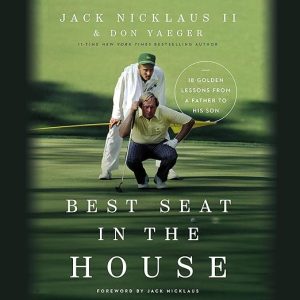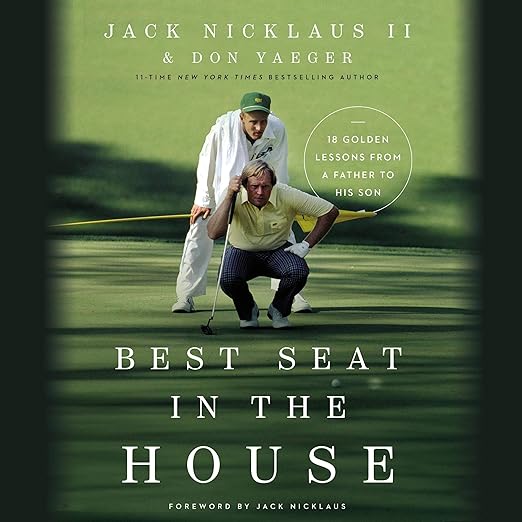
Jack Nicklaus II's Best Seat in the House, narrated by Tom Parks, opens with a story that captures the book's entire emotional argument: a teenage Jack II, frustrated at having to take a phone call during a golf tournament, spends twenty minutes describing every hole and every shot to his father on the other end of the line. His father listens, asks questions, and then mentions, almost as an afterthought, that he just won the US Open. It was Father's Day 1980. This audiobook, written with New York Times bestselling author Don Yaeger, is Jack Nicklaus II's attempt to account for what his father taught him and how, across eighteen lessons that mirror the number of holes in a round of golf.
The structure is deliberate and effective. The Golden Bear's record number of PGA major championships is the public achievement that defines Jack Nicklaus in most people's minds, but this audiobook insists on a different accounting: the measure of a person's legacy through the character of their children and the quality of the relationships they sustain. At 5 hours and 28 minutes, the audiobook does not overstay its welcome. Parks's narration finds the right register from the opening pages, warm without being saccharine, personal without being exclusive to golf fans who care about the championship record.
The Verdict, Briefly
Reviewer Gary Smith makes the most useful observation available in the reviews: he listened to this audiobook during Father's Day week and found himself reflecting on his own father, his own children, and his grandchildren, despite having never held a golf club. That non-golfer response is the audiobook's real achievement. Nicklaus II is not writing a golf book dressed in family language. He is writing about a specific set of values and the specific man who modeled them, and the golf course is the setting rather than the subject.
The eighteen lessons span a genuinely wide range. Some are straightforwardly about competitive psychology: how Nicklaus taught his son to value competitors rather than resent them, what it means to prepare with discipline rather than anxiety, how to walk away from a bad round without carrying it into the next day. Others are more personal, including the 95 percent rule that Nicklaus and his wife Barbara applied to their fifty-plus-year marriage, the importance of family-wide boundaries that everyone agrees on, and the cultivation of consistent values that his children could rely on as a fixed point regardless of his tournament schedule and fame. Reviewer David Allport's note that the Nicklaus name is all about authenticity, sincerity, legacy, faith, family, and integrity reflects how consistently those values surface across the audiobook's specific anecdotes rather than as stated abstractions.
What Makes Best Seat in the House Worth Hearing
Parks's narration is the right match for this material. The book's tone is reflective rather than triumphant. Nicklaus II is not celebrating his father's championship record but documenting the private behavior that ran alongside it, often in its shadow, and Parks communicates that distinction through pacing that allows the listener to sit with each lesson rather than rushing to the next one. The Father's Day 1980 story lands exactly as it should in audio. The pause before Nicklaus Sr. mentions the US Open is everything, and Parks gives it its proper weight without milking it.
The collaboration with Don Yaeger, a New York Times bestselling author who specializes in sports memoir and legacy narratives, is visible in the book's architecture. The eighteen lessons are not a list of platitudes but scaffolding around specific remembered incidents, and the movement from incident to reflection to lesson is handled with the craft of someone who has written about great athletes and what they modeled beyond their statistics. The audiobook benefits from that professional narrative architecture even when the material is primarily personal and family-driven.
Points to Consider
Listeners expecting a traditional sports biography or a detailed account of Jack Nicklaus's championship career will find this audiobook deliberately pointed in a different direction. Best Seat in the House is not an authorized biography of the Golden Bear. It is his son's memoir of growing up in his orbit, which means the tournaments and the records are peripheral rather than central. The golfing world appears primarily as the context in which family lessons were learned and tested, not as the subject of the book itself.
The 5-hour runtime means the audiobook is compact enough to finish in two or three listening sessions. For listeners who want to go deeper into the Nicklaus record and legacy, longer and more comprehensive biographies exist. What this audiobook offers is something more specific and harder to find elsewhere: the perspective from the best seat in the house, which was not the gallery but the family dinner table.
Who Should Listen to Best Seat in the House
The audiobook also works particularly well for listeners who want a model of public achievement combined with private integrity that does not require exceptional athletic talent to internalize. The Nicklaus lessons apply wherever sustained excellence and family coexist under pressure.
Fathers, and particularly fathers of competitive children, are the natural audience for this audiobook, and the Father's Day timing of several reviews suggests that framing has reached its intended readers effectively. Golf enthusiasts who want a personal portrait of Nicklaus beyond the championship record will find the specific family anecdotes and the 95 percent marriage philosophy genuinely illuminating and unlike anything in the standard golf biography. Listeners with no golf background who are drawn to fatherhood memoir and legacy narratives will find, as reviewer Gary Smith did, that the sport falls away quickly and the human material carries the weight without any need for golf knowledge. Those looking for a comprehensive athletic biography should note that this audiobook covers only what the best seat in the house could see.
Common Questions
Does this audiobook require knowledge of golf or Jack Nicklaus's career to be enjoyable?
No. Reviewer Gary Smith specifically notes he had never held a golf club and still found the audiobook deeply affecting. The golf course is the setting for the lessons, not the subject. The book is fundamentally about fatherhood and values rather than athletics.
Is this audiobook a comprehensive biography of Jack Nicklaus, or is its scope more limited?
The scope is specific: Jack Nicklaus II's memoir of the lessons he learned from his father, structured around eighteen episodes. Listeners wanting a full account of Nicklaus's competitive career and championship record should look to longer biographical works. This audiobook covers what the son saw and what it meant.