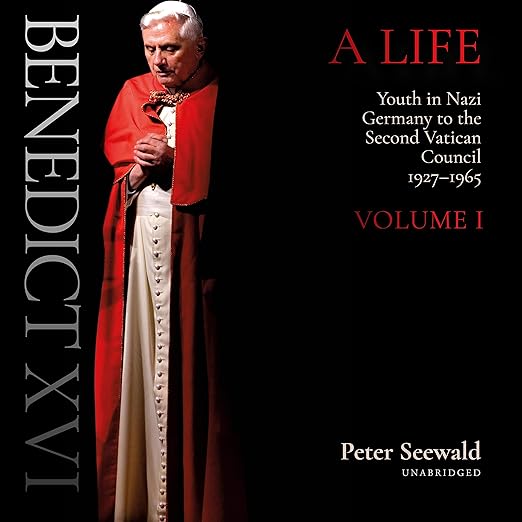
What does a reading do with a book whose four-star reviewer says it needed a new editor? That is not a rhetorical question on this audiobook. The most detailed criticism on the page lists typos, a German school name used throughout with no word of explanation, and sentences where it was often unclear who the author was talking about, Joseph or the other person in the paragraph. Two of those three faults a spoken performance repairs simply by existing. The third it converts into an interpretation.
The Papacy Is Not in This Book at All
Start with what the book is. Peter Seewald spent, in the description's phrase, "countless hours of interviews in Rome with Benedict himself", and produced the first half of a two-volume life. This part runs from a birth in a small German town to the archbishop's chair in Munich, taking in conscription into the Hitler Youth during the war and a career as an academic theologian along the way. The papacy is not in this book at all.
Buyers should hold on to that, because the title invites the opposite assumption. Somebody after the papacy itself, the retirement or the Vatican years has bought the wrong volume. The description says so plainly: those belong to a second volume it describes as forthcoming. That sentence has been sitting on the page since the recording appeared in December 2020, and nothing here has been updated to reflect anything that happened afterwards.
Just under twenty hours for half a life is a serious commitment, and the response pool suggests it is earned. One reader walks through the opening pages in detail, down to a baptism with fresh Easter water on the day of the birth in April 1927, and a discovery about the future pope's mother having been born outside marriage, legitimized later but never recorded. That is the register: granular, documentary, patient. Nobody arrives at a book like this by accident.
Errors Do Not Survive Being Read Aloud
Nobody planned the strongest argument for choosing this version. Typographical errors do not survive being read aloud. Whatever else a performance does to a book, it silently removes the defect that cost this title a star with its most exacting reader, and on a book of this scale that is not a small repair. It is also the rarest kind of case to be able to make for an audio edition, because it is a gain rather than another entry in the usual ledger of losses.
Access to the subject is the second argument, and it is what separates this biography from the others. Seewald interviewed Benedict directly and repeatedly, and the description positions the result as the "necessary companion" to Benedict's own memoir, Last Testament. One response notes that a critic writing in the London Spectator faulted Seewald for growing less adversarial across those interviews, then answers the charge: the book never promised to be a prosecution, and criticism of this pope has never been difficult to find. Access of that kind is rarer than it sounds, since most lives of a pope are assembled from documents and from the people who worked alongside him rather than from the man.
Wartime is the third reason. A future pope conscripted into the Hitler Youth is the fact everybody half-knows and almost nobody knows the shape of, and this volume gives it the room a full biography can afford. One response describes the arc in a single line, as a movement from an obscure provincial childhood to the papacy, with suffering and perseverance running through the middle of it. Length is what lets that be earned rather than asserted.
Meskimen Resolves Ambiguity Through Emphasis and Pacing
Return to the ambiguity, because it is the real production question. A reader who cannot tell whether a sentence concerns Joseph or somebody else can slow down, look back and work it out. A listener cannot. Jim Meskimen resolves each of those sentences through emphasis and pacing whether he intends to or not, which means his reading becomes the text in every place the prose is unclear. That is a genuine gain where he is right and an invisible loss where he is not.
German vocabulary is the other technical demand. A word like Gymnasium, used without a gloss, is exactly the sort of thing a spoken performance either fixes or compounds: said as German it announces its own foreignness in a way no italic on a page can manage, and anglicized it leaves the confusion sitting where it was. Names, church titles and institutions run through this material continuously, and the sound of them does quiet work throughout.
Both of the remaining notes concern the page rather than the book. The title says Volume One while the listing records no series at all, so nothing connects this to its companion and nothing tells a browsing listener that a second half exists. And a 4.7 average resting on 227 ratings is a healthy base, while a pool of five, one entry three words long, makes a thin explanation of it. Read the two substantial notices and treat the rest as sentiment.
Catholic Readers After the Formation Are the Core
Catholic readers who want the formation rather than the papacy are the core audience, and they are very well served. So are theology readers, and I would put them second only to the Catholic audience here, since a large share of this volume covers an academic career rather than a public one. So are readers of twentieth-century German history who want a close view of one Catholic household living through the war, including the son's conscription into the Hitler Youth.
It also suits anybody who has read Benedict's own memoir and wants an outside account beside it. The description positions this as the companion to Last Testament, and a biography built on direct interviews with its subject occupies an unusual middle ground: not authorized in the flattering sense, and not independent either. Knowing which of those two things you actually want matters considerably more here than the star rating does.
The wrong buyer here is after a portrait rather than a record, since the method stays documentary throughout and the pace never lifts. So does anybody who needs an adversarial account, since this was built on years of conversation with its subject rather than on distance from him. A recording of this length buys the making of a theologian, told slowly and in full, and if that is the book you wanted it is very hard to fault.
The Short Version
- Narrator: A single credited reader for a documentary life built out of dates, church titles and German place names.
- Subjects: A theologian's formation, wartime Germany, the Catholic Church seen from inside
- Tone: Patient, granular, unhurried
- Bottom line: The fullest account of the years before Rome, and the format removes the one complaint its sharpest reader files.
Does this audiobook cover Benedict's time as pope?
No. Volume one ends at the archbishop's chair in Munich. The description assigns the move to Rome, the ascension to the papacy and the retirement to a second volume that it still calls forthcoming. A listener who wants the papal years has the wrong half of this biography in front of them.
How long is it, and does the length feel justified?
Close to twenty hours, all of it spent on the years before Rome. The register is documentary and granular throughout, working from records and interviews rather than from anecdote. Anybody who wants that depth will consider the time well spent, and anybody hoping for a brisk portrait will find the going extremely heavy.
Does the audiobook fix the editing problems reviewers mention?
Partly. Typographical errors cannot survive being read aloud, so that complaint disappears outright. The other flaw, sentences where it is unclear which man is meant, does not disappear at all: it becomes whatever the reader decides in the moment, and his choice is then the only version you get.
Is this biography critical of its subject?
Not especially, and one response engages with the question directly. It reports an outside critic faulting the author for growing less adversarial across repeated interviews, then answers that the book never promised a prosecution. Treat it as an insider account built on unusual access rather than as an independent assessment.