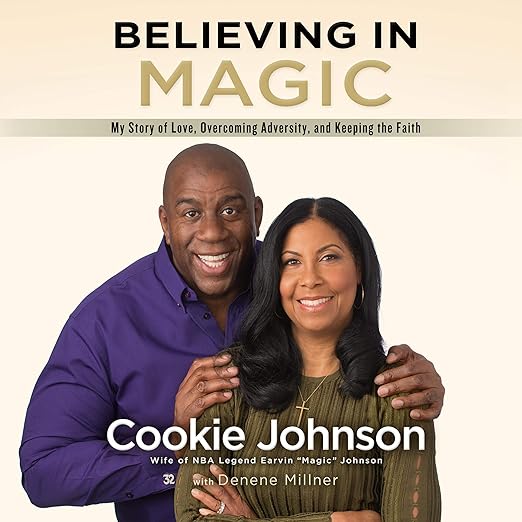
November 7, 1991 is the date basketball legend Magic Johnson told the world he was HIV-positive, and this audiobook memoir belongs entirely to his wife Cookie, telling her own side of that day and the nearly three decades of marriage that followed it. The craft choice here is significant: this is not Magic's story retold from an adjacent angle, it's a genuinely separate account, of pregnancy, fear for her unborn child, and the slow, difficult work of rebuilding trust inside a marriage that had already survived broken engagements before the diagnosis ever entered the picture.
The Verdict, Briefly
Cookie Johnson structures the memoir around the emotional aftermath rather than the headline itself, the fear that she and her newborn might also be infected, the public scrutiny of an intensely private medical crisis, and the day-to-day reality of staying married to someone whose diagnosis had just become a defining national news story. Reviewer Milton Kelly's account of the book highlights just how much genuine relationship difficulty preceded the diagnosis, including canceled wedding plans and a difficult surprise involving a child from outside the marriage, which the book apparently doesn't gloss over in service of a tidier redemption narrative.
That willingness to include the marriage's real friction before the crisis, rather than presenting Earvin and Cookie's bond as uncomplicated until HIV entered the picture, gives the memoir more credibility than a purely inspirational framing would. This reads as a story about a specific, flawed, evolving marriage tested by an extraordinary circumstance, not a simple triumph-over-adversity arc.
Johnson's announcement arrived at a moment when public understanding of HIV was still shaped heavily by fear and misinformation; the virus had been widely, wrongly associated primarily with certain communities, and a globally famous, heterosexual athlete disclosing his status publicly is now widely regarded as a genuine turning point in how the American public engaged with the epidemic. Cookie Johnson's memoir gives a rare inside view of that moment from the vantage point of the family living through the immediate private fallout while the public conversation was happening in real time around them.
Writing this account twenty-five years after the original diagnosis, rather than in its immediate aftermath, gives Cookie Johnson's memoir a reflective distance that a book written closer to 1991 couldn't have offered; she is narrating not just what happened but what it came to mean across a full quarter-century of marriage, parenting, and Earvin's own long-term health, which by the book's writing had defied the era's grimmest predictions entirely. That survival itself, quietly present throughout the memoir as context, changes how the earlier fear reads in retrospect.
Why Believing in Magic Works as an Audiobook
Robin Miles is one of the strongest narrators working in literary and historical nonfiction audio, with a well-established reputation for earned gravity rather than performed suffering, exactly the register a memoir like this needs. Her pacing is calibrated to emotional temperature rather than volume, holding silence where silence does the work, which matters enormously for material built around fear, uncertainty, and eventual hard-won stability rather than triumphant set pieces.
Miles has built a track record specifically with material about conviction tested against hardship, and that description fits Believing in Magic almost exactly: a marriage's core commitment, tested severely, examined honestly rather than sentimentally. At just over seven hours, the memoir moves at a pace that respects both the gravity of the subject and a listener's stamina, long enough to earn its emotional payoffs without stretching thin.
Memoirs narrated from a spouse's position while living through a partner's public health crisis form a smaller, quieter subgenre within celebrity memoir generally, one that trades the primary subject's own perspective for a version of events shaped by proximity, caretaking, and a specific kind of forced patience. Cookie's account benefits from that distance; she is telling a story she lived through directly but did not generate the headlines around, which gives her more room to focus on the domestic, private texture of the crisis rather than its public dimension.
The synopsis specifically frames this as far more than a survival account, extending into the fuller arc of losing their way and eventually finding a path they never imagined, language suggesting the memoir doesn't end at a tidy resolution point but continues tracking the marriage's real, ongoing evolution well past the initial crisis.
Points to Consider
Despite the sports-adjacent subject matter and the Basketball tag attached to this listing, this is not a sports memoir in any meaningful sense; Magic Johnson's basketball career is context, not content, and listeners hoping for game recaps, locker-room stories, or athletic-achievement framing will find almost none of that here. The book's actual center of gravity is marriage, fear, and family, not competitive sport.
This is also a genuinely emotionally heavy listen, HIV diagnosis fear in the early 1990s, when public understanding and stigma around the virus were both far worse than today, colors the entire middle section of the book. Listeners sensitive to sustained medical-crisis material, or to frank discussion of marital strain, should know that intensity is present throughout rather than confined to a single chapter.
Robin Miles's broader body of work includes extensive historical biography narration, and reviewers elsewhere have specifically praised her ability to sustain difficult, emotionally demanding material across long runtimes without losing narrative energy or tipping into melodrama. That same skill set, holding weight without overplaying it, is exactly what a memoir spanning pregnancy fear, marital strain, and eventual stability across nearly three decades requires from a narrator working alone for over seven hours.
Should You Listen to Believing in Magic?
This is a strong recommendation for listeners drawn to memoirs about marriage under extraordinary pressure, and specifically for anyone interested in the human side of the Magic Johnson HIV story that dominated headlines in 1991 but rarely got told from Cookie's vantage point. The 616-rating base with a solid 4.5 average suggests this has reached and satisfied a genuinely wide audience beyond just basketball fans.
The book's stated scope, covering not just the crisis itself but nearly thirty years of marriage before and after it, means listeners get a fuller relationship arc than the HIV storyline alone would provide: the earlier broken engagements, the eventual wedding, raising a family, and the slow accumulation of trust that either survives a crisis or doesn't. That longer view is part of what separates this from a single-event memoir into something closer to a full portrait of a marriage.
Listeners looking specifically for basketball content, game analysis, or a career-focused sports biography should look elsewhere; this memoir barely touches the court. Anyone wanting a lighter listen should also know upfront that the HIV-diagnosis fear and its aftermath sit at the emotional center of the book throughout, not just in an opening chapter.
Before You Press Play
- Narrator: Robin Miles brings earned gravity and calibrated pacing to a memoir about conviction under pressure.
- Subjects: marriage tested by crisis, HIV diagnosis fear in the early 1990s, resilience
- Tone: Emotionally heavy but ultimately steady
- Bottom line: A genuinely moving memoir for listeners drawn to marriage-under-pressure stories, basketball fandom optional.
Questions Listeners Ask
Is this audiobook mainly about basketball or about the Johnsons' marriage?
It's almost entirely about the marriage; Magic Johnson's basketball career is background context, not the book's actual focus.
How graphic is the HIV-related content in this audiobook?
It's handled with emotional honesty rather than clinical detail, centered on fear and family impact rather than medical specifics.
Does Robin Miles's narration suit this kind of personal memoir audiobook?
Very well; her established strength with material about conviction tested against hardship fits this book's core subject closely.
Does this audiobook gloss over difficulties in the marriage before the HIV diagnosis?
No, reviewers note it includes real relationship friction, including broken engagements, predating the diagnosis itself.