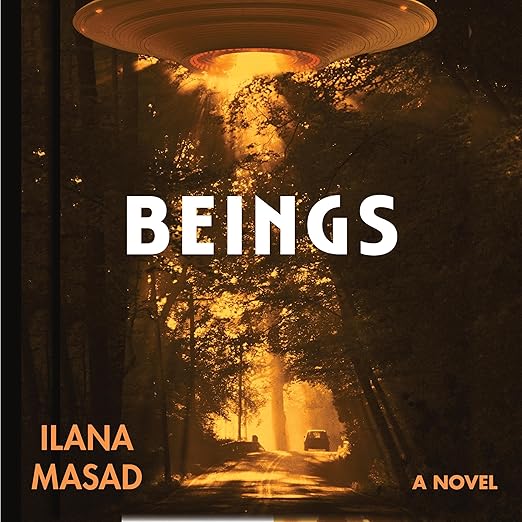
I listened to Beings over several evenings, deliberately slowly, because it is the kind of novel that does not respond well to being rushed. Ilana Masad is doing something precise and considered here: using the 1961 Betty and Barney Hill alien abduction case, the first widely publicized alien abduction narrative in American history, as the scaffolding for a meditation on how humans construct truth from experience. The alien abduction is real in the novel and simultaneously beside the point, which is exactly how Masad intends it.
The novel operates across three interlocking threads. The first follows the abducted couple, identified only as husband and wife, as they attempt to process and narrate an experience that the world around them cannot quite accept. The second thread consists of letters from Phyllis, a lesbian science fiction writer in 1960s Boston, to her beloved Rosa. These letters trace the private texture of queer longing and ambition during a period when both were dangerous. The third thread is set in the present and follows a nonbinary, chronically ill Archivist who becomes obsessed with both Phyllis's letters and the testimony of the original abductees while trying to make sense of their own forgotten childhood encounter. All three threads exist in conversation with questions about whether truth can be separated from narrative, and whether the archive preserves or distorts what it holds.
What We Made of It
This is a remarkably ambitious book, and a deliberately difficult one. Masad, whose debut All My Mother's Lovers drew significant attention, is writing toward the territory that Garth Greenwell and Kristen Arnett occupy: literary fiction with queer experience at the center, attentive to language and structure in ways that demand active reading. The novel's tripartite structure echoes its thematic concern with how multiple perspectives on the same event create something larger than any single account. One reviewer described it as an "incredible novel on memory, writing, loneliness, alien abduction, and queer history," which is accurate, though the emphasis on memory and writing is perhaps more central than the alien abduction element. The speculative premise is a vehicle rather than the destination.
Why Beings Works as an Audiobook
The full cast production is exactly right for this material. Hayden Bishop, Renata Friedman, and Jesus E. Martinez each anchor one of the three narrative threads, giving audio listeners a sonic cue for which story they are in at any given moment. This is structural clarity that the novel's complex layering genuinely needs. The Phyllis letters, which another reviewer described as capturing "the raw ache of queer yearning, loneliness, and alienation in the repressive 1960s," benefit enormously from being voiced rather than read. The epistolary thread is the novel's most emotionally direct passage, and hearing it performed closes whatever distance remains between reader and text.
What Might Not Land
This is not a mystery novel and it is not an alien abduction thriller. Readers who approach it as either will be confused by the pace and frustrated by the lack of plot resolution in the conventional sense. The Archivist's obsession is itself a kind of unreliable narration, and the novel is deliberately uncertain about the boundaries between what happened and what was recorded and what was imagined. The chronically ill, nonbinary Archivist is one of contemporary fiction's more unusual protagonists, and Masad gives them an interiority that requires patience to fully inhabit. The novel earns its difficulty, but it does require the listener to meet it partway.
Who Should Listen to Beings
Essential for readers of literary speculative fiction who want work that engages seriously with queer history, the nature of truth and memory, and the 1960s context of both the civil rights movement and the emergence of the alien abduction genre. If you read and admired All My Mother's Lovers, Masad's second novel is more ambitious and more structurally complex. Less suited to listeners who want narrative momentum or genre clarity. The full cast production makes this one of the stronger recent literary audiobooks on a technical level regardless of your familiarity with Masad's work.
Key Details
- Performance: The full cast of Hayden Bishop, Renata Friedman, and Jesus E. Martinez differentiates the three narrative threads cleanly, with each thread gaining its own distinct audio identity.
- What it covers: Memory and constructed truth, queer loneliness and community in the 1960s, the archive as both preservation and distortion
- Feel: Quiet and accumulative, with the texture of a book you will think about long after the last chapter
- Our call: An ambitious literary novel that uses the Betty and Barney Hill case as a lens for examining how we make meaning from experience, essential listening for readers who want speculative fiction with genuine intellectual stakes.
Frequently Asked Questions
How does the three-narrator cast divide the three narrative threads?
Each narrator anchors one thread: the abducted couple, Phyllis's letters, and the Archivist's present-day obsession. The division is consistent and gives audio listeners a clear sonic anchor for each storyline.
Is this a stand-alone novel or connected to Masad's debut All My Mother's Lovers?
Beings is a completely standalone novel. The connection to All My Mother's Lovers is authorial rather than narrative.
How much does prior knowledge of the Betty and Barney Hill case affect the reading experience?
The novel provides sufficient context that prior knowledge is not required. However, readers familiar with the Hill case will recognize Masad's departures and interpretations more readily, which adds a layer of engagement.