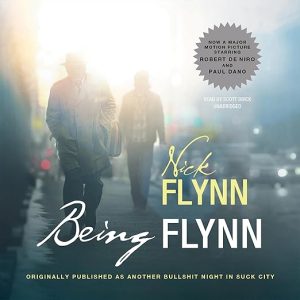
A caseworker in a Boston homeless shelter recognizes a man coming through the door. It is his father, a self-proclaimed poet and con man who wrote him letters from federal prison during his teens and whom he has otherwise mostly avoided. That is the situation Nick Flynn's memoir starts from, and this 2010 audiobook runs seven hours and forty-four minutes through it. The passage the listing quotes up front is the whole book in four sentences: he could have handed over a key, offered a piece of his floor, and did not, because letting his father inside would blur the line between them and speed up what he calls his own slow-motion car wreck.
A Bum and an Underachieving Stoner, by Design
Everything difficult about the book sits inside that refusal. The description promises raw authenticity stripped of self-pity, which is the sort of phrase publishers attach to memoirs carrying plenty of both, and yet the five people who wrote about this one keep confirming it from different angles. One compares it favorably to a well-known addiction memoir and credits it with avoiding the cloying narcissism of the overtly personal style. Another, at four stars, describes a chronicle of the events that shaped him, scraped from the bone. A three-star response calls it flatly depressing and lists what it examines: chronic homelessness, alcoholism, mental illness, and a son's fear of turning into his father. All three are describing the same restraint from different distances.
The father is the reason that restraint is necessary. Add bank robbery to those letters, since that is what the sentence was for, and the description's claim that the book illuminates the hidden story of fathers and sons in America is the sort of sentence that usually signals a thesis being forced onto a life. What keeps it from feeling forced is that the son is not sympathetic either. One four-star account describes two main characters and calls one of them a bum and the other an underachieving stoner, which is unkind and not inaccurate, and the book seems to have invited it. A memoir that lets a reviewer describe its own author that way has not been sanded down for anyone's comfort.
Gorgeous Language Carrying a Book With Little Plot
Flynn is a poet, and the reviews are unusually consistent about what that buys. Language gorgeous at times, from one of the more critical accounts. A hash of words turned into a setting for a memoir, from another. A creative style carrying a book with very little plot in it, from a third. The consensus is that the sentences do the work incident would normally do, which on a father-and-son story about homelessness is the difference between literature and a case file. It is also the reason the book survives being read aloud rather than skimmed.
A Pine Street Inn Coworker Checks the Details
Somebody who worked at the Pine Street Inn, and overlapped with Flynn on the outreach van, left the most interesting response on the page. That account confirms the descriptions of the shelter as incredibly accurate, and it arrives with the specificity of a person checking a memoir against their own workplace. Verification like that is rare, and it tests the one claim a memoir about institutions actually has to meet. Plenty of books about homelessness get the weather right and the procedures wrong; this one apparently does not.
Length is the third thing the book gets right, for a memoir that admits it has no plot. One four-star account says so directly: very little happens, and the day-to-day activity of the two men holds the attention anyway. A longer recording would expose that structure and a shorter one would lose the accumulation. What you get instead is a memoir that circles, returns to the same street and the same building, and lets the repetition carry the argument. The description reaches for the word survival, and at this length survival reads as a daily practice rather than as a climax.
Five Detailed Responses, Silent on the Recording
One thing is missing from all of it. Two hundred and twenty-five ratings, five detailed written responses, and not a single word about the recording. These are not lazy reviews either. They compare the book to two other memoirs by name, argue about a single chapter, and check the shelter descriptions against firsthand experience. Scott Brick is the credited reader, the page offers nothing else about the performance, and anyone weighing this against print is choosing without the one piece of information the format actually turns on.
Two specific warnings. First, the structure breaks. One five-star account, otherwise enthusiastic, singles out a chapter written as a play inside the book, calls it silly and says it ran on far too long, and separately describes the opening as difficult to sift through. A chapter that changes form is where a single-voice recording is either transformed or exposed, and that passage is where the audio edition gets decided for you. Second, the description omits something the reviews do not. One response, flagging it as a possible spoiler, names the suicide of the author's mother as central to the book. Anyone for whom that is not an abstraction should know before pressing play.
Almost Every Family Is Dysfunctional, Some Just More
Readers who want prose more than plot are the audience here, along with anyone drawn to books about family failure that refuse to resolve, and people working in shelters, outreach or social services who will recognize the institutional detail. The two comparisons the reviewers reach for, an addiction diary and a memoir of chaotic parents, are both accurate signposts. If those worked for you, this is the more controlled version of the same territory, and I would put it above either as a piece of writing. One four-star reader opens with a line that doubles as the audience test: almost every family is dysfunctional in some way, and some families are just more so. If that lands as an opening rather than a shrug, you are the reader this was built for.
Momentum is the thing to check for before buying, because the four-star account calling it a book where very little happens is being accurate rather than unkind. Unrelieved bleakness is the other hard limit, since the three-star verdict comes down to one word and that word is honest. The 4.1 average across the full rating pool is the most useful number on the page: a book a great many people admire and a real minority find unbearable, and both groups are reading it correctly.
Common Questions
How much of Being Flynn is about the father and how much about the author?
Both equally, by design. The description frames it as the trajectory that led the two of them onto the streets, into the shelter and finally to each other, The father arrives first as a voice in letters and only later as a person in the room, while the son is on the page throughout and rarely flattered by it. Neither gets the book to himself.
Does the audiobook include the chapter written as a play?
The listing gives no indication of any abridgement, so expect the complete text including that chapter. It is also the passage most likely to divide listeners. One otherwise enthusiastic five-star response calls it silly and overlong, and a section that changes literary form is always the hardest thing to carry in a single-voice recording.
Is this audiobook too bleak for a reading group?
It is bleak, and the three-star response says so in one word. A group that handles addiction, homelessness and suicide can take it, and the prose gives plenty to discuss. Assign it knowing the ending offers recognition rather than repair, and that the mother's death is central rather than incidental.
Why is the average only 4.1 when the written responses are mostly positive?
The five visible accounts run five, five, four, four and three stars, and even the critical ones praise the writing. The objections are about mood and momentum, not quality: depressing, slow, very little plot. A memoir that alienates a steady minority collects exactly this kind of average.