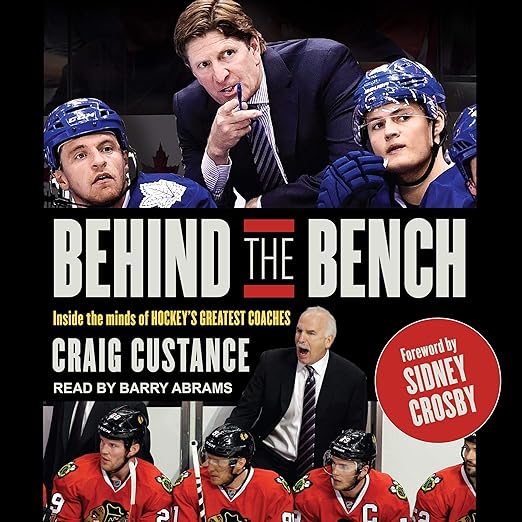
Key Details
- Voice: Barry Abrams has to keep six named coaches distinct inside one writer's prose, with pacing and register rather than impersonation as the only tools available.
- Big ideas: NHL coaching, leadership under pressure, film-session analysis, Stanley Cup and Olympic turning points
- Atmosphere: Candid shop talk with the video still running
- Worth it?: Real access to closed rooms and transferable leadership material, dated in places and harder going for listeners new to hockey.
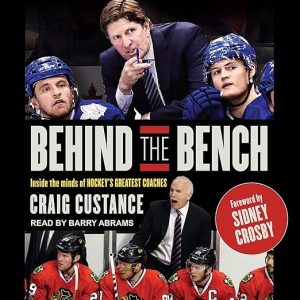
Interview books live or die on access, and Craig Custance got the kind that cannot be faked. Mike Babcock, Ken Hitchcock, Joel Quenneville, Claude Julien, Dan Bylsma and Todd McLellan all sat down with him, and not for a phone call. The method here is film sessions, coach and writer watching video of games that mattered and talking through what was actually happening. Eight hours of audiobook come out of that arrangement, and the format explains both what works and what a listener gives up.
The framing the publisher copy uses is the best short description of the job I have read. Coaches are "motivators, key strategists, tough bosses, and choreographers", and they can be "branded as heroes, ousted as scapegoats, quietly valued as friends" depending on results they only partly control. The copy sets that contradiction up front, and the specific games are where it gets tested: Stanley Cup finals, Olympic gold medal deciders, World Championship matches, wins and losses given equal weight. The losses are where the book earns its keep.
What lifts it above a compilation is that Custance is present as a character. Mark Pargas, who titles the five-star notice "Custance's adventure becomes yours", lists what else is in here beyond the coaching talk: "fun with technology, moments of doubt, family time and buying an RV", and says you are still only halfway to covering "the map that Craig Custance navigates in this gem of a book". That is worth knowing in advance, because the publisher copy sells pure access and the book delivers something looser and more personal alongside it.
What Makes Behind the Bench Worth Hearing
Woody supplies the sharpest comparison available, likening the experience of watching "how some of these guys think the game and interact with their players" to behind-the-scenes television, "except you hear their point of view and what they are thinking". That is the distinction that makes the book valuable. Documentary cameras catch coaches performing; a film session with a writer catches them explaining, at leisure, with the video paused. The gap between those two things is where the useful material lives.
The tactical content is genuinely specific rather than gestural. Line changes executed with a game hanging on them, dressing rooms full of the league's top stars, moments where a plan survived contact and moments where it did not. Anyone who coaches anything, in any sport or outside sport entirely, will find the leadership material transfers with almost no translation. Woody is blunt about the overall verdict: "I think Craig killed it with this book."
The losses get equal billing, which is worth pausing on. The copy is explicit that the signature games are "reflected upon and broken down in detail" whether they ended in a win or a loss, and that is harder to arrange than it sounds, because the people who agree to sit down with a writer and a video screen are usually the ones with something to celebrate. Whatever Custance traded for that access, the result is a book that does not only reconstruct victories, and the Stanley Cup finals and Olympic deciders on the list cut both ways.
Eight hours and five minutes is a comfortable shape for this. The book is built out of individual conversations around individual games, which makes it naturally episodic and forgiving of interruption, with no running argument underneath to lose your place in. It is a good gym listen and a very good long-drive listen, and because each conversation stands alone it survives being spread over a couple of weeks without the thread fraying.
Things to Know Before Starting Behind the Bench
The audio-specific caveat is built into the method. This is a book about watching video, and a listener cannot see the video. When a coach pauses a clip to show why a defensive pairing collapsed, the description has to carry a spatial event through language alone, and even excellent writing loses something in that transfer. Custance handles it as well as the form allows and hockey fans with a picture of the ice in their heads will follow easily. Newcomers to the sport will have a harder time, and no narration can solve that.
The datedness question is real and one reviewer raises it directly. DB, at four stars, writes that "With all that happened with Babcock, the book has a sort of datedness to it", having noted the book is essentially a look into "coaches' philosophy and how they instill that in their players". Events after publication have changed how at least one of these subjects is regarded, and the book cannot account for that. The philosophy and the game-level analysis remain intact. The portraiture reads differently now, and a listener should know that going in.
On the reading, Barry Abrams is credited and nothing in the three reviews addresses the narration or the audio at all. The technical demand is a specific one: six named coaches speaking at length inside one writer's prose, which means a listener must always know whether they are hearing Custance or hearing a quotation. That has to be done through pacing and register rather than impersonation, since these are real and identifiable people and doing voices for them would be a disaster. The personal thread Pargas describes adds a second register on top. I would sample a passage where a coach is talking and check that the seams are clear without being announced.
Who Craig Custance Is Writing For
Hockey fans are the obvious audience and will get the most from it, especially anyone who follows the sport closely enough to recognize the games under discussion. Beyond that, the leadership material has a genuine second audience: coaches in any sport, and managers who have to get results from people they cannot simply instruct. A 4.6 average built on three hundred and forty-five ratings is a solid signal from a readership that knows the subject intimately and would be quick to notice if the access on offer were thinner than the description advertises.
Come to it warned about two things: the coverage stops at a fixed point in a sport that has moved on, and the personal material woven through will charm some listeners and irritate the ones who wanted pure tactics. Newcomers with no feel for the game should probably start somewhere more introductory, since the film-session passages assume you can picture what is being described. Everyone else gets eight hours in rooms that are normally closed, which is the whole reason a book like this exists.
A Few Questions About Behind the Bench
Do you need to follow hockey to enjoy this audiobook?
It helps considerably. The book breaks down specific games through film sessions, and following a description of a defensive collapse without seeing the video is much easier if you can already picture a rink. The leadership and management material transfers to any field, but the tactical passages assume familiarity. Casual fans will manage; complete newcomers will struggle in places.
Which coaches are actually interviewed in the audiobook?
All six named in the copy, and not equally. The sessions are built around games rather than careers, so the balance follows whichever matches got broken down rather than which coach is the bigger name, and Custance's own presence takes up more room than a straight interview book would allow.
Is there more to the audiobook than tactics?
Considerably more. Custance writes his own year into the book rather than staying invisible behind the interviews, so a passage about a Stanley Cup final may pass through his family, his equipment and his own doubts before it reaches the ice. Anyone expecting a pure tactical compendium should adjust their expectations early.