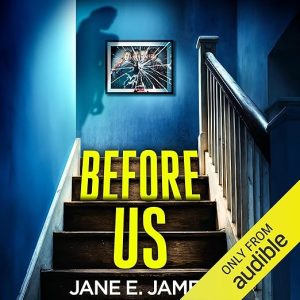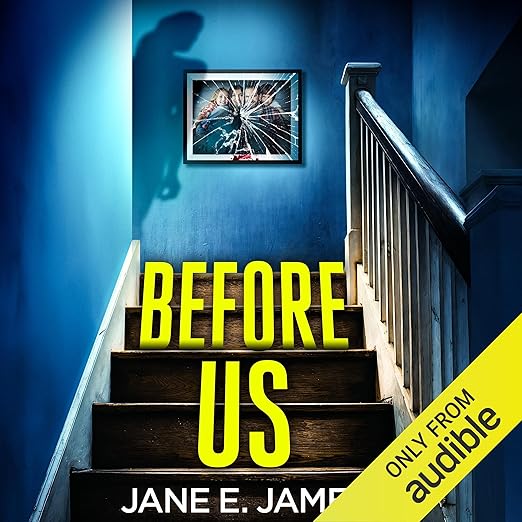
I listened to Before Us across two evenings, which is exactly the right pace for this kind of book. Jane E. James is writing in a mode I have always found compelling: the psychological mystery that uses a domestic space, a house someone else lived in before you, as the mechanism for uncovering something that was meant to stay buried. The premise is specific and well-constructed. A couple moves into a beautiful new home and immediately the wife senses a presence, the traces of the previous occupants. A mysterious diary. Photographs of a couple in their thirties, tired parents with two small children. The opening chapter does what it needs to do with real efficiency.
The dual timeline structure, alternating between the new occupants' discovery of the mystery and the story of the previous couple, is doing most of the structural work in Before Us. James uses it to create dramatic irony: the reader understands the connection between past and present before the protagonist does, which produces a particular kind of dread that is more atmospheric than visceral. This is not a thriller in the sense of relentless plot momentum. It is a mystery that uses suspense as a slow build rather than as a series of shocks.
An Abrupt Diary Ending Drives the Mystery
The central object of the mystery, the diary that ends too abruptly, is a well-chosen artifact for this kind of story. A diary promises intimacy and truth while delivering only what the writer chose to record and what they chose to withhold. Its abrupt ending creates the right kind of narrative gap: something happened that the diary cannot tell you, and figuring out what produces the story's propulsive element. James does not rush this. The early chapters lay out the mystery carefully enough that you understand what kind of information you are looking for, which makes the accumulation of clues satisfying rather than confusing.
Several reviewers note the alternating chapter structure as both a strength and a challenge. One writes that the back-and-forth between then and now was sometimes hard to keep up with. This is a legitimate observation. The temporal structure requires listeners to hold both timelines in mind simultaneously rather than processing them sequentially, which increases the cognitive demand of the audiobook. For listeners who find this kind of structure rewarding when it pays off, James executes it competently. For listeners who prefer linear chronology, this will require more attention than the premise suggests.
Reviewers Split Hard Over This Ending
The ending of Before Us is the most discussed element in the reviews, and the responses divide fairly sharply. One reviewer describes clutching non-existent pearls at the twists, which suggests genuine surprise at the revelations. Another describes it as an unbelievable plot that evolved from an interesting start into disappointment. A third describes it simply as not a thriller despite being described as one.
This split is characteristic of domestic mysteries that prioritize psychological revelation over action-based resolution. James takes the story somewhere genuinely unexpected, but not everyone finds unexpected satisfying when the path there requires accepting certain plot developments as credible. The reviewer who notes that the book is not what it was described as is making an honest point about marketing rather than quality: if you arrive expecting the genre conventions of a thriller, with immediate danger and visceral stakes, you may find Before Us underpowered. If you arrive expecting a slow-burn mystery about domestic history and hidden identity, the book delivers on that promise more consistently.
Sarah Kants Gives Each Timeline Its Own Register
The narration challenge in Before Us is maintaining clear differentiation between the two timelines across eight and a half hours of alternating chapters. Kants uses vocal register to distinguish between them: the contemporary narrative has a slightly more tense quality, while the past narrative carries a slower, more intimate tone that reflects the diary's intimacy. This distinction helps the listener stay oriented across the structure without requiring constant explicit labeling of which timeline is active.
The pacing Kants establishes in the early chapters serves the atmospheric quality of the book well. She does not rush the accumulation of clues or the slow revelation of what the previous occupants were hiding, which suits James's preference for sustained tension over sudden shock. Listeners who prefer audiobook narration with more dramatic performance may find this subdued, but the restraint is appropriate to the material.
Know Which Category You're Buying Into First
Before Us is a reasonable choice for readers who enjoy the domestic secret subgenre, atmospheric pacing over propulsive plotting, and mysteries that build toward revelation rather than action. The 4.0 average rating from nearly 1,000 listeners reflects both genuine appreciation and the frustration of listeners who arrived expecting something more conventionally thrilling. Knowing which category you fall into before you start will significantly improve your experience of the book.
Good to Know
How confusing is the dual timeline structure across the alternating chapters?
Several reviewers flag this as requiring active attention. The chapters alternate between the present, in which the new couple uncovers evidence of the previous occupants, and the past, which follows the previous couple directly. Sarah Kants distinguishes between the two in her narration, but listeners who find temporal structure cognitively demanding should be prepared to pay close attention.
Is the ending of Before Us satisfying or does it leave too many questions open?
Reader responses are genuinely split. Some reviewers describe the ending as genuinely surprising in a positive way. Others describe the plot developments as unbelievable or disappointing relative to the promise of the setup. The ending makes choices rather than hedging, which is either its strength or its weakness depending on whether those choices feel earned to the individual listener.
Do the diary and the photographs play a significant role throughout the book or mainly in the setup?
They are the primary mechanism of the mystery rather than merely an opening device. The diary's contents and its abrupt ending are central to what the protagonist is trying to understand throughout the book, and the photographs function as a recurring reference point as the mystery develops. Both objects pay off at the ending rather than being abandoned after the first act.