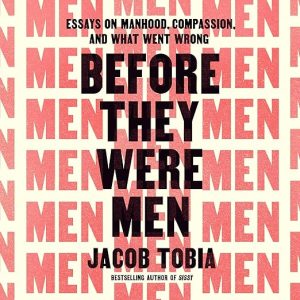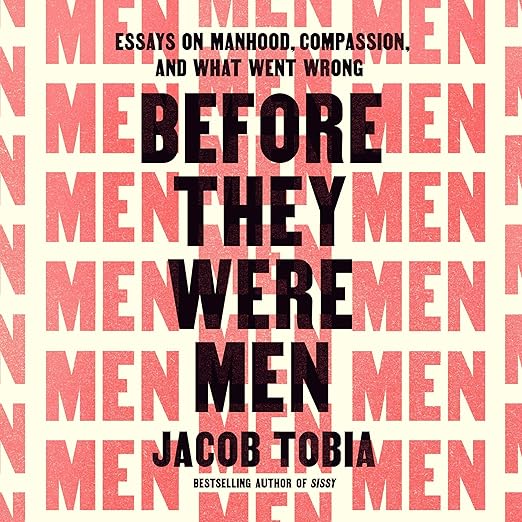
Can a book about men be written by someone who spent a lifetime running away from being one? That is the wager of this audiobook, and Jacob Tobia reads it themselves, which matters more here than a credit line usually does. Random House Audio released the recording in August 2025 at seven hours and fifty-one minutes. The review column underneath holds a single written response, so nearly everything a buyer can weigh has to come from the argument itself rather than from the grades stacked above it, and the argument is the interesting part in any case.
Manhood arrives as something done to you in Tobia's account, never as something you simply are. The description is blunt about the mechanism: for a gender-defying adolescent heart, the nonconsensual process of being made a man was crushing. That word, nonconsensual, is the hinge the whole book turns on. It reframes masculinity as an initiation nobody agrees to, administered by other men and by institutions, and it lets Tobia reach a conclusion that sounds impossible coming from a genderqueer writer, which is that men and boys may be the ones suffering most under the gender binary right now. You do not have to accept that conclusion to notice how carefully the ground beneath it gets prepared.
Essays are the form, and the form does specific work. The book is built as a run of personal and, in the publisher's word, revolutionary pieces rather than as one sustained argument, which gives a listener room to recover between the harder ones. The topics named in the copy show the range: unspoken body image issues and dysmorphia among men and boys, the difficulty of challenging a world that glorifies war and aggression and male violence, and the abuse men endure in the name of gender norms. Any one of those could carry a book on its own. Kept as essays they stay personal and specific, which is the register where Tobia writes best.
Compassion Over Argument as Political Strategy
Compassion gets proposed as a political method, and that is the genuinely surprising move. Tobia's position is that compassion and empathy, not argument and not shame, are the forces that will carry men toward something better, and the book calls men, women and nonbinary people alike back to the table. The one written response on the record reads exactly along those lines: it recommends the book for its vulnerability and compassion, describes a path forward toward healing our divisions, and calls the result immensely insightful, entertaining and inspirational. That is a single grade filed in September 2025, and it is carrying a lot of weight on a page this quiet.
Retiring the vocabulary is where the book turns combative. The copy states the aim without hedging: it makes the case for rethinking and ultimately retiring counterproductive terms like toxic masculinity and male privilege, and it charges feminist discourse with failing to grapple with men's suffering. Whatever you make of that, it is a real position with real consequences, and it is being argued by a nonbinary writer rather than by the people who usually advance it. Amanda Montell's blurb on the listing calls the book a reckoning, a manifesto, a wellspring of curiosity and an invitation to consider better ways of imagining masculinity, which is generous and also honest about the mixture inside.
An Overreaching Claim Told Through Self-Narration
Rewiring feminism is an enormous promise for one book to make, and this is where a listener should stay alert. The framework Tobia wants replaced is load-bearing for a great many people, and the claim that men are co-survivors of patriarchy rather than categorical beneficiaries of it will strike some listeners as sleight of hand no matter how carefully it is constructed. The book anticipates that and calls itself a nonbinary intervention into a two-sided discourse gone stale. Fair enough as a description. But an essay collection can assert a reframing far more easily than it can demonstrate one, and several stretches here ask for agreement before they have finished earning it.
Seven hours and fifty-one minutes of a writer reading their own testimony about being forced into manhood is a demanding listen, and self-narration raises the stakes in both directions. Author-read work carries an authority no hired performer can manufacture, and it also removes the buffer that a professional reading places between a listener and painful material. Tobia is the only name in the credit line, so one voice carries the memoir, the polemic and the invitation alike. For this particular book that is the right call, and it is also the reason to sample a few minutes before committing an evening to it.
Teachers, Therapists, and Men Without a Vocabulary
Listeners who work with young men, as teachers, therapists, coaches or parents, have the most to gain here, because the book supplies vocabulary for something they watch constantly and cannot name. Readers of gender studies get an intervention argued from an unusual position rather than the familiar one. And men who have never had language for what the initiation cost them may find this the first book that offers some without demanding an apology first, which is a narrow door but a real one.
My reservation is straightforward. This is a book of assertions rather than evidence, and an author reading their own testimony is a persuasive format by design, so the places where the argument thins out are exactly the places least likely to announce themselves. Anyone wanting empirical grounding for claims about men's suffering will not find it here, and readers committed to the frameworks Tobia wants retired will spend eight hours arguing back. Everyone else gets an unusually generous book about the people it would have been much easier to blame.