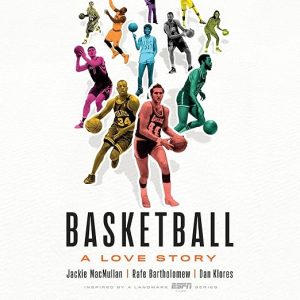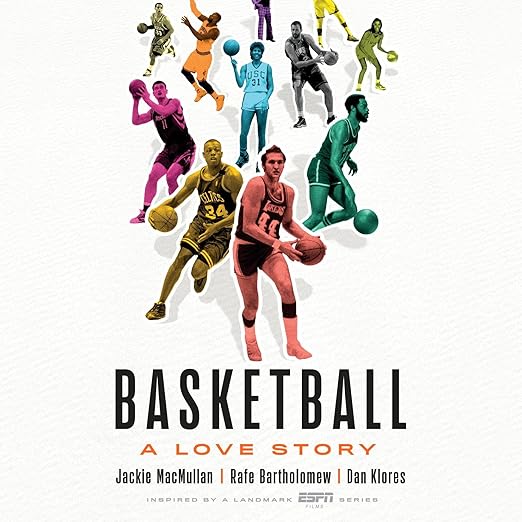
Jackie MacMullan is one of the sharpest basketball writers alive, and when her name appears on an audiobook of this scale, it demands serious attention. Basketball: A Love Story is not a conventional sports history. It is, as the synopsis explains, the product of nearly a thousand hours of interviews assembled by MacMullan alongside Rafe Bartholomew and Dan Klores. The result is a project that sits somewhere between oral history and literary journalism, and the audio format is not merely adequate for the material, it is the ideal delivery mechanism for it.
The full cast production features six narrators: James Fouhey, Jim Frangione, Sullivan Jones, Pete Larkin, January LaVoy, and Carol Monda. That choice matters enormously. Oral history is about voices, about the sense that you are hearing people think and remember and contradict themselves in real time. Six narrators cycling through perspectives from Kobe Bryant to Magic Johnson to Phil Jackson gives this audiobook a documentary texture you simply cannot replicate on the page. When a production commits to a cast at this scale, it is making an argument about the nature of the material itself.
A Closer Look at Basketball
The most striking quality of this project is what one reviewer called the extraordinary candor of its subjects. Players speaking about secrets they had never discussed on the record is a phrase that could easily be marketing copy. Here it is demonstrably true. The oral history format creates a social contract between subject and listener that written biography cannot. When someone speaks directly, even through a narrator's voice, the psychological distance collapses. You feel you are hearing confession rather than curation. That quality of directness runs through the best passages in this audiobook, the ones where players talk about what the game costs rather than what it rewards.
MacMullan and her co-authors are not merely interested in championships and statistics. The book positions basketball as a lens for examining American culture across decades, touching on the Civil Rights movement, the impact of Title IX, the economics of the sport, and the contradictions built into a game where Black athletes generate enormous wealth for predominantly white institutions. These are not decorative gestures toward social history. They are structural to the project's argument that basketball is a story about what this country values, who it rewards, and how it defines greatness across generations. Reviewer Derrick Cannon specifically noted the book highlights the Civil Rights movement and Title IX in a truly enlightening way, which confirms that the cultural ambition is realized rather than merely announced.
What Makes Basketball Worth Hearing
The oral history format translates exceptionally well to audio, arguably better here than in print. Listening to six narrators handle hundreds of voices creates an effect closer to a radio documentary than a traditional audiobook. Reviewer LSmith noted that the collaboration between three accomplished basketball writers takes a different approach to talking about various aspects of the game, and that difference is what makes this worth 16 hours of your time. The structure is thematic rather than purely chronological, which means the audio never loses momentum the way a straight timeline might. Each thematic section builds its own internal logic, pulling from different eras and voices to make a point about the game's evolution.
The sheer scale of the interview base, nearly a thousand hours of recorded conversation, means this audiobook has a density of primary material that most sports histories simply do not achieve. The authors talked to legendary players and to the coaches, executives, commissioners, and journalists who shaped the game's institutional history. That breadth is audible in the way the narrative refuses to stay at a single altitude. It can hold the view of the superstar and the view of the administrator in the same sequence, and the tension between those perspectives is often where the most interesting material lives.
Things to Know Before Starting Basketball
At 16 hours and 9 minutes, this is a substantial listening commitment, and the thematic structure does mean some sections feel more propulsive than others. Listeners expecting a strict biographical treatment of specific players will find the format initially disorienting. The book moves by subject and era rather than by individual career, which is intellectually interesting but can feel diffuse when you want to stay with a particular figure longer. A listener hoping to spend an extended stretch on, say, the dynamics of the Chicago Bulls dynasty will find the material broken across multiple thematic frames rather than concentrated in a single arc.
The six-narrator cast is largely effective, but six is a large ensemble, and not every transition lands with equal clarity. Reviewer WDX2BB noted that fans whose memories go back beyond the current generation will thoroughly enjoy this, which suggests the depth of historical reference. Casual listeners who know the sport primarily through recent seasons may find some of the mid-century material requires more active engagement than expected. The audiobook rewards existing knowledge of basketball history rather than building it from scratch.
Who Jackie MacMullan Is Writing For
This audiobook is essential for anyone who loves basketball as more than entertainment, who wants to understand where the game came from, what it cost the people who built it, and what it continues to mean beyond the final score. The format rewards listeners who enjoy documentary-style nonfiction: interviews, oral testimony, and layered perspectives rather than a single authoritative narrator. Readers who responded to Dave Zirin's work on sports and politics, or who found value in Ken Burns-style historical reconstruction, will find this speaks a familiar language at considerable depth. Skip it if you want a straightforward biography of a single player or coach. This is the full panorama, not the close-up, and it earns its ambition through the honesty of the voices it assembles.
Common Questions
Does the six-narrator cast in the Basketball audiobook make it hard to follow?
The six-narrator format does require some adjustment, especially in shorter listening sessions. Each narrator handles different voices and sections, which gives the production a documentary feel. Listening in longer stretches helps you track the ensemble more naturally and lets the cumulative effect of hundreds of voices build an argument together.
Does the audiobook cover both the history of the sport and its cultural context, or is it primarily statistics and games?
Cultural context is central to the project. MacMullan and her co-authors integrate the Civil Rights movement, Title IX, and the economics of the sport alongside the athletic history. This is a book about what basketball means as much as what happened on the court.