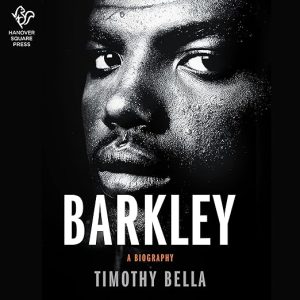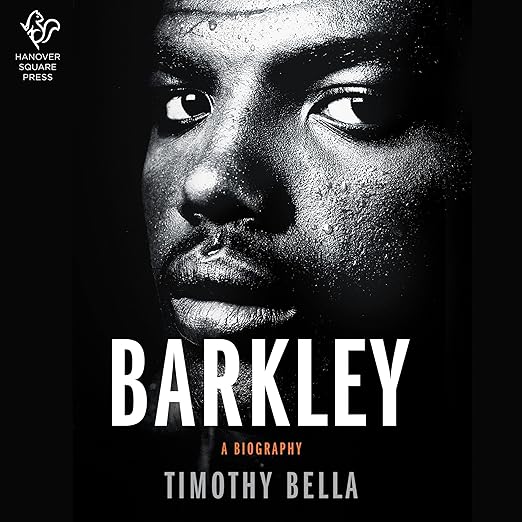
Leeds, Alabama is where the story starts, with a boy raised by his mother and his grandmother who could not find a place to fit until he found a court. Sixteen hours and forty-six minutes later, Timothy Bella's audiobook has carried Charles Barkley from that town through a Hall of Fame career and out the other side into a second life as one of the loudest and least manageable voices in American public argument. The distance between those two points is the book, and Bella refuses to smooth any of it.
Our Take on Barkley
The publisher calls this the definitive biography, which is the kind of claim that usually deserves suspicion and in this case is at least defensible. Bella conducted over three hundred and seventy original interviews, and the density shows in how the book is built. Rather than moving from highlight to highlight, it accumulates testimony from people who were in the room: teammates, opponents, family, executives, journalists. Dan, one of the listeners who rated it, describes the effect precisely: "No stone is left unturned as Timothy Bella examines every detail of Charles's life from childhood to today."
What that method buys is a portrait rather than a highlight reel. Barkley went toe to toe with Magic, Michael, Hakeem and Shaq during the most competitive stretch the league has produced, and a lesser biography would have parked itself in that decade and stayed there. This one treats the NBA years as the middle act. The Alabama childhood gets real weight, and so does the long afterlife in which Barkley became, in the publisher's phrase, a bold agitator for social change who grapples brashly with the thorniest cultural issues going.
The candour question is the interesting one. Barkley has been contradicting himself in public for forty years, frequently on purpose, and any biographer has to decide whether to reconcile those contradictions or display them. Bella displays them. Dan calls the result "a very thorough biography about one of the NBA's most polarizing players", and polarizing is the operative word: the book does not arrive with a verdict pre-attached, which means listeners who came to have their existing opinion confirmed will find themselves negotiating instead.
Why Listen to Barkley
Korey Jackson reads it, and the casting logic is sound in a way that is easy to miss. A subject this loud does not need amplification. Barkley supplies his own volume, and the quoted material throughout is already at maximum. What a book like this needs from a narrator is restraint, a delivery that lets the subject's own words provide the energy and keeps the connective reporting steady and unhurried. Jackson's established strength is exactly that understatement, trusting the material to carry itself rather than signalling in advance which moments are supposed to matter.
Nearly seventeen hours is a serious commitment and the structure earns it. Because Bella works chronologically and by season, the book gives you natural resting points roughly every chapter, which matters far more in audio than it does in print. You can put it down after a year of Barkley's career and pick it up a week later without losing your footing. For a commuter this works out at around a month of listening, and the interview-driven construction means every session delivers something concrete rather than a stretch of connective summary.
The era coverage is the underrated pleasure. Dan mentions enjoying "the nostalgia of reliving" the seasons he lived through, and if you watched basketball in the late eighties and nineties, that recognition effect is real and constant. The book keeps naming games, teams and rivalries you have opinions about. What lifts it past nostalgia is that Bella is equally interested in the parts of the story sportswriting usually skips: the poverty, the racial politics of Alabama, and the specific mechanics of how an athlete becomes a commentator whose opinions carry outside sport.
What to Watch For in Barkley
The most important caveat is one a reviewer raises rather than the publisher. Scott Albin, who gave it four stars, writes that "Barkley did not consent to a review for this project, but the author's 374 interviews with people who knew Charles in one capacity or another more than make up for that omission." Albin considers the gap covered. I would say it is covered for the external record and not for the interior one. A biography built entirely from other people's accounts can tell you what a man did and how it looked from outside, and it can only infer what he thought at the time.
A second gap deserves flagging before you commit seventeen hours. Richard H Bohner, who rated it five stars and enjoyed it, still adds: "I would have liked more about his post playing days." That is a fair complaint about a subject whose second career has arguably reached more people than his first. If you are coming to this primarily for the broadcasting and commentary years rather than the playing career, calibrate accordingly. The book covers that period, but the weight sits earlier.
Two practical notes. A supplemental enhancement PDF accompanies this audiobook, which usually means photographs, notes or source material, so download it if your listening app supports it rather than assuming the audio is complete on its own. And the 4.4 average across three hundred and fifty ratings is lower than the enthusiasm in the individual reviews would suggest, which fits the pattern for a long, detail-dense biography of a divisive figure: the people who wanted a fast, affectionate sports read do not all stay to the end.
Who Should Listen to Barkley
Basketball listeners who lived through the Barkley era get the most here, and anyone interested in how an athlete converts fame into a genuine public voice gets a case study with unusual documentation behind it. It suits readers of serious long-form biography more than it suits readers of sports memoir, and the Alabama chapters make it worthwhile for people who care about the social history around the game as much as the game. Commuters with a month to spare will find the seasonal structure ideal.
Give it a miss if you want Barkley in his own voice, since he did not participate and every word about his interior life is inferred from other sources. Skip it too if seventeen hours of thoroughly reported detail sounds like more than you want from a sports book, or if you are looking primarily for the broadcasting years. What Bella has produced is a fully documented biography of a man who has spent four decades resisting summary, and it is better for refusing to resolve him.
A Few Questions About Barkley
Is the supplemental PDF needed for the audiobook?
The listing notes that a supplemental enhancement PDF accompanies the recording. Materials like this usually hold photographs, notes or source references rather than anything load-bearing, but download it through your listening app anyway. Biographies built on hundreds of interviews often put their sourcing there, and it costs nothing to have it available.
How much of the audiobook covers his broadcasting years?
The publisher promises coverage of his enduring legacy as a provocative voice in American pop culture, so the post-playing period is genuinely included. One five-star reviewer still wished for more of it. If the commentary career is your main interest rather than the NBA seasons, expect the weight of the book to sit earlier than you would like.
Do I need to follow basketball to enjoy it?
It helps but it is not essential. Roughly half the book covers a childhood in Leeds, Alabama and a second career as a public voice on race and culture, neither of which requires knowing a box score. The NBA chapters will mean considerably more if you watched the Magic and Michael era yourself.