Before You Press Play
- Performance: Anna McNuff narrates her own adventure memoir with the infectious enthusiasm and self-deprecating honesty that characterizes all her books; her voice is perfectly matched to the material.
- What it covers: Physical endurance and mental limits, community built through vulnerability, the unexpected generosity of strangers
- Feel: Warmhearted and propulsive, with honest lows that give the highs genuine weight
- Our call: McNuff narrating McNuff is one of the best arguments for author-narrated adventure audiobooks; this is her most emotionally resonant account yet.
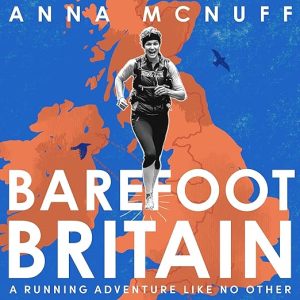
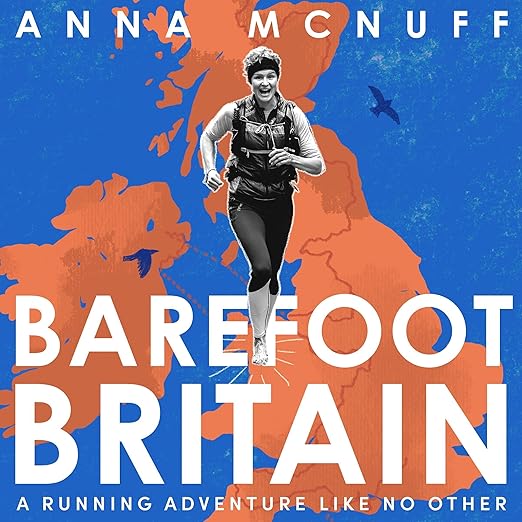
I came to Anna McNuff later than I should have. A friend had mentioned Barefoot Britain three different times before I finally pressed play, and when I did I was on a treadmill, which felt both appropriate and slightly comic. McNuff was running 100 marathons across Britain without shoes, and I was running nowhere slowly, with shoes on. The gap between those two situations did not prevent the book from being immediately compelling.
The premise is the kind that sounds invented: McNuff had never run a mile barefoot before deciding to run a route from the Shetland Islands to London covering the equivalent of 100 marathons without shoes. The goal was to test what the mind and body are capable of, fueled, as she honestly puts it, by a desire to drink tea and eat biscuits across Britain. This combination of enormous physical ambition and completely normal human motivation is McNuff's signature, and it is what makes her books feel real rather than aspirational.
How Barefoot Britain Holds Up
The question any reviewer should answer about an adventure memoir is whether the physical feat generates enough interiority to justify the format. Running in bare feet is striking as a concept, but the story of Barefoot Britain is not really about feet. It is about what happens when you do something publicly vulnerable for a very long time. McNuff's route gathered momentum as it went: she was joined by thousands of runners along the way, people who came out to run a segment with her because her journey was public and her openness about the difficulty of it made strangers want to be part of it.
Reviewer Aspire captured this well, noting how McNuff combined "warmth, humor and the joys of community with the reality of pain, loneliness and self-doubt." In audio, delivered by McNuff herself with her full voice behind the emotional honesty, those lows land with particular weight. When she describes the days when the feet were genuinely damaged, when continuing required a kind of decision that goes beyond motivation, the story stops being an adventure narrative and becomes something closer to a meditation on endurance.
Author narration is always a gamble, and for adventure memoirs it is an especially significant one. Adventure writers often describe experiences better than they can voice them. McNuff is an exception. Her narration is not technically polished in the way a professional audio actor's performance is, but it is authentically hers, and that authenticity is doing real work. When she describes staying with complete strangers, people who opened their homes to her along the route, the logistical reality of 100 marathons requiring a lot of sofas and spare bedrooms, the gratitude in her voice is not performed. Reviewer Abigel Csurdi noted that she wept when the adventure ended, and I understood that response completely by the time I reached the final stages of the route.
Reviewer Holly, who has read four McNuff books in sequence, described her as "bananas" with genuine affection, and this is accurate. McNuff's humor is self-deprecating in a specific British way, not modesty for show, but a genuine willingness to make herself the comic subject whenever the material allows. In audio, this comes across as warmth rather than self-pity.
Weak Spots in Barefoot Britain
One underappreciated element of Barefoot Britain is its geography. McNuff runs a deliberately wiggly route that takes her through the Shetland Islands, rugged coastlines, small inland villages, windswept moors, and the kinds of places that would never appear in a conventional travel memoir. Her descriptions of the landscape serve the book's emotional argument: this is a country of extraordinary variety, and the people who come out to run with her are as varied as the terrain. The adventure does not happen in Britain as a backdrop; it happens in specific British places, and McNuff's attention to those specifics gives the book texture.
Reviewer ktre, who had never visited Britain, described feeling transported by the landscape descriptions and the encounters with locals. That is the best evidence that the book succeeds beyond its athletic premise: it is also, accidentally, an affectionate portrait of a country glimpsed from ground level, at walking pace, with no shoes.
The Right Listener for Barefoot Britain
Listen if you enjoy adventure and outdoor memoirs and respond well to emotional honesty about difficulty alongside celebration of achievement. Listen if you are interested in Britain and want a perspective radically different from the usual tourist circuit. Skip if your primary interest is in barefoot running as a physical practice; this is a memoir, not a running technique guide. Skip if you need your adventure narratives to stay heroic and upbeat throughout, because McNuff does not spare herself or the reader when things get genuinely hard.
Good to Know
Is Barefoot Britain part of a series, and do I need to have heard McNuff's previous audiobooks first?
It is listed under the Anna's Adventures series but is completely standalone. McNuff's other books cover different adventures, running the length of New Zealand, cycling across America, and while longtime fans will recognize her voice and approach, no prior familiarity is needed.
Does the audiobook include anything about the practicalities of barefoot running, or is it purely a narrative memoir?
Barefoot Britain is a narrative memoir, not a guide to barefoot running. McNuff addresses the physical challenges and adjustments required, but her interest is in the experiential and emotional dimensions rather than technique. Listeners wanting training advice should look elsewhere.
How honest is McNuff about the difficult days and physical pain, and does the audiobook feel balanced rather than one-sidedly inspirational?
Very honest. Multiple reviewers specifically cited the book's willingness to sit with the hard days, damaged feet, loneliness, self-doubt, as one of its strengths. McNuff does not present herself as superhuman, and the difficulties make the community and progress she finds more meaningful.
At nearly 10 hours, is Barefoot Britain paced well for a long listening session, or does it drag in the middle?
Reviewers consistently describe it as propulsive and hard to put down. The geographic structure of the journey gives the narrative natural momentum, and McNuff's voice and humor prevent the middle sections from slowing. It is one of the better adventure memoirs for sustained listening.