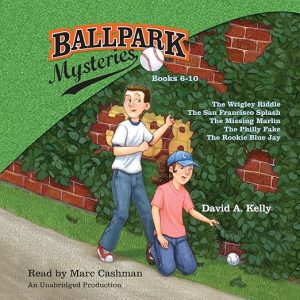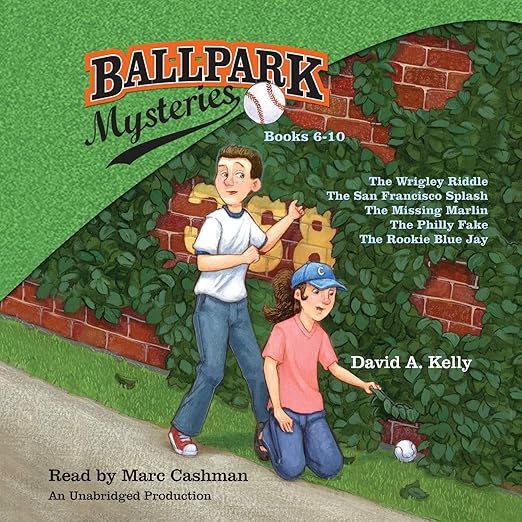
Five separate whodunits share one detective duo in this audiobook collection, and each mystery is anchored to a real Major League ballpark: ivy going missing at Wrigley Field, a stolen World Series ring in the San Francisco bay, vanishing fish at the Miami Marlins' tanks, accusations against the Phillie Phanatic in Philadelphia, and ghost lights haunting a rookie Blue Jay in Toronto. Ballpark Mysteries Collection: Books 6-10 bundles the sixth through tenth entries in David A. Kelly's series, built for early chapter book listeners who already like a puzzle wrapped inside a baseball setting.
The Wrigley Riddle sets the tone for how these mysteries work: when patches of the ballpark's famous ivy start disappearing, Mike and Kate have to figure out whether it's simple vandalism, a curse-the-Cubs prank, or something tied to rumors of treasure hidden underneath the vines, a plot engine that's silly enough for the target age range without ever talking down to them.
Aimed at Feinstein's Readers' Younger Siblings
Kelly's formula borrows deliberately from two established traditions, Ron Roy's A to Z Mysteries for the puzzle structure and Matt Christopher's sports fiction for the athletic setting, and the synopsis pitches it directly at younger siblings of John Feinstein's readership, a smart positioning choice for a series built to be a gateway into both mystery and sports fiction simultaneously. Each entry in this bundle uses its stadium's real identity as a plot device rather than generic scenery, the Wrigley ivy, the Marlins' fish tanks, which gives young readers a reason to actually learn something true about each ballpark along the way.
Reviewer Josette T., whose two sons are 8 and 11, notes that the mysteries involve real professional teams and that Mike and Kate are written as relatives of sports reporters who travel to the actual stadiums, a detail that grounds the fiction in something recognizable rather than a fully invented world. Reviewer mlynapier confirms continuity matters here too, noting her son enjoyed books one through five just as much as this later bundle, a good sign for a series someone might pick up starting anywhere in the run.
A Championship Ring Lost in the Bay
The San Francisco Splash mystery follows the same formula with a different hook: a retired player pulled from the bay after a man-overboard scare realizes his championship ring is gone, and the mystery leaves open whether it sank to the bottom or was stolen by a rival from decades earlier, exactly the kind of open question that keeps a young listener guessing rather than passively absorbing an already-resolved plot.
The Philly Fake mystery adds a lighter comic layer to the bundle, built around the beloved Phillie Phanatic getting unfairly blamed for the team's losing streak during a Fourth of July visit, while The Rookie Blue Jay closes the collection on a spookier note, with unexplained lights on the field distracting a promising young player. That range, from a mascot-focused caper to something bordering on a ghost story, keeps the five mysteries from feeling formulaic even though they share the same basic structure and cast throughout.
Cashman's Familiarity Is Genuinely Audible Here
Marc Cashman has narrated this series across its full run, and that accumulated familiarity is genuinely audible; Mike and Kate stay consistently differentiated across all five mysteries in this bundle without the character voices drifting or blurring the way a narrator new to the series sometimes struggles with. His pacing understands the assignment specifically, moving briskly enough to hold a young listener's attention without tipping into the kind of theatrical over-performance that can actually undercut a mystery's tension for early readers.
The real-ballpark grounding pays off in audio specifically, since hearing Wrigley Field's ivy-covered walls or the Blue Jays' stadium described aloud does some of the visualizing work a young listener might otherwise need a photo for. Reviewer musicwithlaura's simple "my kids love these" confirms the basic appeal holds regardless of format, and the mystery structure, a clear puzzle with a satisfying resolution in each entry, suits the attention span of the intended early-chapter-book age range well.
Younger siblings following in the footsteps of older kids who already know Ron Roy or Matt Christopher get a natural next step here, since Kelly borrows the clean puzzle structure of the former and the sports-first setting of the latter without requiring familiarity with either source series first; the mysteries work as a genuine entry point in their own right.
The bundle format also gives a family a natural way to gauge whether a young reader is ready to move on to slightly more complex chapter-book mystery series once all five entries here are finished; five mysteries is enough runway to confirm real interest before committing to a longer series elsewhere.
Musicwithlaura's CDs Point to a Different Format
This bundle starts at book six, and while mlynapier's review suggests the series works fine picked up anywhere, a reader unfamiliar with Mike and Kate as characters will get slightly less context here than starting from book one; the mysteries themselves are self-contained, but the ongoing friendship and family dynamics build cumulatively across the run.
The available reviews for this collection are relatively brief and general, Josette T.'s stands out as the most specific, while mlynapier's and musicwithlaura's are short confirmations of enjoyment rather than detailed assessments, and musicwithlaura's mention of "cds" suggests her family's experience may reference a physical format rather than this specific digital audiobook. There isn't much granular listener feedback here beyond broad, consistent approval.
The collection format means five distinct mysteries arrive as one bundle rather than five individually sampled entries, which is convenient for a family committing to the series but also removes the option to try just one mystery before deciding whether the format works for a particular kid; a single standalone entry might be the better test case for a first-time reader unsure whether the series will land.
Building Reading Stamina Through Mystery-Solving
Kids already partial to books one through five will slide right into this bundle without missing a beat, and young baseball fans specifically get the most out of it, since the real stadium details reward existing interest in the sport rather than requiring it from scratch. Parents looking for a chapter-book series that builds reading stamina through mystery-solving rather than pure sports narrative get a genuinely well-balanced hybrid here.
Newcomers dropped in at book six miss some of the earlier relationship-building between Mike and Kate, so a family starting completely fresh with the series might get more mileage beginning with the first bundle instead; kids with no particular interest in baseball as a sport may also find the stadium-specific details land less than they would for an already-invested young fan.
Common Questions
Do I need to have listened to Ballpark Mysteries books 1 through 5 before starting this audiobook?
Not strictly. Each mystery is self-contained, and one reviewer's son enjoyed this later bundle as much as the earlier books, though newcomers will miss some of the built-up context around Mike and Kate's friendship.
Does this audiobook cover real Major League Baseball stadiums?
Yes, each of the five mysteries in this collection is built around a real ballpark, including Wrigley Field, the San Francisco bay-adjacent stadium, the Miami Marlins' park, Philadelphia, and Toronto.
Is the Ballpark Mysteries Collection audiobook appropriate for kids who aren't baseball fans?
It works best for kids with at least some existing interest in baseball, since the stadium-specific details and real team references are part of the appeal rather than incidental background.
How does Marc Cashman differentiate Mike and Kate's voices across five mysteries in this audiobook?
His long history narrating the series shows in consistent, distinct characterization for both leads across all five entries, without the drift that can happen when a narrator is new to an established cast.