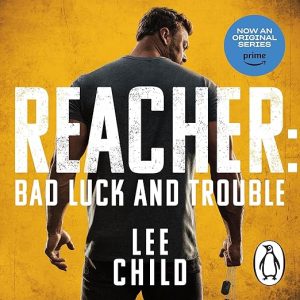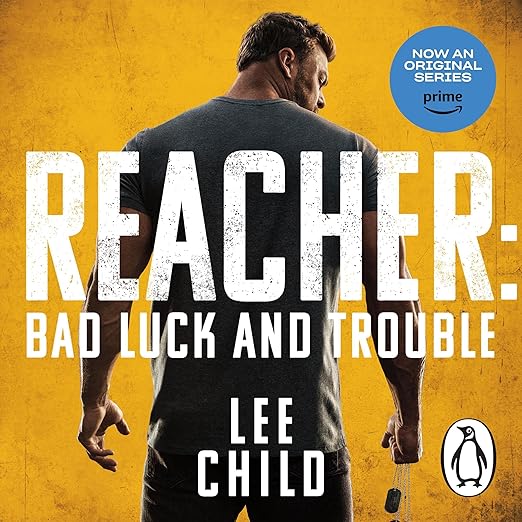
I came to Bad Luck and Trouble relatively late in my Reacher journey, having heard enough about Lee Child to be curious but skeptical of the genre conventions. I'm generally cautious about thriller series that depend on physical invincibility as their primary dramatic engine. What Child does with Jack Reacher, though, is smarter than that premise suggests, and Bad Luck and Trouble is an instructive example of why.
The book opens with a man being thrown from a helicopter three thousand feet above the California desert. Child doesn't ask you to ease into this. He drops you directly into the evidence of violence and then rewinds to show you the mechanism.
How Bad Luck and Trouble Holds Up
The eleventh Reacher novel is a reunion story of sorts, which is an unusual structure for a series that typically relies on Reacher's isolation as a fundamental condition of his existence. When one of his former Special Investigators unit is found dead in that desert, and six more are missing, Reacher assembles what remains of his old team. The shift from solo avenger to unit leader changes the book's texture in interesting ways. Reacher still has the decisive, analytical quality that defines him, but he's now operating within a group dynamic, which means Child can show him as a leader rather than just a force of nature.
The mystery of who is targeting the unit and why involves a defense contractor and a terrorism scheme, which sounds like generic thriller scaffolding but is executed with Child's characteristic economy. He wastes very little on setup he doesn't use later. One reviewer described the book as among their top three in the series so far, noting that "all been a lot of fun." That's perhaps too casual an assessment for what Child is actually doing with pacing and structure, but it captures the experience accurately enough.
Why Bad Luck and Trouble Works as an Audiobook
Jeff Harding's narration is specifically praised in promotional material, with The Sunday Times noting that it "captures Reacher's character perfectly" and that "you have to savour every minute." That's a reasonable description. Harding has a voice with controlled authority, and he matches Reacher's internal register without performing it. Reacher thinks in clear declarative sentences; Harding delivers them with the same economy. The twelve-plus hours of audio feel shorter than they are, which is a sign of well-matched narration.
One reviewer noted coming to Child through a friend's recommendation after being "skeptical about reading a series," and found the books better than the format suggested they might be. Bad Luck and Trouble works as an entry point, though the series' accumulated reputation for formula means you'll know roughly what shape the ending will take before you arrive there. Child's pleasure is always in the path, not the destination.
Weak Spots in Bad Luck and Trouble
The team dynamic in this book is somewhat unusual for Reacher, and not all readers of the series will warm to it equally. Reacher's effectiveness in solo books depends partly on his removal from ordinary social bonds, and assembling a group requires Child to handle interpersonal dynamics he doesn't typically spend much time on. He manages this with reasonable skill, though the supporting team members are somewhat thinly drawn compared to Reacher. The question of Karla, raised in one review as a point of forward curiosity, suggests at least some reader investment in whether supporting characters reappear, which Child doesn't always accommodate.
The book's violence is exactly what you'd expect from Reacher: precise, consequence-laden, and narrated with the same matter-of-fact quality as everything else. Child doesn't dramatize violence for its own sake; he presents it as problem-solving, which is disturbing only if you think about it too carefully.
The Right Listener for Bad Luck and Trouble
Existing Reacher readers will find this among the better entries in the series for its team structure and for the opening set piece, which is one of Child's more memorable. New listeners can start here, since the Jack Reacher novels are designed to be read in any order and Child provides enough backstory. Listeners who dislike series fiction on principle will find the formula visible but competently executed. Anyone currently following the Prime Video adaptation with Alan Ritchson will find the audio version of the source material rewards comparison.
Before You Press Play
- Voice: Jeff Harding's delivery has been praised as capturing Reacher's character perfectly, and on this evidence that reputation is deserved. He brings precision and economy to the prose that mirrors Reacher's own thinking.
- Big ideas: Military loyalty and unit bonds, vigilante justice, the mathematics of revenge
- Atmosphere: Propulsive and controlled, with a cold efficiency that suits the material
- Worth it?: One of the stronger entries in the Reacher series, offering both a satisfying team dynamic and the usual Child plotting pleasures, with a narration that enhances rather than merely accompanies.
Common Questions
Do I need to read the first ten Reacher novels before Bad Luck and Trouble?
No. Lee Child designed the Reacher series so that each book functions independently, and Bad Luck and Trouble provides all the backstory you need. The series regulars who appear here are introduced clearly enough for new listeners.
Is Jeff Harding the definitive narrator for the UK-published Reacher audiobooks?
Harding narrates the Penguin/Transworld UK editions of the Reacher series. Dick Hill narrates the Delacorte US editions. Both have strong reputations among Reacher fans. Harding's work on Bad Luck and Trouble has been specifically praised by The Sunday Times, and his delivery is well-matched to Child's prose style.
How does the Amazon Prime TV series with Alan Ritchson compare to the Reacher described in the books?
Ritchson captures Reacher's physicality and decisive quality, and the series has been well-received. The audiobooks give you Child's internal narration, which is one of the format's strengths: Reacher's analytical process is much more present in audio than it can be on screen. They're complementary rather than competing experiences.