At a Glance
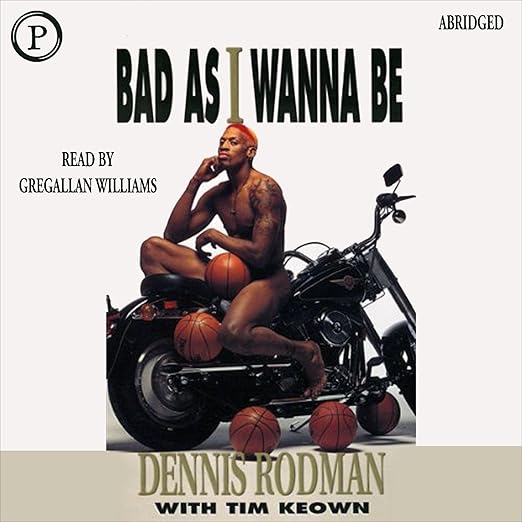
- Narration: Greg Alan Williams brings an edge to Rodman's first-person voice that fits the memoir's uncompromising self-portrait, though the material's repetitive stretches test even a skilled narrator.
- Themes: Poverty and survival, fame and self-destruction, race and the NBA power structure
- Mood: Brash and confessional, with an undertow of real pain
- Verdict: A memoir that captures the specific texture of Rodman's contradictions better than any profile could, though its brevity leaves important chapters of his career underexplored.
I listened to Bad as I Wanna Be on a Saturday morning and finished it before my coffee was cold. That is not entirely a compliment. Dennis Rodman's memoir, which first appeared in 1996 and became a cultural document of its era, runs to just over an hour in this audio edition, and that brevity is the book's most significant limitation. Rodman is one of the more genuinely strange and interesting figures in American sports, and seventy-two minutes is not enough time to do justice to the complexity of what he is trying to say.
What the book does well, it does very well. Rodman does not waste time with pleasantries. He opens in 1993, sitting in a parking lot with a loaded gun, and that image captures something real about where his success had brought him. The early chapters, covering his emergence from poverty, his brief period of homelessness before college, his transformation from a scrawny late bloomer into one of the NBA's most physically dominant defensive players, are the most compelling material in the book. The specificity of the early poverty chapters is genuinely striking: Rodman is one of the few NBA players of his era to have come up from that depth of material deprivation, and the memoir earns its emotional weight in those passages.
The book's power is in its candor about what the NBA actually is as a social institution and what it does to the people inside it. Rodman has never been interested in the approved narrative of the grateful athlete, and Bad as I Wanna Be is the documented proof of that refusal. He talks about race, about the way players are marketed and controlled, about the specific dynamics of Bulls teams built around Michael Jordan, with a directness that was unusual in 1996 and would still be unusual today.
Reviewer Alicia Crumpton provided the most detailed contextual reading, noting Rodman's Hall of Fame status and his career across five franchises, but the memoir is not interested in the official biography. It is interested in what that life actually cost. Reviewer Age_Warrior observed that the book is repetitive in places, and that assessment is accurate: Rodman returns to certain themes without always building on them, which is a structural weakness that a more rigorous edit might have addressed.
What Makes Bad as I Wanna Be Worth Hearing
Greg Alan Williams brings a performance that suits the memoir's unvarnished register. He does not soften Rodman's voice or domesticate the rougher passages, which is the right call for material this deliberately blunt. The audio format suits the first-person confessional mode well, and Williams's pacing keeps the shorter runtime from feeling rushed even when the material covers significant ground quickly. His ability to hold the contradictions of Rodman's self-presentation, brash and wounded at once, is the narration's key quality.
Things to Know Before Starting Bad as I Wanna Be
The vulgarity is genuine and persistent, and readers who find that mode exhausting will find the memoir challenging regardless of its other qualities. Reviewer Age_Warrior mentioned buying it despite its vulgarity and finding it worthwhile, which is a fair summary of the experience for readers who are not already Rodman fans. The repetitive structure in the middle sections, where certain points about fame and excess are restated rather than developed, is the book's clearest weakness.
The seventy-two-minute runtime also means that significant periods of Rodman's career receive only surface treatment. The Chicago Bulls dynasty years, the San Antonio experiment, the later chapters of his career, are present but not examined with any depth. Listeners looking for a comprehensive sports biography will need to supplement this with other sources. This is a primary document of how Rodman experienced his own life, not an objective account of what he did.
Who Dennis Rodman Is Writing For
Rodman fans and basketball history readers will find this a worthwhile primary document of one of the NBA's most genuinely unusual careers. The memoir functions best as a portrait of a specific kind of American celebrity in the 1990s rather than a complete biography. Those who lived through the Bulls dynasty era will find familiar events reframed through a perspective that was never part of the official story. New listeners to sports memoir might be better served by a longer-form treatment first, using this as a companion rather than an introduction to Rodman's full life and career.
Is the audio version of Bad as I Wanna Be an abridgment, or does the seventy-two-minute runtime reflect the full book?
The runtime suggests this is either an abridged edition or a significantly condensed audio production. The 1996 print edition was a full-length memoir, and seventy-two minutes does not cover that material in full. Listeners should be aware that this audio version is substantially shorter than what the original book contained.
How does Rodman address his relationships with Michael Jordan and the Chicago Bulls in the memoir?
The Bulls years are present but the brevity of this edition means they receive surface treatment. Rodman's perspective on the specific dynamics of those championship teams is one of the most interesting aspects of the book, and the compressed runtime limits how deeply any of those relationships can be examined.
Is Greg Alan Williams a convincing voice for Rodman's first-person narration?
Yes. Williams does not smooth out the memoir's bluntness, which is appropriate for a subject who built his entire public persona around refusing to perform likability. The performance matches the register of the material without overdramatizing it.
Does the book engage seriously with Rodman's personal struggles, or is it primarily about basketball?
The memoir opens with Rodman in a parking lot with a loaded gun, which signals his intent to engage with the personal costs of his career directly. The early chapters on his emergence from poverty and homelessness are among the most candid material in the book. Basketball is context rather than the primary subject.