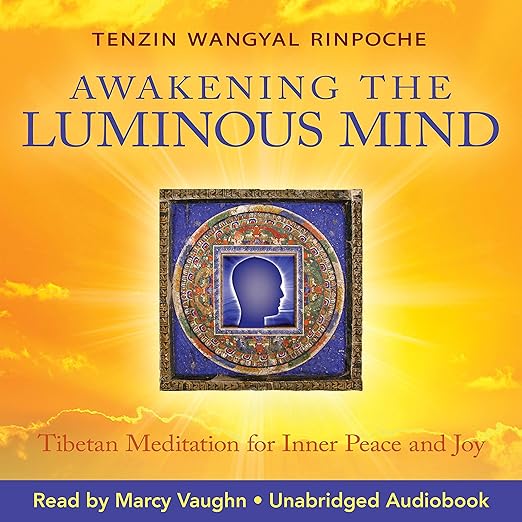
I found Awakening the Luminous Mind through the meditation and spirituality section of my listening queue, where it had been sitting for several months after a colleague, a longtime meditator with a background in several traditions, pressed it on me with unusual emphasis. She tends to be measured in her recommendations, so the strength of her feeling registered. I listened to it over the course of a quiet week, a chapter or so each evening, and I came out of it understanding both why it has accumulated a near-perfect rating across more than 200 reviews and why it generates the particular kind of grateful response that is distinct from ordinary satisfaction.
Tenzin Wangyal Rinpoche is a teacher in the Tibetan Bon Buddhist tradition, and Awakening the Luminous Mind draws on the heart instructions of Dawa Gyaltsen, an eighth-century Tibetan meditation master, to present a practice that is both ancient and immediately applicable. The book completes a trilogy of meditation instruction titles by Rinpoche, and while it functions as a standalone introduction to the three doors practice, stillness, silence, and spaciousness as entry points to the natural mind, listeners who have engaged with the earlier volumes will find this conclusion richer for that grounding.
Anticipating Your Objections Before You Raise Them
The book's central quality, the one reviewers return to consistently, is its directness. One reviewer who has read widely in Buddhist and contemplative literature describes Rinpoche as having a rare gift for giving the essence of the Dzogchen method without the philosophical abstraction and jargon that renders so much of the tradition inaccessible to Western practitioners. Another notes that the teaching seems to anticipate exactly where your ego will object, how your mind will wrestle with the simplicity, and how you might dismiss what's being offered as too basic to be profound, and then Rinpoche moves through each of those objections with what the reviewer calls a finesse that few other masters possess.
That quality of anticipatory understanding is genuinely rare in dharma writing, and it is part of what makes this audiobook valuable as a practice companion rather than purely as an intellectual exercise. The guided meditations included with the audio download extend the teaching into direct experience, which is where the real test of any contemplative instruction happens. Reviewers who engaged with those guided components report deeper meditation sessions as a result, not merely understanding the concepts but actually accessing the states Rinpoche is pointing toward.
Vaughn's Calm Voice Prepares You for Practice
Marcy Vaughn's narration deserves specific acknowledgment. Contemplative texts present a particular challenge for audio narrators: the material invites a certain quality of attention that can be undermined by a voice that draws too much attention to itself, whether through excessive expressiveness or a pace that pushes the listener through ideas that need time to settle. Vaughn avoids these traps. Her delivery is calm without being flat, unhurried without dragging, and the quality of attentiveness in her reading creates a listening environment that is itself a preparation for the practices being described. This is not accidental, it is skilled matching of voice to material.
The book's approach to self-doubt and self-judgment is particularly valuable. Rinpoche treats these not as obstacles to be overcome through effort but as temporary obscurations of something that is already present. The instruction, to recognize warmth, openness, and awareness in ordinary experience rather than to build toward them through accumulated practice, is one that experienced meditators may find both confirming and challenging in equal measure. One reviewer who had spent years in complex practice notes that it is hard for the ego to accept how simple deep practice can actually be.
Guided Meditations Favor Audio Over the Ebook
The audiobook format comes with one meaningful limitation: the supplementary PDF containing supporting material is available for download but is not read aloud. One reviewer specifically flagged that the guided meditations, which are crucial to the full practice, are included in the audio version but absent from the ebook. As an audiobook, you do get access to those meditations, which is a genuine advantage over other formats. However, the PDF companion material requires separate engagement, and some of the practice detail that exists in written form will not be captured if you listen without downloading it.
This is also not a book for passive background listening. The teaching mode requires genuine attention, not the focused analytical attention of a demanding argument, but the receptive, open attention that the book itself is cultivating. Listening while driving or exercising will work for the conceptual sections but will not serve the practice instructions well.
Three Doors Open Even to Complete Beginners
Practitioners with some existing contemplative background will get the most from this, particularly those who feel stuck in complex, effort-based practice and are looking for a simpler, more direct approach. Complete beginners to meditation are not excluded, Rinpoche's directness makes the essential instructions accessible, but some basic familiarity with sitting practice will help you apply what you are hearing rather than simply understanding it intellectually. Listeners interested in Tibetan Buddhist and Bon tradition who find the scholarly literature overwhelming will find this a remarkably accessible entry point to the Dzogchen view. Those committed to other traditions may still find the three-doors framework a useful supplement to their existing practice.
- Read by: Marcy Vaughn's calm, unhurried delivery is well matched to the contemplative nature of the material, creating a listening environment that itself approximates the stillness the book is teaching.
- At its heart: Tibetan Bon meditation practice, the three doors of stillness, silence and spaciousness, dissolving self-judgment through direct recognition
- Vibe: Quiet and quietly transformative, best listened to in a state of genuine attention
- Short version: One of the more accessible and direct introductions to Dzogchen-adjacent practice available in audio form, particularly valuable for listeners who find other Tibetan Buddhist teachings too densely philosophical to apply.
Frequently Asked Questions
Do you need prior knowledge of Tibetan Buddhism or Bon tradition to benefit from this audiobook?
No formal prior knowledge is required. Tenzin Wangyal Rinpoche has specifically designed these teachings to be accessible to practitioners from any background or none. Some familiarity with basic meditation concepts will help you apply the practices, but the instruction itself is unusually clear and non-jargon-heavy for material from this tradition.
Are the guided meditations actually included in the audiobook version, and are they as important as reviewers suggest?
Yes, the guided meditations are included with the audio edition, which is a meaningful advantage over the ebook format where they are absent. Reviewers consistently describe the guided practices as central to the full benefit of the book, the conceptual teaching points toward what the guided sessions allow you to experience directly.