The Short Version
- Performance: Taylor K. Reynolds self-narrates, and the author-voiced delivery carries a direct, coaching quality that suits the guide's intent. The personal investment in the material comes through clearly across nearly 20 hours.
- What it covers: Nursing school exam preparation, test anxiety reduction and smart study strategy, structured preparation for all TEAS 7 sections
- Feel: Focused and reassuring, like working through material with someone who has already figured out what actually works
- Our call: A comprehensive, author-narrated audiobook study guide for the ATI TEAS 7 that rewards disciplined listening with genuine exam confidence.
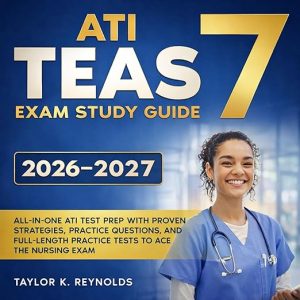
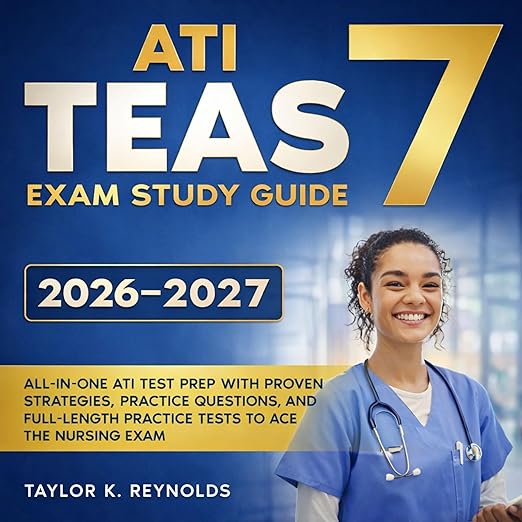
TEAS 7 preparation separates nursing school hopefuls not just by what they know but by how efficiently they can organize what they know under pressure. Taylor K. Reynolds's ATI TEAS 7 Exam Study Guide opens from that premise and builds a structured preparation program that covers Reading, Math, Science, and English while keeping test anxiety and study efficiency at the center of the conversation throughout. This audiobook is self-narrated by Reynolds, which is immediately apparent in the coaching quality of the delivery. There is a directness to the author-narrated format that conventional narrators rarely replicate: Reynolds is not performing someone else's material but teaching from it, and the distinction matters when you are preparing for an exam that will determine your entry to nursing school. The question driving the opening, whether passing the TEAS 7 is about studying harder or studying smarter, is the right question to ask and the right one to answer across 19 hours and 10 minutes.
The TEAS 7 is a significant gatekeeper. Nursing programs use it as a primary admissions criterion, and many applicants face the exam after years away from formal academic settings, or while managing work and family obligations alongside their preparation. Reynolds addresses this reality directly. The guide promises to help you perform at your best rather than simply review content, which reflects an understanding that exam performance and content knowledge are related but not identical skills. The structural framework here, sharp targeted lessons followed by proven performance strategies followed by realistic practice, is a coherent approach to what the exam actually tests and what candidates actually struggle with in preparation. The explicit focus on returning students, noted in the synopsis, signals that the content is scaffolded for people who may have gaps in foundational knowledge rather than assuming recent classroom experience.
Test-Day Mistakes Get Equal Billing With Content
At 19 hours and 10 minutes, this is one of the longer study audiobooks in the test-prep space, and that length is justified by the scope of the TEAS 7 itself. The exam covers Reading, Mathematics, Science, and English and Language Usage, each with its own question types and cognitive demands. Reynolds's coverage of common test-day mistakes alongside the content review is particularly practical. Many candidates who have mastered the material still underperform because they misread question formatting, rush in sections where they feel confident, or panic when an unfamiliar question type appears early in the exam. Addressing those behavioral patterns explicitly, as Reynolds does, is the difference between a content review guide and an actual exam preparation system. The companion PDF with two full-length practice exams and over 300 exam-style questions is a significant addition that transforms this from an audio-only resource into a two-format preparation system that covers both knowledge acquisition and timed performance.
Reynolds Coaches Rather Than Simply Narrates
The argument for choosing this audiobook over written alternatives is largely logistical for most TEAS candidates. Aspiring nurses who are working, raising families, or managing existing coursework while preparing for the exam cannot always carve out dedicated desk time. Turning a commute or a domestic task into productive TEAS preparation is a real advantage that this format provides. Reynolds's self-narration adds a dimension that written study guides cannot replicate: the coaching voice of someone who designed the preparation system and believes in it. The study habits section on focus, memory, and long-term retention for busy or returning students reflects genuine understanding of the TEAS 7's typical candidate profile. At 5.0 stars from 48 ratings, the audience response is uniformly positive, which for a study guide typically indicates that the material delivers on its practical promises rather than on general appeal to casual readers.
Math Sections Demand Pausing and Processing
Nineteen hours is a substantial commitment, and the math sections in particular are content that audio learners should approach actively rather than passively. Mathematical reasoning on the TEAS 7 covers operations, applications, and data interpretation, and working through those concepts by ear requires pausing and processing rather than continuous playback. The companion PDF practice exams are essential rather than supplementary for anyone seriously preparing for the exam. The guide's system works when the listener is doing the work alongside it, and passive listening through 19 hours will not produce the same results as the active pause-and-recap approach Reynolds recommends throughout. Candidates who are very strong in three sections and weak in one should consider supplementing with targeted resources for their challenging area rather than relying solely on this broad-spectrum preparation guide, which necessarily distributes its attention across all four subject areas.
Busy Adults Turn Commutes Into TEAS Prep
Nursing school applicants preparing for the ATI TEAS 7 who learn effectively through audio and want a comprehensive, structured preparation program will find Reynolds's guide the most practical available option in the audiobook format. Returning students who have been out of school for years and need both content review and test strategy will find the dual focus on knowledge and on-exam performance particularly valuable. Busy adults balancing work and family alongside exam preparation who cannot commit to a traditional written study schedule will find the flexible audio format genuinely functional in ways that desk-based study cannot be. Those who want to supplement with a realistic practice exam experience should note that the companion PDF is essential and should be used in parallel with the audiobook. Candidates seeking preparation for the NCLEX or other nursing licensure exams should note that this guide is specific to the TEAS 7 admissions context.
Good to Know
Does this audiobook include practice questions, or is it purely a content review?
Reynolds includes a downloadable PDF companion available in your Audible library that contains two full-length practice exams and over 300 exam-style questions with detailed answer explanations. The audiobook covers content and strategy while the PDF provides the practice component, making it a two-part preparation system.
Is this audiobook suitable for the current TEAS 7 format or an older version of the exam?
The guide is specifically titled and described as covering ATI TEAS 7, the current exam version. Candidates should confirm the exam version their nursing program requires, as preparation objectives can differ between TEAS versions.
How does Taylor K. Reynolds self-narrating this audiobook affect the preparation experience compared to a professional narrator?
Self-narration gives the guide a coaching quality that professional narrators rarely replicate. Reynolds delivers the material as the designer of the preparation system teaching directly, which many test-prep listeners find more motivating and trustworthy than a third-party performance of the same material.
At nearly 20 hours, can this audiobook realistically serve as a comprehensive TEAS 7 preparation resource on its own?
It covers all four TEAS 7 subject areas and includes test-taking strategy alongside content. Combined with the companion PDF practice exams, it functions as a comprehensive preparation system. Active listeners who pause and review throughout will gain substantially more than those listening passively, particularly in the mathematics section.