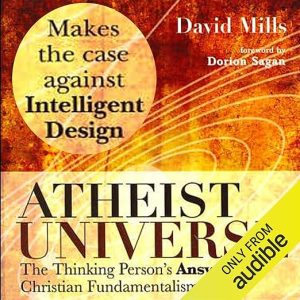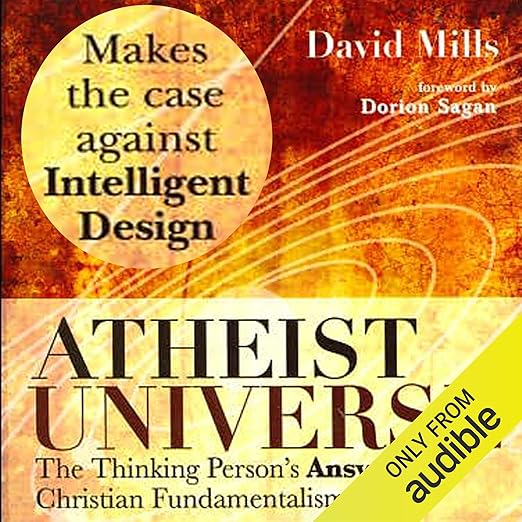
David Mills wrote Atheist Universe in 2006 as a comprehensive rebuttal to arguments for God's existence, and David Smalley narrates this audiobook edition at 9 hours and 9 minutes. The book's staying power is the first thing worth noting: reviewer O.Y.W.K. has been returning to it since reading it as a teenager at publication, describing it as "a constant guide and voice of reason in the face of religious fundamentalism" across nearly two decades. That longevity is significant for a book engaging with questions, the cosmological argument, the problem of evil, the historicity of miracles, that are regularly revisited but rarely resolved.
Smalley is not a generic audiobook narrator; he hosts the "Dogma Debate" podcast and has a professional background in secular humanist discourse. That background changes the texture of the narration in ways that listeners will notice immediately. He reads Mills's arguments with the confidence of someone who has made versions of these arguments himself, which gives the audiobook an energy that a more neutral narrator would not bring. Whether that is an asset or a liability depends on what the listener is looking for. For those already skeptical of religious claims, it adds conviction. For those approaching the book to understand the atheist position from a position of genuine curiosity or opposing belief, the narration's assured advocacy tone may feel less welcoming than the text itself.
Mills structures the book as a systematic primer, moving through the major arguments for God's existence, the cosmological, ontological, teleological, and moral arguments, before addressing specific biblical claims about miracles, resurrection, and the compatibility of science and scripture. The Q&A format that structures some sections gives the audio a conversational quality that helps the more abstract philosophical material remain accessible. Reviewer Joseph J. Truncale, who describes a lifetime of reading philosophical and science-based books on the question of God's existence, calls this "one of the very best books I have ever read on this topic," placing it above many more academically prestigious treatments. That endorsement from an experienced reader of the genre is meaningful context for placing the book's level of ambition.
The sections on morality without God and on the meaning of life without religious framework are where Mills is most original. Most atheist primers address the cosmological and evolutionary arguments with competence; fewer address the affective dimensions of atheism, what it actually feels like and means to live without a theological framework, with the same directness Mills brings. Smalley's narration handles these sections with a warmth that distinguishes them from the more combative passages where Mills is directly dismantling specific arguments.
Brain Candy That Still Feels Relevant Today
The audiobook's most consistent strength is its accessibility. Reviewer The Spinozanator described it as "brain candy for the non-believer," which captures both the pleasure and the limitation: it is engaging and readable rather than rigorous in the way academic philosophy of religion is rigorous. But that accessibility is a genuine virtue for listeners who find academic philosophy either inaccessible or too detached from the felt questions that motivated their interest in atheism. Mills writes for people who have real questions, not for seminar rooms, and Smalley's narration carries that spirit forward.
The political religion section, addressing the behind-the-scenes relationship between political power and religious institutions, is the area where the book is most clearly a product of its 2006 American context. The specific political configurations Mills references have shifted since publication, but the underlying dynamics he describes, the leveraging of religious identity for political mobilization, remain recognizable enough that the analysis does not feel dated. Listeners who engage with current discussions of faith and politics will find the historical perspective useful rather than stale.
One-Sided by Design, Thinnest on Near-Death Claims
Mills writes from a position of conviction, and the book is not designed to be an even-handed survey of arguments on multiple sides. Listeners who want to understand the best case for religious belief alongside the secular rebuttal will need to supplement with other sources. The book is "a primer for countering today's religious dogma," as its own description states, and it functions most effectively when approached as exactly that rather than as a comparative philosophy of religion text.
The near-death experience and medical miracles section is worth noting because it is the area where Mills's arguments engage most directly with phenomena that are not straightforwardly explained by either religious or purely materialist frameworks. He addresses these with the same systematic skepticism he applies to biblical claims, and the analysis is competent, but listeners with particular interest in consciousness research will find the coverage less thorough than the more historically grounded sections on biblical historicity and evolution.
Smalley's Narration Adds Authority for Secular Listeners
This audiobook is most immediately valuable for listeners who are already atheist or agnostic and want a comprehensive, accessible verbal articulation of the secular position across philosophical, scientific, moral, and biblical dimensions. It also serves those who have left religious frameworks and are still working through the intellectual architecture of that transition. Curious religious listeners who want to understand secular counterarguments fairly will find the tone combative enough that approaching it as an intellectual exercise rather than a dialogue is the most productive framing. David Smalley's narration adds authority for listeners already in the secular humanist orbit. The 9-hour runtime is substantive without becoming exhausting, and the systematic chapter structure makes it easy to return to specific sections on individual questions.
The Short Version
- Performance: David Smalley's narration carries the particular authority of a host already immersed in secular humanist discourse, and his engagement with David Mills's arguments is genuine enough to feel like an endorsement rather than simply a performance.
- What it covers: Atheism and secular philosophy, scientific cosmology versus religious explanation, ethics without religion
- Feel: Confident and combative, intellectually engaging
- Our call: David Mills's systematic case against theological necessity has held up remarkably well since 2006, and David Smalley's narration gives the arguments the energy of live debate without sacrificing the logical rigor Mills built them on.