- Narration: Paul Mantell delivers a clear and unhurried read that suits academic survey material, steady rather than dynamic, but never a barrier to the content.
- Themes: History of secular philosophy, ethics without religion, explicit vs. implicit atheism
- Mood: Measured and curious, occasionally wry
- Verdict: The most thorough and balanced introduction to atheist philosophy available in audiobook form, essential for believers curious about secularism and atheists who want their history.
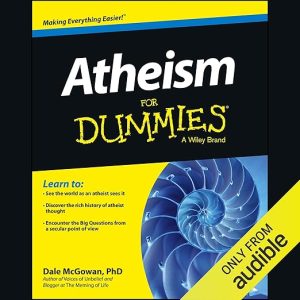
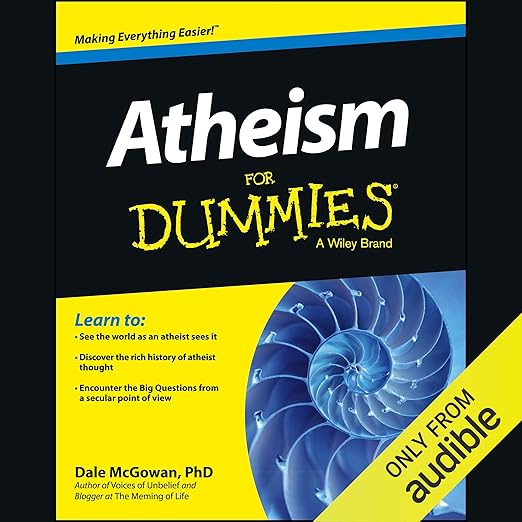
I picked this up after a conversation with a friend who had grown up in an evangelical household and was mid-deconstruction, not looking for a fight, just wanting to understand what she was possibly moving toward. She asked me if there was something she could listen to in the car that would tell her what atheism actually was, without an agenda. I had to think about it. Most of what exists in the secular nonfiction space is either polemical, the New Atheist tradition of Dawkins and Hitchens, full of elegant contempt, or personal memoir. Atheism for Dummies by Dale McGowan is neither of those things. It is the survey text that tradition somehow never produced.
Nearly fifteen hours of runtime across a subject that can generate more heat than light is a commitment, but McGowan earns it by treating the topic as a historian and philosopher rather than an advocate or an opponent.
A Dummies Title That Outgrows Its Own Series
McGowan, who holds a PhD and was a former professor before becoming a writer, structures the audiobook as a genuine introduction: the historical evolution of secular philosophy, the nature of atheism as a spectrum rather than a fixed position, the relationship between atheism and ethics, and the cultural and social contexts in which nonbelief has emerged across different eras. Reviewer "Still Learning, Still Thinking" called it "the most thorough, clear, and well-written treatment of non-belief" they had encountered, and argued it deserved a broader title than the Dummies series branding allows. That's a fair observation. The format somewhat undersells what the content delivers.
The distinction McGowan draws between explicit and implicit atheism, the difference between someone who actively disbelieves and someone who simply lacks belief, is handled with the kind of philosophical precision that pays off throughout the rest of the book. It prevents the kind of definitional confusion that derails most conversations about nonbelief before they begin.
Neither Polemic nor Sermon, Just an Explanation
The book's refusal to be polemical is its most significant virtue. McGowan is clearly a secular humanist, but he writes about religious believers without contempt and about atheists without triumphalism. Reviewer "The Shopping Buddhist" noted that the book "made me feel better about not only myself but the world around me", an unusual response to a survey text, but it reflects how carefully McGowan calibrates his tone. He is not trying to recruit or deconvert. He is trying to explain.
Reviewer "The Professor" highlights the treatment of evolution as a historical gateway to atheism, and specifically the 1859 inflection point when Darwin's Origin of Species resolved the fundamental design-versus-chance question that had made atheism intellectually difficult to sustain before. That historical framing gives the book structural spine that a simple definition-and-argument format would lack.
Sixteen Hours That Reward Focused Listening
At nearly sixteen hours, the audiobook occasionally settles into a reference-text pace that prioritizes comprehensiveness over momentum. This is a book to listen to in segments rather than marathon-style, Paul Mantell's narration is clear and consistent, but the material density in some of the historical philosophy sections rewards focused attention rather than passive listening during commutes.
Some listeners who come expecting engagement with contemporary debates, the New Atheism moment, responses to religious fundamentalism, science and religion discourse post-2006, may find the treatment somewhat more academic than topical. The book's strengths are historical and philosophical rather than polemical, which is exactly what makes it valuable and also what might frustrate listeners looking for ammunition for arguments.
Not for Fireworks, Better for Orientation
This is the right book for curious believers who want to understand what their atheist friends or family members might actually believe, for people mid-deconstruction who want intellectual framework rather than ex-evangelical testimony, and for atheists who want a clearer understanding of their tradition's history. It is less useful as a debate resource and more useful as an orientation. Skip it if you want the fireworks of Dawkins or Hitchens, McGowan is doing something different and, for most purposes, more durable.
Questions Listeners Ask
Is the audiobook hostile toward religious believers?
No. McGowan explicitly avoids polemic and writes about both religious and secular positions with analytical rather than adversarial framing. Multiple reviewers from religious backgrounds describe finding it respectful and clarifying rather than combative.
Does Paul Mantell's narration add anything to the material, or is it purely functional?
Primarily functional. Mantell reads clearly and consistently, which is what nearly sixteen hours of dense nonfiction requires. He does not animate the material the way a skilled narrative nonfiction narrator might, but he does not impede it either.