In Brief
- Performance: Keith Sellon-Wright reads the whole thing alone for University Press Audiobooks, an academic imprint rather than a trade one.
- What it covers: Arguments for a creator answered one by one, the problem of evil, omniscience, belief examined rather than mocked.
- Feel: Patient and level, closer to a long tutorial than a debate.
- Our call: The right pick if you want the strongest version of both cases; the wrong one if you came for a fight.
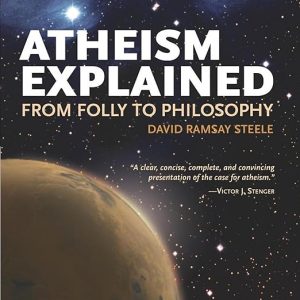
Nobody wins an argument about God at a dinner table, and that failure is roughly the problem this book sets out to fix. David Ramsay Steele spends eleven hours and forty-seven minutes pulling the standard cases apart in order, first the ones for a creator and then the ones against, and University Press Audiobooks recorded it in June 2016 with Keith Sellon-Wright reading. Forty-seven ratings have it at 4.3. Temperature is what separates this audiobook from most of the shelf it sits on: the description promises calm, careful criticism, and the responses underneath it confirm that promise from people who came looking for ammunition and got a seminar instead.
Theistic Arguments Taken Apart on a Workbench
The opening half is a fair hearing. Steele sets out the case for God as its defenders actually make it: that the wonders of the world require an intelligent creator, that the universe had to start somewhere, that telepathy and out-of-body experiences point to a spirit world, and that direct personal experience of God counts as evidence like any other. Only after working through those does he turn and argue the other way, on three grounds the description names plainly: monstrous evils, the impossibility of omniscience, and what it calls the senseless concept of a thinking mind without a brain. Sequence matters as much as content here, because putting the defense first means a listener meets the strongest version of each claim before hearing anything against it.
Virtuoso Fan, writing back in 2008, explains the gap this fills better than any publisher could. That notice reports dozens of books on atheism already read, from Nietzsche and Russell through the more recent polemics of Dawkins, Hitchens and Harris, and then the complaint: none of them supplies "a solid critical and logical argument against the theists who are bent on ridiculing you". That is a specific and unglamorous need, and it is not the same need that a bestselling polemic is written to meet.
Star Stuff, posting from Canada a few months later, produced the image that has stayed with me: theistic arguments "systematically taken apart on Steele's workbench". A workbench is exactly right. The book is not a manifesto and it is not a debate performance; it is a bench with a lamp over it, and one claim at a time gets clamped down and examined until you can see how it was assembled.
Calm Delivery Sustains Twelve Hours of Argument
Steele's method creates a genuine reading problem, and it is worth understanding before you buy. For long stretches this book is voicing positions it does not hold. A listener who tunes in halfway through a paragraph can easily hear the case for an intelligent designer being stated carefully and mistake it for the author's own view. Everything therefore rests on how clearly the recording signals the difference between a position being presented and a position being answered, so sample a passage where an argument is under examination instead of the first few minutes.
Calm is a real advantage over twelve hours. Books in this category tend to be written at volume, which works in three hundred pages and becomes exhausting in a recording you are carrying around in your ears all week. A voice reading measured prose about the problem of evil is something you can listen to for two hours at a stretch. A voice reading indignation is not.
N Metten, writing from the United Kingdom in 2015, puts the register precisely: Steele "goes through all the argument for and against the existence of god and lets the reader decide what to think of it. He is not a missionary, on a mission to save the world from religion." That last sentence is what I would show anyone hesitating. Whatever conclusion the second half reaches, the process is genuinely open, and open process is what makes long-form audio bearable.
Sub-Chapter Navigation Lost in a Linear Recording
The three-star notice on this page is the most useful thing on it, and its praise is the warning. That reader liked the layout above all: chapters divided into sub-chapters "from 1 to several pages in length", a format that makes it "easy to read a little here and there (or more when time permits) without having to commit to long chapters". Every part of that advantage disappears in a linear recording. The same entry stops after five chapters, disagrees with what Steele does in the first two lines of the book, and then breaks off mid-word, which is a shame, because a considered dissent is scarce here.
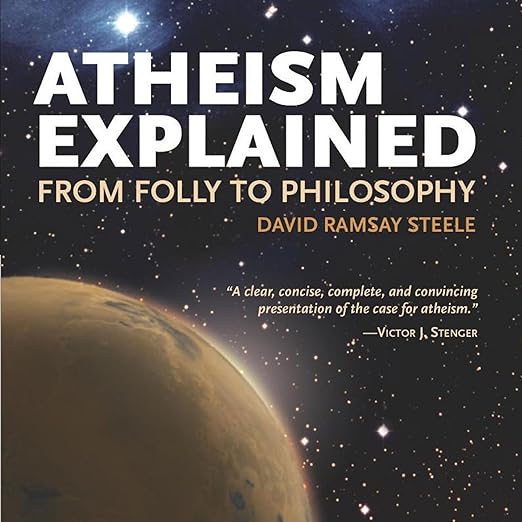
Everything else here predates the recording it sits under. All five notices predate the June 2016 release, the oldest by nearly eight years, and one of them bought the book partly because of "the cover design", which the reviewer read as a vision of outer space promising a book about the universe. That is a print purchase described in print terms, and it is a fair reminder that a 4.3 average here is a verdict on an argument rather than on a performance.
Finally, the filing. This sits under religion and spirituality with an Atheism tag, so it will surface next to devotional titles, and some listeners will arrive expecting something gentler. They will get a hearing, which is more than most books in this fight offer, but the second half does argue that God cannot exist, and the description's promise that listeners will form their own conclusions should be read with that in mind.
Believers and Philosophy Students Both Benefit
Natural buyers are people who have already read the famous atheist books and found them better at scoring points than at building a case, or anybody on the receiving end of an argument they cannot answer. Philosophy students will find it a useful map of the terrain. So will believers who want the strongest version of the opposition rather than a caricature, since the first half of this book is more generous to their position than most of their own side's popular writing.
Anyone hoping for rhetorical fireworks should choose a different title, and anyone who wants to skim, dip and cross-reference should buy the print edition, because the structure that its own admirers praise is precisely what a recording flattens.
To my ear, the calm is the whole product. A recording of somebody being furious about religion for this long would be unlistenable by the third hour, and this is the rare book in the category still worth your attention near the end of it.
Common Questions
Does this audiobook cover intelligent design and the power of prayer?
Both are named in the description, alongside religion without God and the question of whether belief makes people happier and healthier. They sit in a later section of controversial topics rather than in the main sequence of arguments about God's existence, so expect them as extensions of the central case.
Is the audiobook a survey of both sides or an argument for atheism?
Both, in that order. The opening half gives the arguments for a creator a long and unhurried hearing, and only then does the second half argue that God cannot exist. Anyone expecting a demolition from the first minute will be surprised by how much room the opposing side is given first.
Would this work for a believer who wants to understand the other side?
Better than most titles in the category. The description commits to disputing the arguments for God through calm, careful criticism rather than ridicule, and nothing in it is built to humiliate a reader. What it will not do is leave the question hanging, since the closing half argues a firm conclusion, so take it as the strongest available statement of the other side rather than a neutral survey.