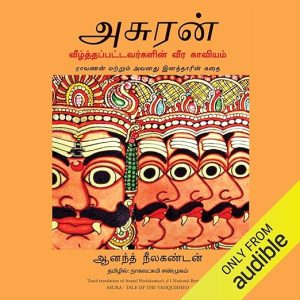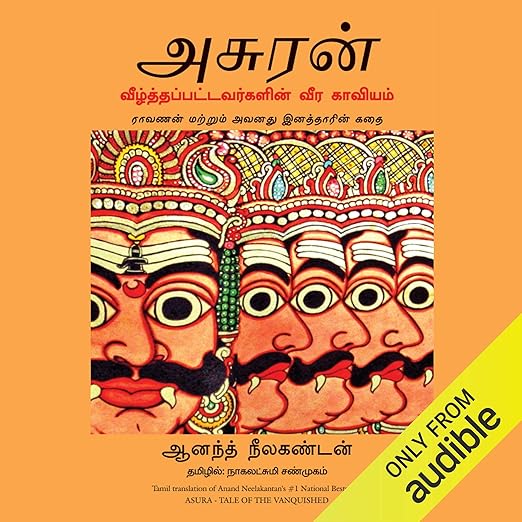
Before anything else, a note that matters: this audiobook is in Tamil. The language is stated clearly in the metadata and the synopsis itself includes a direct disclosure. I am making this explicit at the top of the review because a listener expecting an English narration will have a genuinely different experience from the Tamil-speaking reader for whom this version was produced. Within that frame, what Anand Neelakantan has done in Asura is something that deserves serious attention regardless of the language it arrives in.
I came to this one through the broader landscape of mythological retellings that have proliferated over the last decade, many of them engaging with the same impulse: what does a foundational story look like when told by the one history decided to lose? The Ramayana, one of Hinduism's two great epics, has Ravana as its antagonist. He is the demon king of Lanka who abducts Sita. He is defeated by Rama. He is, in the traditional telling, the obstacle. Neelakantan's Asura, subtitled The Tale of the Vanquished, asks what Ravana's story looks like from inside, and it asks this question not as a literary exercise but as an act of political memory.
A Closer Look at Asura
The title Asura refers to the class of beings in Hindu cosmology that are typically translated as demons or titans, beings in opposition to the devas, the divine. The Asura people who appear in Neelakantan's telling are not supernatural monsters but a human community, the oppressed outcastes of India who have carried a counter-narrative of the Ramayana for three thousand years. That counter-narrative, in which Ravana is not a demon but a king, not an abductor but a defender, not a villain but a vanquished ruler whose story was erased by the victors, is what Neelakantan is restoring to literary form.
The political dimension of this project is not incidental. A reviewer in the UK noted that the book best explains the inclusive nature of the peoples of South India and Sri Lanka, and that it presents Ravana's thoughts as a vision of an egalitarian society where everyone is treated equally. This is mythological retelling as political act, not merely as narrative experiment. Understanding that frame changes how you listen to even the most conventional epic elements of the story. Every battle scene carries the weight of a suppressed history asserting itself.
What Makes Asura Worth Hearing
Neelakantan is working within a broader tradition of postcolonial and subaltern literary retellings that have reshaped how we read foundational narratives across multiple cultures. The impulse is as old as literature but the theoretical framework is relatively recent: the recognition that the stories a culture tells about its origins are also stories about who has the authority to narrate, and that centering the defeated perspective is not merely a reversal of the conventional tale but a different kind of truth about what happened.
The comparison point that Western listeners might reach for is something like Gregory Maguire's Wicked, which retells The Wizard of Oz from the Wicked Witch's perspective, or John Gardner's Grendel, which gives Beowulf's monster an interior life. But the stakes in Asura are considerably higher than a literary experiment. The Ravana of Neelakantan's telling carries three thousand years of suppressed identity, and the communities for whom this story has circulated in various forms are not simply literary audiences but peoples whose relationship to the official mythology has been shaped by caste hierarchy and political marginalization across centuries.
Things to Know Before Starting Asura
At twenty-seven hours, Asura is an epic in scale as well as subject matter. Neelakantan is not retelling highlights: he is building a world. Reviewers who read it in other formats before the audiobook noted the density of the storytelling, the attention to the social and political texture of Ravana's Lanka, the development of secondary characters who in the Ramayana are merely functional presences. This is a book that takes its own premise seriously enough to follow through on all its implications.
The narrator Saki is praised in reviews for a performance that matches the book's emotional register: the defiance, the grief, the dignity of a figure who knows he is speaking from a position the official history will not honor. For Tamil-speaking listeners, the experience of hearing this story in their own language, told from the perspective that their communities have preserved, is described by reviewers as something that goes beyond literary appreciation. The reviewer who called it the best explanation of the inclusive nature of South Indian and Sri Lankan peoples was describing this quality.
Who Anand Neelakantan Is Writing For
The audience for this audiobook is primarily Tamil-speaking listeners for whom this recording is the natural format for a story of this cultural significance. For English-speaking listeners curious about Neelakantan's work, the novel is available in English translation and there are English-language recordings of related material that would be a more accessible starting point.
Scholars and students of postcolonial literature, comparative mythology, and the politics of narrative will find the project of this book intellectually significant regardless of whether they can access this particular recording. The question of who gets to narrate a culture's foundational myths, and what changes when the narration shifts to the traditionally defeated, is one that this book engages as seriously as any literary work in this territory. It is not a comfortable retelling. It is not meant to be.
This audiobook is listed as Tamil language. Is there an English version available?
Yes. Anand Neelakantan's Asura was originally written in English and published in English, with multiple editions available. This particular Audible recording, produced by Audible Studios and narrated by Saki, is in Tamil. Listeners who want the story in English should seek the English-language edition, which has its own recordings and print versions.
What is the relationship between Asura and the traditional Ramayana? Do I need to know the Ramayana first?
Familiarity with the broad outlines of the Ramayana, the story of Rama, Sita, and Ravana, will significantly enrich the experience of Asura, since the book is explicitly positioned as the counter-narrative to that epic. However, Neelakantan provides enough context within the narrative that readers without prior knowledge can follow the story. The emotional impact is considerably deeper with the original as a frame of reference.
What is the cultural significance of telling the Ramayana from Ravana's perspective for South Indian communities?
The tradition of Ravana as a noble and unjustly vilified king has circulated among certain communities of South India and Sri Lanka for centuries, connected to caste identity and political resistance to Brahminical narratives. Neelakantan's retelling draws on this counter-tradition and gives it literary form, which is why reviewers describe it as more than a narrative experiment. For communities that have identified with the Asura people for generations, this version of the story carries significant cultural weight.