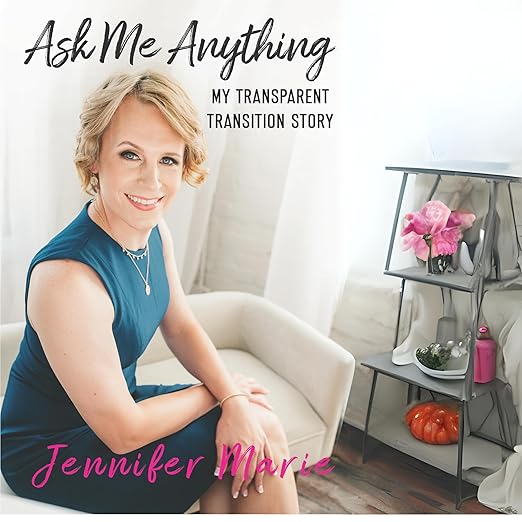
The title is an invitation and the audiobook takes it literally, since the person issuing it also reads it aloud. Jennifer Marie opens her description with a self-introduction and a qualifier: she is not the typical trans woman you usually hear about. She grew up in a Christian home, became a Christian herself, and held on to that faith while embracing her identity, a sequence the public conversation around trans lives leaves very little room for. Reflek Publishing put the recording out in October 2024 at six hours and eleven minutes, and the entire book is constructed as an answer to questions people are too uncomfortable to ask out loud.
Fairly PG, and Written for Three Different Audiences
What makes the copy unusual is that it addresses three separate audiences in a single paragraph and never pretends they are the same. If you are questioning your own gender identity, the book is for you. If you want to understand trans people better, it is for you. And if you do not buy into any of this transgender stuff, in the description's own phrasing, it is for you as well. Most memoirs in this category pick one of the three and write to it. Writing to all of them at once demands a tone that neither pleads nor lectures, and the parenthetical promise that it stays fairly PG so parents and kids can listen together tells you which register got chosen.
Marie's most honest sentence is also her most complicating one. Marie says she experienced tremendous support that, unfortunately, many in her community do not, and she flags it as unfortunate instead of folding it quietly away. That qualifier reshapes everything after it. This is not an account of rejection and survival, which is the dominant shape in the category, so a listener arriving from a hostile household will not find their own situation mirrored back at them. One May 2025 entry identifies what the book supplies in its place: it is written nonjudgmentally, and it closes with a set of dos and don'ts. A practical document has been attached to a personal one, and the pairing is the whole design.
Marie Reads Her Own Invitation to Contact Her
One caution before you weigh the written column. One of the five responses states plainly that it read an advance copy, and it was filed at the end of July 2024, more than two months before this recording came out, alongside a second entry from the same day. Neither can be describing the audio and neither was a purchase. The advance entry remains the most informative writing on the page: it reports a fast-paced memoir built from short stories, aimed squarely at people who do not consider themselves readers, and it describes the author allowing herself to be extremely vulnerable in order to educate. Take the structural detail, discount the timing.
Marie reads the book herself, and on this title that is not a cost-saving decision. A memoir called Ask Me Anything, closing with an invitation to contact the author directly, would be a strange thing to hand to a stranger in a booth. The copy also promises that parents and children can listen together, which puts the recording in the room in a way a paperback never is: a family playing this in the car is hearing a trans woman answer questions in her own voice, and the format does part of the persuading before the content has started. Six hours and eleven minutes is a manageable commitment for that.
Five Perfect Ratings, Yet No Skeptic Wrote In
Shelving is where this record gets muddled. The genre reads LGBTQ, the tag reads Parenting and Families, and the two point at different buyers: one is browsing for a memoir, the other for a manual. This book is both, unevenly, and the page never indicates which part dominates. The PG promise is softer than it sounds, too. Fairly PG is the author's own phrasing, it leaves the transition material undefined, and a parent planning a shared listen with a nine-year-old is working without specifics. Nothing on the listing fills that gap, which on a title marketed for family listening counts as a real omission.
Then the unanimity. Five entries, five top grades, and the copy's third audience, the reader who does not buy into any of it, is represented by nobody who identifies themselves as such. The closest the page comes is a February 2026 five-star reporting that the book helped its writer understand and respect transgender people, which is phrased as a change of state and not as a confirmation of one. That is real evidence the persuasive strategy works on somebody, and it is exactly one entry. A book aiming at skeptics has assembled a column of people who arrived convinced, which says more about distribution than about quality.
Parents, Siblings, and Friends Afraid to Ask Questions
Clearest fit: a family in the middle of this right now. A parent trying to understand a child, a sibling sitting on questions they are afraid to voice, a friend who wants to help and dreads saying the wrong thing: the copy's own standing offer exists for precisely those people, and six hours is a single weekend. Listeners questioning their identity inside a religious household will find the rarest thing on offer here, which is somebody who kept both things at once and describes the keeping without ever framing it as a compromise she had to make.
Three things would send me elsewhere. Wanting a political or a medical account of transition, because this is neither and the copy stays personal from beginning to end. Needing the faith material to break one way or the other, since the book neither evangelizes nor apologizes and both of those positions will disappoint someone. And leaning on the star average, given how much of that column arrived before the recording existed. Depend instead on the memoir itself: direct, self-read, built to answer questions instead of defending a position, and written by someone who decided in advance not to take offense at any of them.
Key Details
- Narration: Jennifer Marie answers her own invitation aloud, and on a book built for family listening the author's voice does work no hired reader could do for her.
- Themes: gender identity, faith kept instead of abandoned, family questions, practical guidance
- Mood: Gentle, patient and disarming
- Verdict: A trans memoir written for the skeptic and the sibling as much as for the questioner, though its column of praise largely arrived before release.