The Short Version
- Performance: Sukhbir Kalsi delivers the dialogue between Ashtavakra and King Janaka with measured gravity, letting the non-dualistic philosophy breathe at an unhurried pace.
- What it covers: Advaita Vedanta and non-dualism, self-realization through direct intuition, liberation from ego-identification
- Feel: Still and contemplative, demanding but deeply rewarding
- Our call: Essential listening for anyone serious about Advaita Vedanta philosophy, though newcomers to Indian spiritual texts should expect a steep but worthwhile entry curve.
I came to the Ashtavakra Gita through a side door. I had been working through several of the better-known Vedantic texts when a philosopher friend told me that the Ashtavakra Gita makes everything else look timid by comparison. That recommendation sat in my queue for weeks before I finally put it on during a series of long walks through my neighborhood, choosing the audio version narrated by Sukhbir Kalsi precisely because I wanted to sit with the text without the temptation to underline or skip ahead. By the third chapter, I understood what my friend had meant.
This is not a gentle introduction to Indian philosophy. The Ashtavakra Gita, also known as the Ashtavakra Samhita, is a short treatise on Advaita Vedanta attributed to the sage Ashtavakra, and it presents its central argument without preamble or comfort: the self that you take yourself to be is an illusion, pure awareness is what you actually are, and any spiritual practice aimed at achieving liberation is itself a form of bondage because it assumes the seeker is separate from what is being sought. For a tradition that values preparation and gradual progression, this text is almost shockingly direct.
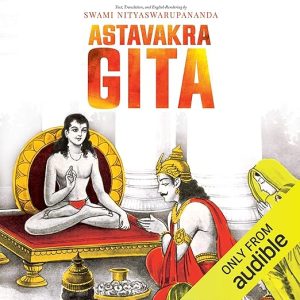
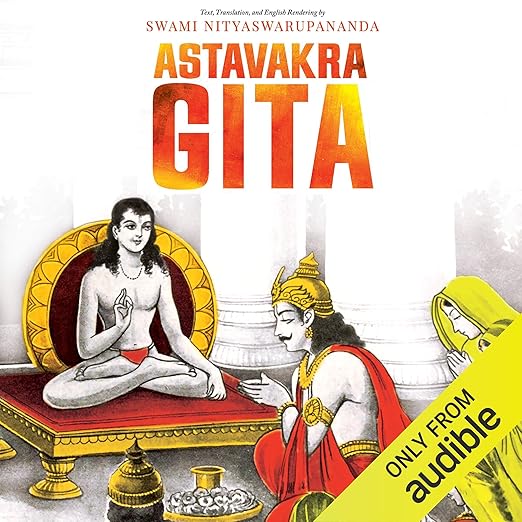
The text takes the form of a conversation between the teenage sage Ashtavakra and his royal disciple King Janaka, and this framing is more than structural. It places radical philosophical assertion inside a relationship, which softens nothing but does provide a human context for claims that might otherwise feel purely abstract. When Ashtavakra tells Janaka that he is already free, that the bondage he experiences is a mental construction with no ultimate reality, the exchange acquires a quality of transmission rather than instruction. You are not reading a treatise; you are overhearing a moment of direct pointing.
Swami Nityaswarupananda of the Ramakrishna Mission prepared this edition, providing English translations alongside word definitions, commentary, and a scholarly introduction that significantly contextualizes the text without domesticating it. Reviewers consistently noted that this editorial work raises the worth of the original, and I would agree. The commentary does not soften the Gita's more unsettling claims but it does provide enough scaffolding that a reader unfamiliar with Advaita terminology can follow the argument. One reviewer who described the text as initially hard to understand but utterly captivating once grasped was articulating something I recognized from my own experience with the audio.
The Best Parts of Ashtavakra Gita
Narrating a philosophical dialogue text presents specific challenges. The voice needs to carry authority without suggesting the kind of ego-investment that the text is explicitly arguing against. Sukhbir Kalsi achieves this balance. His pacing is unhurried in a way that allows the implications of individual verses to register before the next one arrives. The dialogue format is rendered clearly, with sufficient distinction between the voices of Ashtavakra and Janaka that the exchange feels genuinely conversational rather than monotonous. At eight hours and twenty-one minutes, the runtime is appropriate for the depth of the material, though listeners should expect to pause frequently and return to passages.
One reviewer mentioned being unable to believe the text was written decades ago, given how fresh its philosophical moves feel. That surprise is well-founded. The Ashtavakra Gita predates much Western philosophy of mind by centuries, yet its central argument about the constructed nature of the experiencing self is strikingly consonant with certain strands of contemporary philosophy and contemplative neuroscience. Hearing that argument voiced rather than read on a page gives it an immediacy that the silent reading experience sometimes lacks.
Before You Commit to Ashtavakra Gita
The most frequent note in reader responses to this text is transformation. Multiple reviewers described the Ashtavakra Gita as having changed them from the inside out, and one described it as pure, raw, original, and divine. I want to be careful with that kind of language because it can make a book sound like something it is not, namely a feel-good spiritual product. The Ashtavakra Gita is demanding in ways that most spiritual writing avoids. Its core claim is that there is nothing to achieve, which means it actively undermines the goal-orientation that most spiritual seekers bring to their reading. That is either profoundly liberating or deeply frustrating, depending on where you are when you encounter it.
Listeners who come with prior exposure to Vedanta, Buddhism, or non-dual philosophy will find the Ashtavakra Gita extends and radicalizes ideas they already have some framework for. Listeners who are entirely new to this tradition may find the audio format less reliable than a physical copy for a first encounter, since the density of the argument rewards re-reading in ways that rewinding audio only partially replicates.
There is a particular moment in the audio, deep in the commentary sections, where Swami Nityaswarupananda's scholarly framing steps aside and the text is allowed to speak with minimal mediation, and the effect is striking. The verses of the Ashtavakra Gita have the quality of statements so radical they initially pass through comprehension without registering. On the second or third encounter with the same idea, something shifts. That quality of delayed understanding is why the audio format actually serves this text better than you might initially expect: you cannot slow-read a verse into submission, so you are forced to let it land and move on, and the accumulation of that experience over eight hours produces a different understanding than careful study does.
Should You Listen to Ashtavakra Gita?
This free audiobook is essential for anyone with a serious interest in Advaita Vedanta or non-dual philosophy who has not yet encountered this text. It is also worthwhile for anyone who found the Bhagavad Gita's ethical and devotional emphasis interesting but wanted something more philosophically austere. Those who prefer spiritual writing with practical guidance, step-by-step methodology, or a warm and encouraging tone should approach with awareness that the Ashtavakra Gita offers none of those things. Its generosity is of a different order entirely.