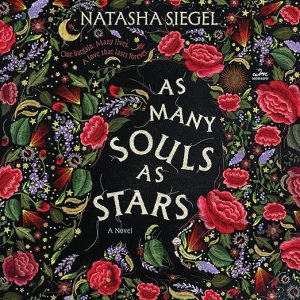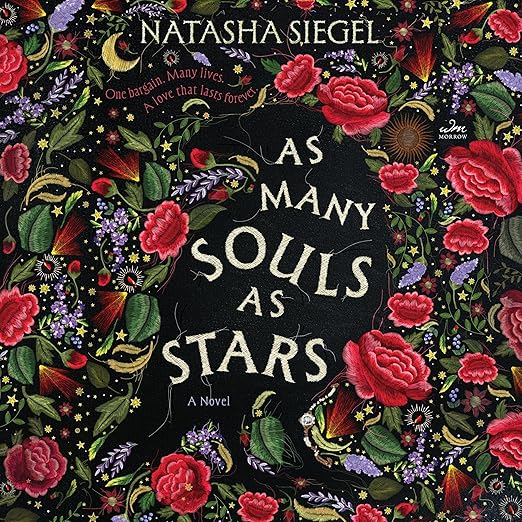
As Many Souls as Stars arrives with the kind of critical endorsement that creates pressure: starred reviews from Kirkus and Publisher's Weekly, comparisons to Addie LaRue, blurbs from S.T. Gibson and Sunyi Dean. Natasha Siegel's novel, now available as an audiobook narrated by Kristin Atherton across eleven hours and fifty minutes, manages to live up to that reception without leaning on it. The central premise, a centuries-long cat-and-mouse arrangement between a cursed mortal woman and an immortal soul-consuming creature, is executed with the kind of specificity that prevents it from collapsing into its own romanticism.
Is As Many Souls as Stars Worth Your Time?
The bargain at the book's center is worth unpacking. Miriam, a creature of shadow who sustains her existence by consuming mortal souls, encounters Cybil Harding in 1592 and finds her soul unlike any she has encountered before. The offer she makes, reincarnation in exchange for eventual consumption of that soul, is presented as a mercy: Cybil can escape her cursed present circumstances and live again, repeatedly, until Miriam finally claims her prize. Cybil accepts, and the arrangement begins.
Siegel is careful about the power dynamics embedded in this setup. Miriam has enormous structural advantage: she is immortal, she has been making and breaking arrangements with mortals for a very long time, and she does not fully understand her own attachment to Cybil's soul until that attachment has already complicated her ability to simply take what she came for. Cybil's position is weaker in most respects, but she has the advantage of knowing something Miriam has forgotten: that agency and adaptability matter more than raw power when the goal is a specific outcome rather than simple dominance.
The centuries-spanning structure is the book's most formally demanding quality. Siegel does not simply age Cybil through a single lifetime; she reincarnates her, which means each major section of the book involves a new version of Cybil with different circumstances, relationships, and starting conditions. What persists is something harder to name than memory: a pattern of resistance, a quality of soul that Miriam recognizes across every lifetime. Siegel renders this through accumulated detail rather than magical shorthand, which makes the recognition scenes feel earned rather than convenient.
L. Eliza's review highlights the shifting balance of power as a central pleasure of the reading experience, and this is where Siegel's structural instinct is most impressive. The balance genuinely shifts. Miriam gains the upper hand in some lifetimes; Cybil outmaneuvers her in others. The accumulation of these encounters builds toward a final reckoning that the book earns through its prior complexity rather than resolving arbitrarily.
Kristin Atherton's narration is a significant asset for this particular story. The gothic atmosphere Siegel builds requires a narrator who can sustain a slightly elevated register without tipping into parody, and Atherton manages this consistently across the nearly twelve-hour runtime. The two central voices, Cybil's various incarnations and Miriam's consistent immortal perspective, are differentiated clearly enough to maintain without being so exaggerated that the intimacy between them gets lost.
The book is fundamentally about loneliness of two distinct kinds: Miriam's loneliness as an immortal entity who has outlived every connection, and Cybil's loneliness as someone cursed to bring disaster to those around her. Siegel is attentive to what each kind of loneliness produces in terms of character, and the convergence of two varieties of fundamental isolation into something that neither party can cleanly categorize or safely pursue is the emotional engine of the novel. Atherton's delivery gives that emotional complexity room to develop rather than pressing for resolution too quickly.
The sapphic dynamic is not peripheral to the book's architecture; it is structurally central. The particular shape of a relationship between two women across centuries, one of whom is not quite human and the other of whom keeps dying and returning, is not a detail that Siegel adds for representation purposes. It shapes what the characters want, what they fear, and what they are willing to risk in ways that could not be replicated by simply changing the genders. Tiffany Shemwell's description of it as a "delightfully toxic love story that spans time" captures the balance the book achieves between genuine danger and genuine feeling.
Publisher's Weekly's comparison to Addie LaRue is apt and useful for setting expectations. The immortality mechanics are different, but the emotional register, a love story conducted across centuries between people in fundamentally incompatible positions, is similar. Fans of Schwab's novel who wanted more gothic atmosphere and more explicit examination of power dynamics will find what they are looking for here.
Before You Commit to As Many Souls as Stars
The pacing is deliberate. Siegel is not interested in rushing through her centuries-spanning structure, and the novel rewards patience rather than momentum-seekers. Cindy T. Rizzo's three-star review reflects a reading of the book that wanted faster payoff, which is a legitimate preference but not an accurate criticism of the book's own goals. Listeners who want a plot-driven chase story will find the atmospheric and psychological dimensions given priority over action.
The gothic register is consistent throughout, which creates a particular tonal intensity that some readers will find immersive and others may find claustrophobic over twelve hours. The historical settings span several centuries, and while Siegel renders each period with enough specific detail to feel grounded, the emphasis remains on the central relationship rather than on social history. Listeners hoping for rich period recreation of multiple historical moments may find the historical texture thinner than expected.
The moral status of both central characters is genuinely complex. Miriam has killed many people and consumed their souls. Cybil's resistance to the bargain has its own costs, including for people around her. Siegel does not resolve this complexity into a simple redemption arc or a clear alignment of reader sympathy, which is the book's greatest strength and also the quality that makes it less conventionally satisfying than straightforward romance. Readers who prefer their morally compromised characters to end up clearly justified may find the ambiguity uncomfortable.
The ending is designed to satisfy within the book's own terms rather than to deliver conventional romantic resolution. Some readers will find it deeply satisfying; others will feel the resolution is more ambiguous than they wanted after nearly twelve hours of investment. Siegel earned the ending she wrote, but it is worth knowing in advance that the book is not delivering a traditional happy-ending arc.
Should You Listen to As Many Souls as Stars?
This audiobook is built for readers who love sapphic fiction with genuine gothic atmosphere, complex power dynamics, and a love story that earns its emotional weight through structural sophistication rather than conventional plotting. Fans of A Dowry of Blood, The Book Eaters, and Addie LaRue will find their expectations confirmed and in several respects exceeded.
Listeners who want to begin exploring sapphic speculative fiction will find this an ambitious but rewarding entry point. The quality of the world-building and the precision of the central relationship are high enough to justify the twelve-hour investment for readers who are drawn to the premise rather than requiring prior genre familiarity.
The gothic historical fantasy audience, which overlaps substantially with the sapphic speculative fiction community but extends beyond it, will find As Many Souls as Stars among the more formally interesting entries in recent memory. Kristin Atherton's narration makes the audio format the right choice for this particular novel, adding a performance dimension that amplifies what the prose is already doing.
Questions Listeners Ask
Is As Many Souls as Stars audiobook suitable as a standalone or does it require prior reading?
Fully standalone. Natasha Siegel's novel is a complete, self-contained story. No prior reading is required, and the book introduces its world, characters, and rules from the beginning.
How explicit is the content in As Many Souls as Stars as an audiobook?
The romantic and atmospheric content is adult in tone but not explicit. The gothic darkness involves soul consumption and the consequences of curses, and the romance is emotionally intense without being graphic. Appropriate for adult readers and mature older teens.