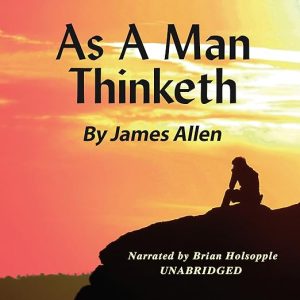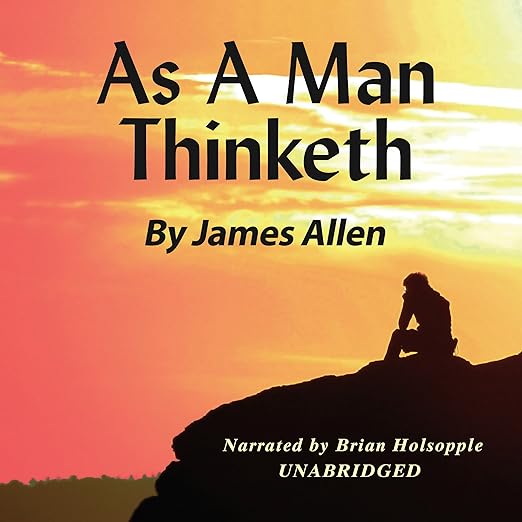
I came to As a Man Thinketh at the end of a long week when I had about an hour before the evening started and no patience for anything that would ask too much of me. At 55 minutes, it fit the gap perfectly. What I did not expect was to spend the following three days turning James Allen's ideas over in my mind, returning to specific passages, and finding that the brevity of the original was working on me in ways that a longer book might not have managed. The compression is part of the argument. Allen believed that a single clear idea, fully understood, was worth more than a hundred complicated ones half-grasped, and the essay form enacts that belief at the level of structure.
James Allen published As a Man Thinketh in 1902, which places it squarely in what is now called the New Thought tradition, a late Victorian and Edwardian movement that argued consciousness and thought are primary causes of life circumstances. The ideas here have since been borrowed, diluted, vulgarized, and republished in thousands of self-help books that strip out Allen's philosophical precision in favor of motivational slogans. Encountering the original, even in this brief audiobook form, gives you a sense of what that tradition lost in its popularization. Allen is not selling you on the idea that positive thinking will bring material rewards. He is arguing something considerably more demanding: that your character is the complete sum of all your thoughts, and that environment is merely a mirror of inner life. That is a harder claim and a more interesting one.
Seeds, Soil, and Fruit Fit This Brief Audiobook
The synopsis reproduces Allen's introductory verse, and it rewards close attention: Mind is the Master-power that moulds and makes, and Man is Mind, and evermore he takes the tool of Thought, and, shaping what he wills, brings forth a thousand joys, a thousand ills. Reviewer Desmond Yuen, who described the book as intriguing enough that he spent more time thinking about what he learned from each chapter than he expected, was responding to exactly this quality. Allen writes in a compressed, almost aphoristic style where each sentence carries more weight than its length suggests. The gardening metaphor that runs through the whole text, thoughts as seeds, character as soil, circumstances as fruit, is a coherent extended metaphor that the audiobook's brevity allows you to hold entire rather than losing the beginning of it by the time you reach the end.
Parker S Weighs Stoic Roots Against New Research
Reviewer Parker S, who is 31 and arrived at Allen relatively late, made a connection worth examining: the ideas here are as ancient as those found in the Stoic tradition and as contemporary as our understanding of the relationship between mental states and physical health. Parker appropriately noted that the chapter on thought's effect on the body should be taken with a grain of salt by modern readers. Allen was working without contemporary neuroscience and occasionally overstates the direct causal relationship between thought and physical condition in ways that do not survive the intervening century of research. But the philosophical spine of the book, that we are responsible for our inner lives and that inner life shapes outer circumstance over time, is compatible with Stoic practice in ways that make it feel less like historical curiosity and more like a position that keeps being rediscovered by every generation that needs it.
Holsopple Refuses to Modernize Allen's Cadence
Allen's writing style is formal in the register of its era, which means listeners accustomed to contemporary self-help's conversational tone may need to adjust their listening posture. Reviewer Pankster noted reading more slowly and carefully than usual and finding that the slower pace helped grasp the truths. Holsopple reads with deliberate authority that honors this quality. He does not hurry the prose toward contemporary legibility or give the text the kind of warm-coffee-mug reading that modern self-help narrations often receive. The rhythm of the Victorian period sentence, which Allen handles with considerable skill, is allowed to develop its full cadence. This is the right narration choice for a text that works through accumulation of carefully weighted statements rather than through argument or narrative drive. It demands a quality of attention that the format rewards, and at 55 minutes, the demand is manageable even for listeners who do not usually read Victorian prose.
This Gentle Nudge Rewards a Second Listen
At under an hour, this free audiobook asks almost nothing of your schedule while potentially asking a great deal of your attention. The text is short enough to listen to twice in a single sitting, which is probably the most productive way to approach it. Reviewer Jazmine Hardnett described it as a gentle but firm nudge to take responsibility for your own growth, which is accurate framing for what the essay does at its most accessible. But Allen is also doing something more philosophically specific than the typical self-help nudge, and the listeners who get most from it, like Parker S and reviewer Desmond Yuen, are the ones who sit with the ideas long enough for them to do their work. Come to it if you want to encounter an idea that has been influencing self-development thought for over a century in the form its author actually intended, undiluted by the decades of popularization that have followed. Skip it if you want prescriptive advice or actionable steps rather than a philosophical argument about the nature of thought and character.
Frequently Asked Questions
Is this 55-minute recording the complete, unabridged As a Man Thinketh?
The synopsis states this version is true to the original and that every word written by James Allen is spoken. The original 1902 text is genuinely short, approximately 60 pages in print, so the 55-minute runtime is consistent with an unabridged reading.
Is Brian Holsopple's narration suitable for Allen's formal Victorian prose style?
Yes. Holsopple reads with deliberate authority that respects the formal register of Allen's 1902 writing. He does not rush the prose toward contemporary informality, which is the correct choice for material that rewards slow, careful attention.
Is this text relevant to listeners without a spiritual or metaphysical orientation?
Reviewer Parker S made explicit connections to Stoic philosophy, suggesting the text's core arguments about thought and character are philosophically grounded rather than exclusively spiritual. Listeners interested in Epictetus or Marcus Aurelius will find familiar terrain.