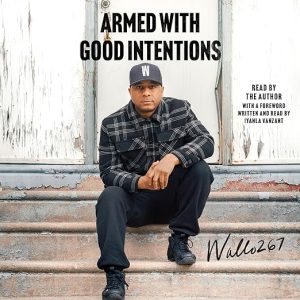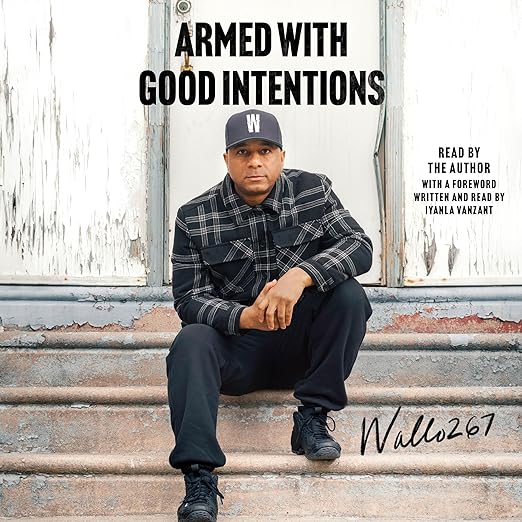
Nineteen to fifty-two years was the sentence a young armed robbery charge earned Wallace 'Wallo267' Peeples, and this audiobook is the account of how twenty of those years, and the choices made inside them, became the foundation for a life he once seemed locked out of entirely. Named after a father who disappeared when he was two, Wallo grew up in North Philadelphia with his mother, brothers, and grandmother, cycling through juvenile detention centers where school psychologists and counselors labeled him 'criminal-minded' well before his eventual arrest. Wallo narrates his own memoir, tracing the path from that label through prison and back out into a life built around entrepreneurship and motivational speaking that has since reached millions of followers. Deion 'Coach Prime' Sanders calls it a memoir 'that everyone can glean wisdom from.' That is a claim the book's four hour and fifty-seven minute runtime sets out to earn quickly rather than slowly.
Wallo narrating his own story is close to non-negotiable for a memoir built this specifically around personal transformation, since the credibility of the whole project rests on hearing the man himself describe reckoning with his own choices rather than having someone else perform that reckoning for him. Reviewer Mocha calls it 'amazing' and describes a genuinely striking use case: buying the book for an incarcerated nephew, who 'enjoys it as well' and finds 'great learning lessons' in it while still serving his own sentence, which says something about how directly this memoir speaks to listeners currently living through what Wallo already survived. Reviewer MeliB praises how 'Wallo teaches us that you have to persevere and remain open to learning and evolving.' That lesson comes through, in her words, via 'his life story, which he tells in a raw and emotional way.' Erika Ayers Badan, CEO of Food52, calls the book 'full of energy, hard learned lessons, and no BS advice,' adding that it is 'a must for anyone who wants to take a chance to bring their best to the world.' Wallo's memoir sits in a specific and fast-growing lane, the social-media-creator memoir, written by someone whose platform was built entirely after release rather than before incarceration, which gives Armed with Good Intentions a different shape than either a traditional celebrity memoir or a straightforward prison narrative written by someone who found fame first and told their story after. North Philadelphia is not just a backdrop here; Wallo returns to specific streets, relationships, and community dynamics throughout as the actual texture of his early life, grounding the more abstract 'criminal-minded' label the book opens with in a specific, lived place rather than a generic account of urban poverty.
The Strengths
The through-line of this memoir, from a father's disappearance to a 'criminal-minded' label to two decades inside to viral motivational success, gives Wallo's story a shape that avoids the redemption-arc shortcuts a less honest memoir might reach for; he specifically frames the book around reckoning with the choices that put him in prison rather than simply narrating what happened to him. Wallo's rise after release is genuinely striking on its own terms: over sixty thousand Instagram followers gained on his first day of freedom, built into a career as entrepreneur and motivational speaker without softening the specifics of what came before it. The book's title, drawn from his own vow to arm himself with only good intentions upon release, functions as more than a marketing hook; it is the organizing idea the whole memoir works to earn across its relatively short runtime, connecting a prison-yard philosophy to the concrete choices Wallo made once he was actually free to test it. Listeners who gravitate toward business and entrepreneurship content will find real overlap here too, since Wallo frames his post-release success not as luck but as the direct application of discipline and networking instincts he sharpened, out of necessity, while still incarcerated, a throughline that gives the memoir practical relevance beyond its emotional core. The memoir's structure mirrors its title's own logic: extensive time spent on the choices, and the specific pressures, that led to the armed robbery charge, followed by a comparatively shorter but pointed section on the reckoning itself, before the book pivots fully toward the post-release chapters most listeners are probably picking this up for in the first place. That proportion, more time spent on causes than on the eventual triumph, is a meaningful choice that keeps the book from feeling like it is rushing past the hardest material just to get to the inspiring part.
What to Watch For in Armed with Good Intentions
Anyone allergic to motivational-speaker cadence should brace for it here, since Wallo's public persona as a viral content creator and speaker shapes the delivery throughout, direct, energetic, built for quotable takeaways rather than literary restraint. At under five hours, this moves quickly through twenty years of incarceration, which means some of the harder, more granular texture of prison life gets compressed in service of the larger redemption arc rather than explored in full detail. Listeners looking for a slow, reflective memoir in the vein of more literary prison narratives should know this leans toward the energetic, direct register that made Wallo's social media following in the first place, not toward quiet introspection. The book's positive framing throughout, informed by its motivational-speaking context, means listeners wanting a harder, more critical look at the systems that produced his 'criminal-minded' label in the first place will find that critique present but secondary to the personal transformation story. The specific mix of public figures endorsing this memoir, a well-known athlete-turned-coach alongside a media-company CEO, signals how deliberately Wallo's story has been positioned to cross over from a narrower urban-memoir audience into broader business and mainstream motivational spaces, worth knowing if you came to this expecting a smaller niche audience instead.
Recommended For
Second-chance stories find a natural home with listeners drawn to memoirs about incarceration, reinvention, and family legacy, and Wallo's specific arc, from a father's disappearance through prison to viral success, gives this one real specificity beyond the genre's familiar beats. Fans of motivational content creators, the audience that already made Wallo's Instagram following what it is, will find his speaking voice translates naturally to long-form audio without losing the energy that built his platform. Reviewer Mocha's example of gifting this to an incarcerated family member points toward a genuinely valuable use case: listeners currently inside the system, or with family members who are, may find this lands differently and more usefully than for casual listeners. Anyone wanting a slower, more critical examination of the systems Wallo moved through, rather than a personal transformation story centered on individual choice, should treat this as a starting point rather than the full picture.