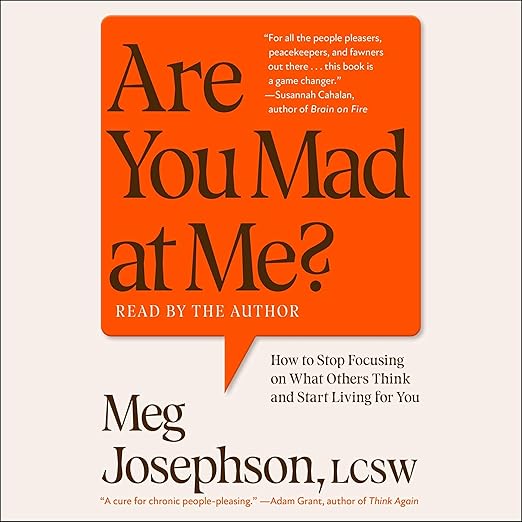
Chronic people-pleasing gets reframed as a nervous system response, not a character flaw, within the first chapter of Are You Mad at Me?, and that reframing is the whole engine of Meg Josephson's audiobook. Josephson, a psychotherapist known online for exactly this kind of clear, compassionate breakdown, narrates the book herself, including a guided mindfulness meditation folded into the material. Is the anxious scan you run after every text message, every group conversation, every mildly awkward silence actually protecting you from something, or has it just outlived whatever it was originally protecting you from? That is the question Josephson spends the book answering, moving through roles she names directly: the peacekeeper, the caretaker, the perfectionist, the chameleon, each a variation on the same underlying fawning response.
Josephson Builds Leaning Back Into a Concrete Skill
Josephson resists the two easy failure modes of this genre: she does not tell listeners to simply stop caring what others think, and she does not treat every instance of accommodating someone else as a symptom to eliminate. Instead, the book teaches a genuinely useful distinction between fawning that is situationally necessary, managing a chaotic boss, for instance, and fawning that has outlived its purpose with people who actually deserve honesty, like a close friend. The practice she calls 'leaning back' in relationships gets built out as a concrete skill rather than a vague suggestion to set better boundaries.
Chris K.'s review praises the book's multiple insights into boundaries, conflict avoidance, and the specific caretaker role many listeners recognize in themselves, and that range is accurate: this is not a single-idea book stretched to full length. Tucker Mackenzie's review makes a sharper point, that the title alone triggers a jolt of self-recognition before a listener has even started the first chapter, which speaks to how precisely Josephson has named a feeling most people have never had specific language for.
Christie Tate's blurb promises 'explanations, comfort, and best of all, solutions,' and that three-part structure is a fair description of how the book actually moves: naming the problem clearly, sitting with how it feels before rushing to fix it, then finally handing over tools a listener can use. Adam Grant's framing of the book as a 'cure for chronic people-pleasing' sets a high bar, but Josephson's case stories give that claim real specificity rather than leaving it as jacket-copy hyperbole.
A Title Built From a Question Everyone Silently Asks
Josephson also resists the temptation to pathologize every accommodating behavior, which keeps the book from tipping into the opposite extreme of treating basic kindness or compromise as evidence of dysfunction. That balance, validating real survival strategies while still pushing listeners toward change, is harder to strike than either extreme alone, and it is where the book's clinical background shows most clearly, informed by years of sitting across from clients working through the exact same tension in real time.
The book's title works as a piece of craft in its own right, since Josephson builds an entire framework out of a question most listeners have silently asked themselves at some point without ever naming it directly. That specificity, starting from a real, recognizable internal sentence rather than a clinical term, is likely part of why the book found such a wide readership beyond people who would normally pick up a book about trauma responses.
Parked in the Lot Just to Keep Listening
Self-narration works as a genuine asset here rather than a budget default. Josephson is a practicing therapist with an established public voice, and Publishers Weekly's blurb praising her 'lucid prose and smart mix of clinical expertise, personal disclosure' describes exactly what her own narration delivers: clinical authority and personal vulnerability from the same voice, in the same breath, without a hired narrator having to imitate either quality secondhand.
Shelly Hiddleson's review describes listening in the car and staying parked in lots just to keep going, an ordinary, specific detail that says more about the book's grip than a general recommendation would. The built-in guided meditation adds something a text-only edition cannot replicate at all, giving listeners a practical tool embedded directly in the same voice that spent the previous chapters building trust.
An instant New York Times bestseller status paired with a 4.6 rating across more than 600 ratings signals a book that has already found a wide, sustained audience rather than a brief viral moment. That combination of critical and popular reception is relatively rare in the self-help category, where bestseller status and consistently strong listener ratings do not always move together.
A Rapid-Fire Quiz Before Any Theory Arrives
The book's structure around named roles, peacekeeper, performer, caretaker, lone wolf, gives it an organized, almost diagnostic clarity that works well for reference and revisiting specific sections, but listeners expecting a continuous memoir-style narrative should adjust expectations. This reads more like a categorized toolkit built from case stories than a single unbroken personal account, which serves the book's usefulness without necessarily maximizing its emotional momentum from chapter to chapter.
With over 600 ratings, this book sits in a crowded, active corner of the self-help market, and listeners who have already worked through other trauma-informed people-pleasing material may recognize some underlying concepts. What still sets it apart is the specificity of Josephson's own case stories and the guided meditation, neither of which a more generic entry in this niche would offer.
The book opens with a rapid-fire list of self-diagnostic questions, are you constantly worried what people think, always overextending yourself, prone to over-apologizing, before Josephson ever explains the underlying theory. That quiz-like structure is an effective hook for pulling a listener in quickly, though it also means the first stretch of the audiobook reads more like a checklist than a traditional narrative opening, which listeners expecting a slower memoir-style start should anticipate.
Eldest Daughters and Chronic Overachievers Recognize Themselves Here
Anyone who overanalyzes a period instead of an exclamation point, silences their own needs to keep a room comfortable, or apologizes reflexively before finishing a sentence is the direct, named audience here. Eldest daughters, chronic overachievers, and anyone who has been called too sensitive for wanting reassurance will recognize themselves specifically rather than generically.
The book also speaks directly to listeners navigating specific relationship contexts the synopsis names outright: a chaotic boss, a demanding family member, a friendship that has quietly become one-sided. Josephson's distinction between necessary and unnecessary fawning gives listeners a genuinely portable filter to carry into those exact situations rather than a single, general principle to apply loosely across every relationship, one they can return to the next time a difficult dynamic resurfaces.
Readers already fluent in trauma-informed therapy language, or currently working through similar material in actual clinical treatment, may find some of this terrain familiar rather than revelatory, though Josephson's specific case stories and her own guided meditation still offer something a general overview would not. For anyone newer to this framework entirely, the accessibility here is a genuine strength rather than a compromise.
Key Details
- Performance: Meg Josephson narrates her own material with the clarity and warmth that built her social media following, including a guided meditation only she could deliver with this much authenticity.
- What it covers: People-pleasing, fawning as a trauma response, boundary-setting
- Feel: Compassionate and validating
- Our call: An accessible, well-earned bestseller for anyone who overanalyzes a one-word text message, delivered with real clinical grounding.