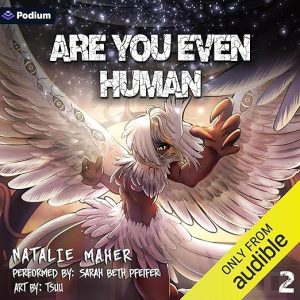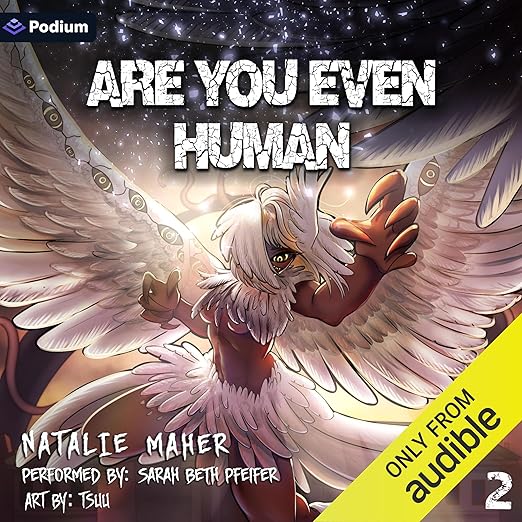
Julietta's situation at the end of Volume 1 was already untenable. Volume 2 makes it considerably worse, and that escalation is precisely what Natalie Maher's series has been building toward. Are You Even Human: Volume 2 picks up with Julietta stuck in boot camp - a detail that might sound mundane for a superhero narrative, but which Maher uses to examine something most invasion stories skip past entirely: how institutions shape and deform the people who pass through them. This audiobook, narrated by Sarah Beth Pfeifer, runs nearly 28 hours and delivers a second installment that takes the series' moral questions seriously.
The structural move that makes Volume 2 work is the language. As Julietta begins to understand the alien tongue, the war she has been fighting starts to look different. The colony occupying St. Louis is no longer an abstraction of threat; it becomes something she can interrogate. Maher is clearly interested in the question the series title poses not as science fiction shorthand but as genuine ethical inquiry. Who qualifies as human? Does the answer change when survival is at stake? The aliens-as-mirror device is not new in the genre, but Maher executes it with enough specificity in the alien culture - reviewers have singled out the worldbuilding as genuinely fascinating rather than decorative - that it avoids the obvious allegory traps.
Boot Camp Slows Down to Build Real Stakes
The boot camp section is longer than you might expect for a book this plot-dense, and some listeners who came in expecting a faster pace from Volume 1 may need to adjust. But Maher is doing structural work there - establishing team dynamics and the institutional texture of wartime training - that the later sequences depend on. By the time Julietta is thrust into the battle for St. Louis, the reader has a granular enough understanding of her allies and rivals that the stakes feel genuinely personal rather than cosmically generalized.
One reviewer described the series as nearly impossible to put down, and that experience is largely attributable to Maher's pacing, which compresses and expands in interesting ways. The alien culture chapters slow the momentum deliberately, letting you sit in Julietta's confusion before the next action sequence fires. This rhythm rewards attentive listening, which is why the audiobook format - where you cannot easily skim - may actually be the ideal entry point for this series. Pfeifer's narration keeps the tonal shifts coherent across what is, ultimately, a very long listen. Another reviewer praised the shapeshifting characterization as the best they had encountered in fiction, and that element is given considerably more structural weight in Volume 2 than in the opening installment, with Julietta's ability becoming entangled in questions of identity and allegiance that have no clean resolution.
Sarah Beth Pfeifer Differentiates a Huge Cast
The shapeshifting elements, mentioned in reviews as among the most distinctive aspects of the series, are handled with more complexity in Volume 2 than in Volume 1. Julietta's abilities are no longer simply a power set to be deployed; they intersect with her questions about identity and belonging in ways that feel thematically integrated. A reviewer who identified as wholly consumed by the series noted that no paragraph feels wasted in Maher's writing, which is a remarkable claim for a 28-hour listen and one that holds up across the major set pieces.
Pfeifer's performance is worth noting specifically in the boot camp sequences, where she differentiates a large cast of trainees clearly enough that the listener maintains orientation without needing to consult a character list. Her handling of Julietta's internal monologue - which carries much of the philosophical weight of the series - is restrained enough to avoid melodrama while still making the emotional beats land. For a volume this long, that consistency is not a given, and it elevates the listening experience above what the source material alone would achieve with a less capable narrator.
Learning the Enemy's Language Becomes Its Own Threat
The scene where Julietta's language acquisition tips from useful tool to something more dangerous to her own sense of self is the emotional fulcrum of the volume. It arrives somewhat quietly amid a lot of action plotting, and it is easy to let it slide past in the momentum of the St. Louis sequence. Pay attention to it. Maher is laying groundwork for a question that the series has been circling: whether understanding your enemy is itself a form of transformation, and whether transformation constitutes a threat to the people on your own side.
Also watch for the family thread. Julietta's motivation throughout both volumes is explicitly about keeping her family safe, but Volume 2 begins complicating what safety means when the institutions ostensibly designed to provide it may be the greater danger. The final positioning of that question - alien invaders versus humanity itself - is stated directly in the synopsis and delivers with considerably more earned weight by the time the volume closes.
Volume 1 Readers Get the Payoff Here
This audiobook is squarely for listeners who completed Volume 1 - it is not a standalone, and attempting it without the first installment will undermine both the plot and the thematic accumulation. Listeners who love science fiction that takes alien cultures seriously, who want their invasion narratives to complicate rather than validate human institutions, and who can commit to a long listen with deliberate pacing will find a lot to reward them here. Readers expecting a faster-moving YA action audiobook may find the ethical interiority more demanding than they wanted.
In Brief
- Narrator: Sarah Beth Pfeifer sustains Julietta's voice across nearly 28 hours with enough vocal range to handle both the boot camp sequences and the more introspective alien-language passages convincingly.
- Subjects: alien invasion, identity and loyalty, the ethics of war
- Tone: Propulsive and morally unsettled
- Bottom line: A strong second volume that deepens the series' central question - and lands it harder than the first.