
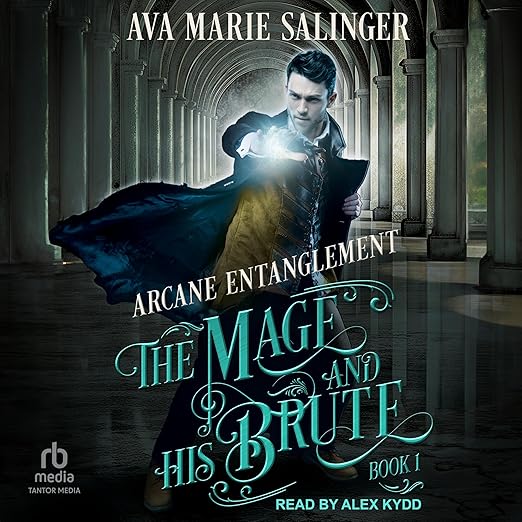
I have been working through a number of MM fantasy releases recently, trying to get a sense of how the subgenre is evolving, and Arcane Entanglement caught my attention partly because of its setting. Alternate Victorian London with a functioning magical class system is a premise that has been used before, but Ava Marie Salinger commits to the politics of it in ways that go beyond decoration. I listened to the first few chapters on a rainy afternoon, fully intending to take notes and maintain critical distance, and found myself four chapters in before I remembered I was supposed to be working.
The premise is layered from the start. Duke Evander Ravenwood presents as old money aristocracy but is secretly an Archmage of unusual power, which in this world's hierarchy creates a very specific kind of vulnerability. His world intersects with Viggo Stonewall, who runs Nightshade, an underground information guild, following a brutal murder that neither man expected to find himself entangled in.
A Closer Look at Arcane Entanglement
What Salinger does particularly well is the class architecture. Magic in this London divides society into haves and have-nots in ways that mirror Victorian economic stratification closely enough to feel meaningful rather than arbitrary. The thralls, the oppressed class in this system, exist not as background flavor but as a political pressure that drives both the investigation and the central relationship. Reviewer Alexandria Quist noted this is heavier thematically than Salinger's Fallen Messengers series, with more classism and discrimination as active concerns, and I agree that this gives Arcane Entanglement more structural weight.
The slow burn between Evander and Viggo is genuinely slow. These are two men whose social positions require opacity, and Salinger uses that constraint productively rather than as an excuse for stalling. The tension builds from situation and circumstance rather than from manufactured misunderstandings, which is a much more satisfying engine.
What Makes Arcane Entanglement Worth Hearing
Alex Kydd's narration is a meaningful part of why this works as an audiobook specifically. Victorian settings demand a certain vocal register to feel authentic rather than theatrical, and Kydd finds the right balance. Evander's careful aristocratic diction is distinct from how Kydd voices Viggo, whose background on the information guild's underside comes through in smaller verbal textures. For a book where social positioning matters as much as it does here, that kind of character differentiation in narration is not incidental, it is structural.
At ten hours and forty-three minutes, this is a substantial listen for a first-in-series title, and it earns the length. The mystery investigation runs parallel to the relationship development without either feeling like a subplot to the other. They converge in ways that feel architecturally deliberate by the final third.
Things to Know Before Starting Arcane Entanglement
Reviewer Sergio, a gay male reader whose first language is not English, raised a pointed critique about the handling of the main intimate scene, noting it fell flat relative to the surrounding material. He gave the book four stars overall and praised the writing elsewhere, so this is not a dealbreaker, but it is worth flagging for readers who approach MM romance with particular investment in those scenes.
This is book one of The Mage and His Brute series. The mystery is resolved by the end, but the broader conspiracy and the relationship arc clearly continue. First-in-series readers who need full closure in a single volume should know what they are committing to, though the ending is satisfying enough not to feel truncated.
Who Should Pick Up Arcane Entanglement
This is an excellent choice for MM fantasy readers who want their romance embedded in genuine political worldbuilding rather than serving as the primary plot. It will also appeal to readers of alternate history who enjoy the Victorian period and want something with more queer representation than the genre traditionally offers. Readers seeking primarily explicit content with fast-building romance should know the slow burn here is a feature of the construction, not a phase before things accelerate. Anyone who has read Salinger's Fallen Messengers series will find this a more ambitious and thematically textured entry point into her catalog.
Key Details
- Read by: Alex Kydd brings a composed Victorian register that suits Evander's restrained aristocratic exterior while still finding warmth in the slower romantic scenes.
- At its heart: Class and power in a magical hierarchy, forbidden desire across social divides, conspiracy and identity
- Vibe: Atmospheric and propulsive, like gaslit streets with something dangerous moving through them
- Short version: A confident opening to an MM fantasy series that delivers on worldbuilding and slow-burn chemistry, with a narrator whose performance elevates both.
Before You Listen
Do you need to have read Ava Marie Salinger's Fallen Messengers series before starting Arcane Entanglement?
No. This is the first book of an entirely separate series, The Mage and His Brute, set in a different world with different characters. Prior Salinger reading enriches your sense of her style but is not required.
How much of the book is focused on the mystery investigation versus the romance between Evander and Viggo?
Both run roughly in parallel throughout. The murder investigation provides the structural spine while the romance develops as a consequence of their forced proximity. Neither feels subordinated to the other.
Is Alex Kydd's narration consistent with both characters, or does he favor one voice over the other?
Reviewers and the text both suggest Kydd differentiates effectively between Evander's controlled aristocratic register and Viggo's rougher edge, which is important given how much the class contrast drives the story.







