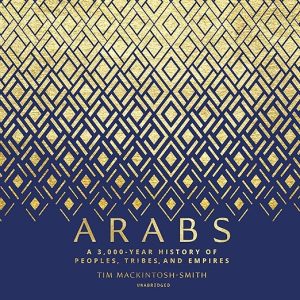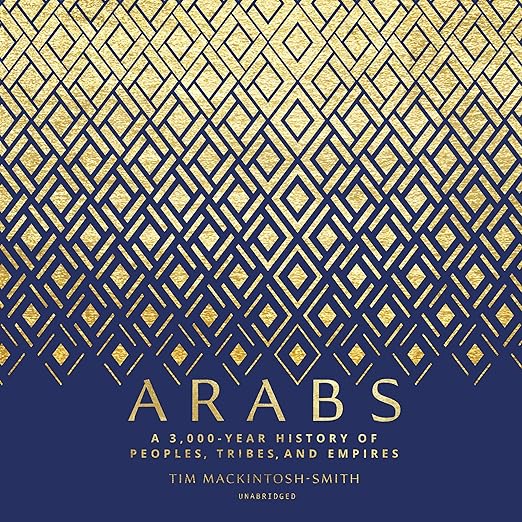
Nearly three thousand years of history unfold across this audiobook's twenty-five and a half hours, and Tim Mackintosh-Smith deliberately starts his account more than a millennium before Muhammad, tracing the Arabic language itself as the real connective thread running through Arab history rather than treating Islam as the natural starting point. That choice alone tells a listener a lot about what kind of book this is: less a religious history and more a sweeping linguistic and cultural one, tracking how a shared language held together tribes and empires scattered across vast, often hostile distances long before and long after any single unifying faith.
The Verdict, Briefly
Mackintosh-Smith is a longtime resident of Yemen and an established travel writer with real fluency in classical and colloquial Arabic, and that grounding shows in how comfortably the book moves between pre-Islamic poetry, the mechanics of how Arabic script developed, and the surprisingly fraught modern history of printing Arabic text at all. One reviewer, Amro Shawli, found the book impressively thorough without ever dragging, crediting Mackintosh-Smith with folding a very relevant past into the present so seamlessly that the whole thing reads, in their words, like 'one colorful contextually written fresco' of the region's history. That description captures something real about the book's method: it layers historical periods on top of each other rather than marching through them on a strict timeline.
The scope is genuinely enormous, tribes and empires across three millennia, and the book earns its runtime by refusing to compress the story into a tidy single narrative. A second reviewer specifically praised the coverage of the period before Muhammad, singling out the anecdote of the Battle of the Camel as a memorable detail, which lines up with the synopsis's own emphasis on beginning the story more than a thousand years earlier than most popular histories of the Arab world typically do.
Mackintosh-Smith is best known outside this book for retracing the medieval Moroccan traveler Ibn Battuta's journeys across Africa and Asia in his own travel writing, and that same instinct, tracking how movement and language shape identity across vast distances, carries directly into this project. His approach favors following language and people across borders rather than organizing the story around fixed political boundaries or single ruling dynasties, part of why the book covers such enormous geographic and temporal ground.
At this length, a narrator's stamina and consistency across dense, name-heavy nonfiction matters enormously, and Ralph Lister's steady, unhurried delivery is well suited to material that demands sustained attention rather than dramatic peaks. This is not battle-scene narration; it's closer to a patient lecture from someone who genuinely knows the subject, and that register fits a book more interested in linguistic evolution and cultural continuity than in individual dramatic set pieces.
The book is filed under a religion and spirituality category on this platform, with an attached tag referencing Islam specifically, but that framing undersells what the book actually is. Mackintosh-Smith's stated project traces Arabic identity to its pre-Islamic linguistic roots, and readers expecting a primarily theological or devotional listen should recalibrate their expectations toward cultural and political history instead, with Islam entering the story as one major chapter among many rather than as the book's central subject.
The synopsis describes the book's own structure as kaleidoscopic, and that word is doing real work: rather than a single continuous narrative thread, the book shifts focus and vantage point as it moves through centuries, sometimes lingering on a specific poet or dynasty, sometimes pulling back to trace a broader linguistic shift. That structural choice suits a story this large in scope, though it does ask a listener to trust the author's organizing logic rather than expecting strict chronological momentum throughout.
Arabic's own internal split between its formal written register and the many distinct spoken dialects across different regions, a linguistic phenomenon known as diglossia, is a detail the synopsis gestures toward directly by naming both spoken and written forms as separate threads worth tracing. That distinction matters for understanding Arab cultural unity in practice: a listener in Morocco and a listener in Iraq may struggle with each other's everyday spoken Arabic while still sharing the same formal written language, exactly the kind of tension between unity and disunity the book's closing chapters explore in a modern political context.
Things to Know Before Starting Arabs
A runtime this long is a genuine commitment, longer than most listeners will spend on any single nonfiction title this year, and the density of names, dynasties, and linguistic terminology compounds that time investment. This is not a casual introduction to Arab history for someone starting from zero; it rewards a listener who already has some framework for the region and wants to go much deeper, rather than someone looking for a broad, simplified overview.
The book's own framing, investigating how Arabic functions as a source of both unity and disunity in the politically fractured post-Arab Spring landscape, means the final stretch engages directly with contemporary politics and conflict. Listeners should be prepared for the historical narrative to arrive, eventually, at genuinely unresolved and still-contentious present-day territory, rather than closing on a comfortably distant historical note.
Arabic's spread as a written and spoken language across an enormous geographic range, from West Africa to Southeast Asia, well beyond the boundaries of any single Arab state, is one of the book's recurring throughlines, and it is a genuinely under-told story in most popular Western histories of the region. Listeners used to histories organized around empires or wars specifically may find this linguistic through-line initially unfamiliar, but it is the book's central and most distinctive argument.
A listener weighing the time commitment should also know the audiobook divides naturally into distinct historical eras rather than forcing a single unbroken narrative arc, which makes it genuinely possible to pause for extended stretches between major periods without losing the overall thread.
Who Will Get the Most From It
This is a strong pick for listeners who want serious, scholarly nonfiction about the Arab world grounded in linguistics and cultural history rather than a purely political or military account. Anyone who enjoys a long-form historical epic that treats language itself as a protagonist will find real substance here, and the near-perfect rating average across a genuinely substantial number of listeners suggests the depth pays off for its intended audience.
Listeners who enjoy nonfiction built around one clear, sustained organizing argument, in this case that language itself is the truest measure of a shared culture, rather than a loose survey of disconnected facts, will find that thesis carried consistently from the opening chapters through the modern political material at the very end.
Listeners wanting a quick primer, or specifically a devotional or theological treatment given how the platform categorizes this title, should look elsewhere; twenty-five hours of dense linguistic and political history is a serious undertaking, not a light introduction. Anyone intimidated by that runtime might sample an excerpt first to confirm the pacing suits their attention span before committing to the full audiobook.
Quick Take
- Read by: Ralph Lister's steady, unhurried delivery suits twenty-five hours of dense linguistic and cultural history.
- At its heart: Arabic language as cultural identity, pre-Islamic history, post-Arab Spring politics
- Vibe: Sweeping and scholarly
- Short version: A serious, rewarding commitment for listeners genuinely invested in Arab history beyond the religious framing its category suggests.
Frequently Asked Questions
Is this audiobook a religious or theological history despite being filed under a religion category?
No, it's primarily a linguistic and cultural history of the Arab world; Islam is one major chapter within a much longer, mostly secular historical arc.
How does Ralph Lister's narration handle a twenty-five-hour nonfiction runtime in this audiobook?
With a steady, unhurried pace suited to sustained attention rather than dramatic peaks, closer to a patient lecture than a performance.