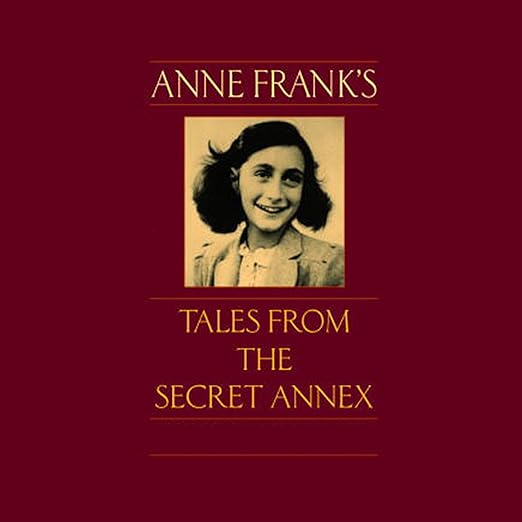
A thirteen-year-old girl hiding above a canal-side office building in Amsterdam started keeping more than just her famous diary, and this audiobook collects what else she wrote while sealed inside the Secret Annex: short stories, fables, personal reminiscences, and the opening chapters of an unfinished novel she called Cady's Life. I came to this collection already having read the diary years ago, expecting a minor supplement, and found instead a genuinely separate body of work, proof that Anne Frank was already deliberately practicing craft, not simply recording her days.
Cady's Life, Cut Short by History Itself
The publisher's key claim here is restoration: these pieces are newly translated and returned to the original order Anne herself used in her own notebook, rather than scattered by an editor's later judgment call about what belonged where. That matters more than it might sound like on paper. Hearing these stories in the sequence Anne actually wrote them gives a clearer sense of her development as a writer over time than a thematically reorganized collection would. Cady's Life, the unfinished novel included here, is the collection's most striking inclusion: an ambitious, longer fictional project from a teenager clearly testing what she could do beyond diary entries, cut short by history rather than by any loss of ambition.
Reviewer Alastair Browne calls this 'a necessary addition' to the original diary, pointing out that Anne references specific stories and fables inside her diary entries that only this companion volume actually contains. That cross-referencing detail elevates the book beyond a simple bonus release; it fills in gaps that attentive diary readers would otherwise just have to wonder about. The short stories and fables themselves range in tone from whimsical to melancholic, and hearing them read aloud makes Anne's range as a young writer more immediately apparent than it might be flipping between chapters on the page.
The collection itself spans several genuinely different literary forms rather than being one consistent type of writing, fables with clear moral shapes, short stories with more developed characters and situations, personal reminiscences closer to the diary's own register, and the sustained fictional ambition of Cady's Life. Hearing that range performed aloud makes Anne's versatility as a young writer more apparent than reading silently might, since a narrator has to shift technique across forms in a way that's harder to notice on the page. That variety also means the collection rewards more than one sitting; the tonal range from piece to piece is wide enough that listening straight through in one long session risks flattening distinctions worth sitting with individually.
Kathe Mazur Reads the Stories as Stories First
Kathe Mazur's narration favors restraint over dramatization, which is exactly the right instinct for this material. An obvious temptation exists with any Anne Frank material to lean into pathos, given what listeners already know about how her story ends, but overplaying that would work against these particular pieces, most of which are ordinary teenage fiction and fable-writing rather than direct reflections on the war. Mazur reads the stories as stories first, trusting listeners to carry the surrounding historical weight themselves rather than underlining it constantly through vocal performance.
The multi-generational reach reviewers describe is worth noting on its own. Karen P bought this for her daughter after it turned up on a school reading list, and describes the personal stories resonating enough to spark 'a growing interest' in more historical fiction generally. Robyn describes a similar pattern from the other direction, having read Anne Frank's work as a child herself and now watching her own kids discover it. That kind of intergenerational handoff is unusually common for Anne Frank's writing specifically, and this expanded collection gives families another entry point into that same tradition beyond the diary alone.
Real value exists, distinct from the diary's own value, in encountering a historical figure's other writing, material produced without the specific self-awareness of keeping an official, eventually-public record. Whatever additional purpose Anne may have had in mind for her diary, these stories and fables read as more purely creative exercises, written for their own sake rather than as testimony. That distinction matters for how listeners should approach the collection: less as additional historical evidence and more as a window into what a genuinely talented young writer chose to create when she was, in a sense, just practicing craft for its own reward.
This Collection Is Not the Diary Itself
The most important thing to clarify before listening: this is not the diary. Listeners expecting Anne's day-to-day account of hiding from the Nazis should look for The Diary of a Young Girl specifically; this collection is fiction, fables, and personal reminiscences written alongside that diary, plus the incomplete Cady's Life. Because Cady's Life was never finished, that portion ends mid-development rather than resolving, which can read as an abrupt stopping point rather than a proper ending. That's not a flaw in this production, it's simply the honest state of the actual historical material, but it's worth knowing before starting so the ending doesn't feel like a production error.
Given the real historical context surrounding every word of this collection, a young author killed in the Holocaust before she reached sixteen, even the lighter, more whimsical fables carry unavoidable weight for adult listeners aware of the ending. That's not a criticism of the audiobook itself, but it does mean this isn't purely light listening despite some individual pieces having a genuinely playful tone. Parents choosing this for a younger listener based on the school-reading-list angle Karen P mentions should be ready to talk through that surrounding context rather than assuming the stories stand entirely alone.
A Companion Rather Than an Introduction
Anyone who has already read The Diary of a Young Girl and wants a fuller picture of Anne Frank as a developing writer is the clearest audience, and that includes both the students Karen P describes finding this through school and adult listeners returning to the material after years away, the pattern Robyn describes in her own family. History-minded listeners specifically interested in primary-source writing from the period, not just secondary accounts of it, will also find real value in hearing these pieces performed rather than read silently.
First-time Anne Frank readers looking for a starting point should begin with the original diary instead, since this collection assumes at least passing familiarity with her story and works best as a companion rather than an introduction. Listeners wanting a complete, polished novel from the Cady's Life material specifically should also adjust expectations, since history, not editorial choice, is what left it unfinished.
- Performance: Kathe Mazur reads with restraint rather than dramatization, letting these lesser-known pieces stand as youthful fiction rather than over-signaling their historical weight.
- What it covers: youthful creative ambition, WWII history, coming of age in hiding
- Feel: Reflective and quietly poignant, more tender than heavy
- Our call: A worthwhile companion to the diary for listeners who already know Anne Frank's story, not the place to start cold.
Before You Listen
Is this Anne Frank audiobook the same as The Diary of a Young Girl?
No, this is a separate collection of Anne Frank's short stories, fables, and an unfinished novel, meant as a companion to the diary rather than a replacement for it.
Does the Anne Frank audiobook include a complete story in Cady's Life?
No, Cady's Life was left unfinished when Anne Frank died, so that portion of the audiobook ends mid-development rather than reaching a resolution.
Is this Anne Frank audiobook appropriate for a school-age listener?
Many reviewers describe using it that way, including for a school reading list, though the surrounding historical context still calls for some adult guidance around the material.