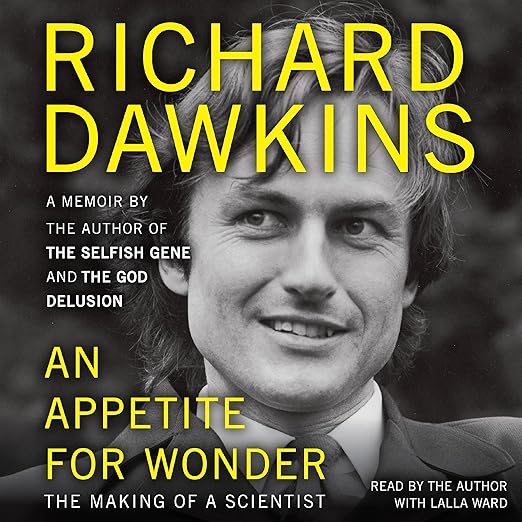
Before You Press Play
- Narrator: Dawkins reading his own memoir is the correct choice, his delivery carrying the rhythms of someone who has spent decades translating science into language, and his dry humor lands better in his own voice.
- Subjects: the formation of a scientific mind in colonial Africa, intellectual inheritance and chosen belief, the slow crystallization of evolutionary thinking
- Tone: Reflective and warmly nostalgic in the first half, increasingly brisk as it approaches his academic career
- Bottom line: A memoir worth hearing for Dawkins's early life and the development of his scientific sensibility, though listeners expecting deep coverage of The Selfish Gene's genesis will find the ending abrupt.
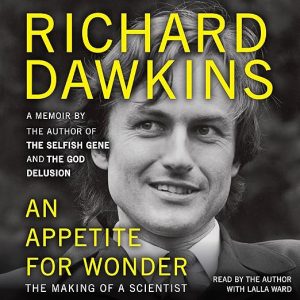
I came to An Appetite for Wonder the week after finishing The Selfish Gene for the second time, looking for the texture of the man behind the argument. Richard Dawkins is a figure who generates strong reactions: admiration, irritation, and occasionally both simultaneously in the same reader. His memoir, covering the first half of his life up through the publication of The Selfish Gene, is a more intimate document than anything in his scientific or polemical bibliography. It is a different kind of listening experience, and it surprised me in ways I did not entirely anticipate going in.
The title announces its subject clearly: wonder, specifically the appetite for it that Dawkins treats as foundational to both scientific inquiry and his own psychological formation from childhood. The NPR review quoted on the book's cover calls it a marvelous love letter to science, and that framing is accurate. It is also, beneath the science, a love letter to a very specific kind of childhood in a very specific colonial moment, and the texture of that time and place is where the memoir is most alive.
Nairobi Childhood Memories Outshine the Rest
Dawkins was born in Nairobi and grew up moving through what were then the remnants of British colonial Africa before returning to England for school. That early period is the most vivid part of the memoir, and reviewer Idonthaveaname, who found the book good but not great overall, praised the Africa memories specifically as fascinating and detailed in ways the later sections are not. There is a quality to Dawkins's recollection of landscape and early intellectual curiosity that is genuinely affecting. He is not a memoirist by temperament, but when he writes about specific sensory experiences and the early encounters with the natural world that generated his scientific instinct, the prose becomes something other than argument.
The book's chapter titles referenced by reviewer Book Shark give a sense of the scope: Genes and pith helmets, Camp followers in Kenya, The land of the lake, Eagle in the mountains. These are not the titles of a conventional scientific memoir. They are the titles of a childhood that understood itself as living at the edge of something, geographically and historically, and that carried that edge perception into the laboratory and the lecture hall later. The transition through English boarding schools is handled with the dry, slightly detached humor that characterizes Dawkins at his best. He is analytical about institutions rather than either bitter or nostalgic, which is the only mode he really has, and it works for the material.
Oxford Years Feel Rushed and Compressed
The most substantial criticism of the book, and it is a fair one, is that it spends inadequate time on the intellectual development that produced Dawkins's atheism and his particular approach to evolutionary biology as a worldview rather than a discipline. Reviewer Idonthaveaname found that the shift in his worldview was covered too quickly given how central that development was to the rest of his life. This is a real structural problem, and one that is difficult to argue against.
The memoir's first half earns its detail and its pace. The second half, covering Oxford, his academic formation, and the specific intellectual encounters that crystallized his thinking, feels compressed in ways that leave listeners who came for that material wanting significantly more. Dawkins treats his own most important intellectual contribution, the publication of The Selfish Gene, as an endpoint for this volume rather than as something to explore in development. For listeners whose primary interest is in Dawkins as a scientist and public intellectual rather than as a colonial childhood, the truncation is genuinely frustrating.
Reviewer Book Shark provided a detailed account of what is covered chapter by chapter, and the coverage of the college years and the transition into academic life is thinner than the Africa sections by a meaningful margin. Whether this reflects the limits of memoir as a form when applied to intellectual development, or a deliberate structural choice to save that material for a second volume, is not entirely clear from the text. What is clear is that the book as it stands is a memoir of formation rather than of achievement, and listeners should approach it with that understanding.
Dawkins' Narration of His Own Compact Memoir
The decision to have Dawkins narrate his own memoir is the right one without reservation. His reading voice is distinctive: measured, occasionally self-deprecating, with the rhythms of someone who has given countless lectures and learned exactly where emphasis falls to serve an argument. The dry humor in the prose lands better in his own delivery because he understands its timing. He also reads the Africa memories with a quality of genuine recall that is audible, a different quality from his more argumentative or explanatory mode, and that difference adds texture the material could not receive from a professional narrator working from the page alone.
At under eight hours, this is a compact memoir. For a figure with as rich and contentious an intellectual biography as Dawkins, that compactness means choices were made about coverage. The choices favor early formation over later achievement, which suits some listeners and frustrates others in ways that are entirely predictable once you know what the book covers.
Stops Before the Atheism Story Gets Interesting
Ideal for listeners who find Dawkins's early life and the formation of his scientific sensibility genuinely interesting as a biographical subject, and for those who want to understand the experiences that preceded The Selfish Gene before or after reading it. Also a good listen for anyone who wants to hear a public intellectual in reflective rather than polemical mode. Skip it if you want deep engagement with his atheistic worldview or a full account of how The Selfish Gene was researched and written. This memoir stops just at the moment those questions become most interesting.
Before You Listen
Does An Appetite for Wonder cover Dawkins's public debates about atheism and religion?
Only in outline. The memoir covers his life up to the publication of The Selfish Gene in 1976, which predates his emergence as a prominent public atheist. His shift toward atheism is mentioned but not explored in depth. Multiple reviewers found this the book's most significant disappointment given how central that development is to his later identity and public role.
Is this a good starting point for listeners unfamiliar with Dawkins's scientific work?
Yes, with a caveat. The memoir is accessible to listeners who have not read The Selfish Gene or his other books since it is a personal rather than scientific document. However, the ending assumes some familiarity with what The Selfish Gene represented as an achievement in evolutionary biology, so basic context about the field's landscape in the 1970s would enrich the experience.
Why does Dawkins narrate his own memoir rather than using a professional narrator?
Self-narration was clearly the right choice. Dawkins has spent decades translating complex ideas into accessible language for live audiences, and his delivery reflects that experience. His dry humor and the genuine warmth in his Africa memories both benefit from his own voice rather than a proxy's interpretation. Reviewer Book Shark found the book enjoyable and heartfelt, which Dawkins's reading voice actively supports.
Is An Appetite for Wonder available as a free audiobook?
Yes. An Appetite for Wonder is available as a free audiobook for eligible Audible subscribers. At under eight hours it is an easy addition for listeners curious about Dawkins's early life without committing a full credit to a longer or more demanding book.