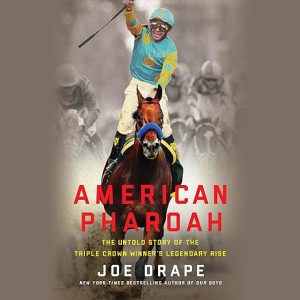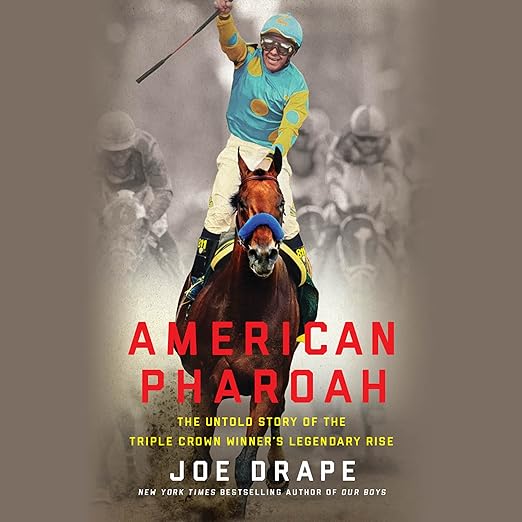
I came to American Pharoah knowing almost nothing about horse racing. I knew the name, vaguely recalled some excitement around the 2015 Belmont Stakes, and had a general sense that the Triple Crown was a big deal. What I didn't expect was to spend a Saturday afternoon completely absorbed in this story, the horse barely visible at the center, surrounded by a cast of obsessives, dreamers, and hard-luck survivors who'd spent years building toward something most of them half-believed would never come.
Joe Drape is an award-winning sportswriter for the New York Times, and that pedigree shows. He understands that great sports writing is always about more than the sport, it's about what people want and why they keep showing up even when it costs them. American Pharoah, the first Triple Crown winner since Affirmed in 1978, is his subject, but the book is really about the ecosystem around the horse: the Hall of Fame trainer Bob Baffert, the jockey Victor Espinoza with his history of heartbreaking near-misses, and the flamboyant owner Ahmed Zayat navigating financial pressures behind the scenes.
A Closer Look at American Pharoah
What makes this audiobook work is Drape's restraint. He doesn't inflate the horse into mythology, he lets the facts do that work. The account of how American Pharoah physically moved, how he responded to competition, how his groom tended to him through the long campaign from the Kentucky Derby through the Belmont, is rendered with specific, patient detail. Reviewer John Duffy compared it to reading about "a superhero in equine form," and that's close, but what Drape actually delivers is something more grounded: a great horse and the fallible humans who helped him become one.
What Makes American Pharoah Worth Hearing
One review compared this favorably to Bill Nack's Secretariat, one of the gold standards of horse racing literature. That's high company, and I'd say American Pharoah earns the comparison in spirit if not always in execution. Drape's background reporting, the extensive interviews, the behind-the-scenes access, gives the audiobook texture and credibility. Aaron Abano's narration carries the racing sequences with real momentum; the Belmont Stakes chapter in particular benefits from his ability to modulate pace and let the tension build. At just over eight hours, the audiobook moves quickly, which suits its subject.
Things to Know Before Starting American Pharoah
One critic noted, fairly, that the book was written quickly and the editing shows in places. There are structural lurches and some passages where the writing at column length doesn't fully expand into book-length form. A reviewer who follows Del Mar closely flagged a factual error about that track. These are real flaws, though they don't fundamentally undermine what the book is doing. If you're coming to this as a scholar of racing history, you may notice gaps. If you're coming as a reader who wants to understand what it meant for a great horse and his team to break a 37-year drought, those gaps matter less.
Who It's For
Ideal for sports fans who like their coverage deep and human, not just statistical. You don't need to know a fetlock from a furlong to get something real from this. Drape writes for the Times's general sports readership, not for racing insiders, and Abano's narration calibrates to that same accessible register. If you followed the Triple Crown run in 2015 and want the full story behind it, this delivers. If you've never thought much about horse racing but enjoy reading about what it takes to produce rare sporting excellence, this is a strong entry point.
The audiobook's eight-and-a-half-hour runtime is well-suited to a single long listening session, a road trip, a long weekend of yard work, a transatlantic flight. It doesn't demand the kind of fragmented attention that complex nonfiction requires. It wants to be followed in sequence, and the structure of the Triple Crown itself, three races, three escalating pressure points, gives the narrative a natural shape that audio suits well.
Key Details
- Narration: Aaron Abano brings a warm, sports-broadcast fluency to the material that fits the racing world's cadence without tipping into sentimentality.
- Themes: sporting greatness, the human machinery behind a champion, legacy and luck
- Mood: Propulsive and nostalgic, with real emotional weight
- Verdict: A portrait of a rare athletic moment told with the depth the story deserves, horse racing fan or not.