In Brief
- Voice: Seth Wickersham reads his own reporting, which keeps the boundary between a source's words and the reporter's conclusions distinct across thirteen hours.
- Big ideas: The quarterback lifecycle, the cost of early selection, mythology against the men inside it, ambition and its aftermath.
- Atmosphere: Reported, humane, and quieter than the subject implies.
- Worth it?: A book about the price of being chosen early, where football supplies the evidence rather than the argument.
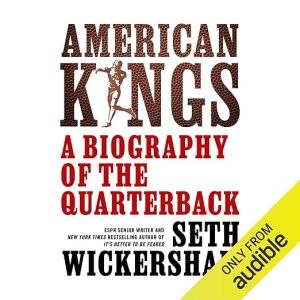
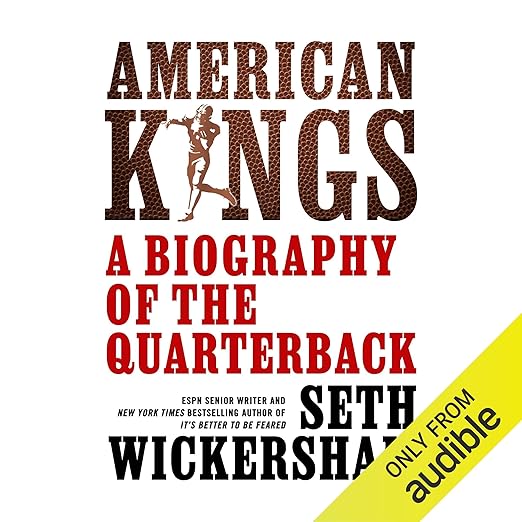
Backyard first, then Pop Warner, then a high school, then a college roster, then a draft that decides whether the previous fifteen years counted for anything. Seth Wickersham lays that pipeline out as a lifecycle, and American Kings is the audiobook of a reporter following it end to end, thirteen hours and eleven minutes, read by Wickersham himself. The subject is the quarterback, described here as the most powerful position in all of sports and the American equivalent of royalty, and the underlying argument is that this one job has become emblematic of what success in American life is supposed to look like.
What We Made of It
The structural decision that makes the book work is the choice of unit. Wickersham is not writing a history of the position or a collection of profiles; he is writing a lifecycle, following one arc through different men standing at different points along it. That lets him put Johnny Unitas and Arch Manning inside a single argument without either reading as a digression, because they are two points on the same curve. Reviewer Jbenny describes the payoff precisely, crediting Wickersham with showing 'the differences in great QBs' while attending more carefully to 'the ties that bind them as well.' The differences are what a fan already knows. The ties are what the book exists for.
The second decision is where he points the reporting. The publisher copy names the measure directly, 'measuring the distance between what the men who have done it expected and what they found.' That is a book about disappointment inside achievement, which is a considerably harder sell than a book about greatness and a considerably more interesting one. Reviewer csszrr, at four stars, identifies the same core, calling it 'a tremendously successful attempt at humanizing those who are admired or loathed like no other figures in the modern American sport landscape.' Humanizing is the operative word. The genre default is mythologizing, and the copy openly admits mythologizing is what this position usually receives.
Why American Kings Works as an Audiobook
Wickersham narrating his own reporting carries an advantage that goes past authenticity. This is an access book built on interviews with dozens of quarterbacks, and in that kind of work the line between what a source said and what the reporter concluded does constant load-bearing work. When the reporter reads it aloud, the shift between quotation and analysis stays clear in a way a hired narrator, however skilled, would have to manufacture. Across thirteen hours with dozens of voices passing through, that clarity is worth a good deal.
The roster is the other reason to give it the hours. Unitas, Elway, Peyton Manning, Warren Moon, Steve Young, and Patrick Mahomes together span the entire modern history of the position, and putting them in one book makes the changes visible rather than asserted: what the job demanded then against what it demands now, how the money arrived, how the media obligations grew, how the physical risk was reframed. Reviewer Robert R Ruch names the range as the selling point, praising the inclusion of 'insights from Hall of Famers, current players, college quarterbacks, and even high school recruited quarterbacks.' Very few sports books reach that far down the ladder.
The emotional register runs broader than the category usually allows, and two reviewers confirm it independently. csszrr describes stories that were 'engaging, touching and humorous,' three words that rarely appear together in football writing, and Jbenny singles out the on-field descriptions as a strength before his review cuts off. A book that can handle a fourth-quarter drive and a retired man's disorientation inside the same chapter is using its length properly.
What Might Not Land
The density of names is the practical hazard in audio. Dozens of quarterbacks, their coaches, their families, and their eras arrive across thirteen hours with no index, no photo insert, and no way to check who somebody was three chapters ago. A listener with deep football literacy will glide through it. A listener who knows Mahomes but not Warren Moon will lose people, and the structure, which moves between men rather than following one to the end, makes that harder rather than easier. Nothing here is unfollowable, but the roster rewards prior knowledge more than the framing suggests.
The second consideration is that part of this book is built to age. Caleb Williams and Arch Manning appear as figures still striving to be remembered, which means those passages report on unfinished careers. In five years they will read either as prescient or as a snapshot of what people believed at the time, and both outcomes are interesting, but neither matches the settled retrospection the Unitas and Elway material offers. That is a property of access journalism rather than a flaw. Buyers should simply know the book has a present tense as well as a past one.
One shelf note. This listing sits in a sports category framed around athletic achievement and competitive spirit, and that framing undersells the book substantially. American Kings is at least as much about the cost of ambition as about winning, and csszrr gestures toward a wider social argument before her review cuts off mid-word. Anyone browsing for straightforwardly motivational sports reading should know the through line runs closer to pressure, insecurity, and what happens once the applause stops.
Should You Listen to American Kings?
Football fans with any appetite for reporting beyond the box score are the obvious audience, and 333 ratings averaging 4.5 suggest a substantial one has already found it. Readers of long-form magazine journalism should look too, since the method here is profile writing scaled up rather than sports history. And I would push it toward one reader who is not a fan at all: anyone interested in what happens to people selected early for greatness and then required to live inside the selection. The football is the case study rather than the subject.
It is a weaker fit for three groups. Anyone wanting a single-player biography will find the attention deliberately divided, since nobody here gets a whole book. Fans of one franchise hoping for their own quarterback's inside story should check the roster first, because the selection favors the position's arc over any team's history. And listeners with no football vocabulary at all will spend more energy on mechanics than the human material warrants, though Wickersham explains less than a novice needs and more than a diehard wants, which is the usual compromise. For everyone else, thirteen hours read by the man who conducted the interviews is about as direct a route into this subject as the format allows.
Frequently Asked Questions
How much football knowledge does this audiobook assume?
A working familiarity helps more than the framing admits. The human material carries itself, but dozens of players across several eras arrive with no index to check, so a listener who recognizes only the current generation will lose track of people. Casual fans will manage; complete newcomers should expect to look names up.
Does the audiobook lose anything compared with print?
Two things. Any photographs are gone, which matters for a book spanning several decades of the sport, and you cannot flip back to reconfirm who a name belonged to. What audio adds is the author's own voice on his own interviews, which keeps attribution unusually clear through a book built almost entirely on access.