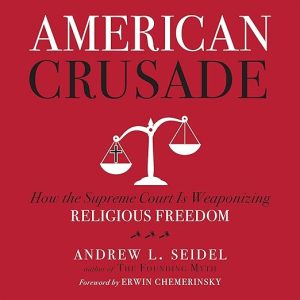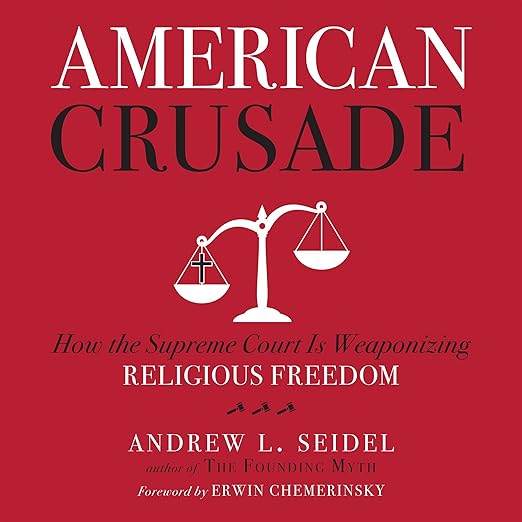
I came to American Crusade after finishing another book on the post-2016 Supreme Court, expecting overlap and redundancy. What I got instead was a fundamentally different kind of argument, one that doesn't treat religious nationalism as a recent aberration but as the product of a decades-long legal strategy executed with remarkable patience and institutional sophistication. By the third chapter, I had stopped taking my usual evening walk and was just sitting in my kitchen, listening.
Andrew Seidel wrote The Founding Myth to dismantle the claim that America was built as a Christian nation. American Crusade is its operational sequel: here's how the legal infrastructure of that myth is being constructed in real time, case by case, ruling by ruling. The two books work together, but this one can stand alone, and its focus on specific Supreme Court cases makes it considerably more concrete and verifiable than arguments built primarily around historical interpretation.
The organizing thesis, that religious freedom has been systematically converted into a mechanism for religious privilege, is not a new observation, but Seidel's contribution is the granular legal tour that gives it teeth. He walks through Masterpiece Cakeshop, Trump v. Hawaii, American Legion v. American Humanist Association, and Tandon v. Newsom with enough clarity that non-lawyers can follow the reasoning, and with enough detail that lawyers will find the analysis substantive. The section on the 40-foot cross on government land is particularly illuminating: Seidel shows how the majority opinion's logic, if applied consistently, would permit a range of religiously preferential state actions that most Americans would find troubling.
One reviewer described the experience as reading a thriller, and that's not hyperbole as a marketing claim, it's an accurate account of how Seidel structures his argument. The players, the long-term strategy, the years of patient legal maneuvering: it reads like the architecture of a very slow heist, which is, in a sense, exactly what it is. The emotional stakes escalate not through invented drama but through the accumulation of documented fact.
Seidel's Own Voice Tightens on the Worst Rulings
Seidel's self-narration is an asset here in ways that aren't always true for author-narrated nonfiction. A constitutional attorney explaining his own arguments about constitutional law carries a different weight than a professional narrator reading the same text. When Seidel's voice tightens around a particularly egregious ruling, or when he pauses fractionally before a key piece of evidence, you're hearing someone who has spent years building this case and still finds the outcome genuinely alarming. That authenticity is difficult to fake and impossible to produce in post-production.
The writing itself is lean and carefully structured. Seidel avoids the common nonfiction trap of front-loading all his best material and then coasting, the back half of the book, covering Roe v. Wade and its implications for the church-state framework, is as dense and argued as the opening. The foreword by Erwin Chemerinsky, author of The Case Against the Supreme Court, provides useful credentialing context for listeners coming to this without a law background.
A Prosecutorial Case That Rewards Active Listening
This is a book with a clear perspective, and listeners should know that going in. Seidel is not presenting both sides of the religious liberty debate in a spirit of journalistic neutrality, he is making a prosecutorial case, and he would say so freely. The argument is documented and the legal analysis is serious, but readers looking for a genuinely balanced treatment of religious freedom jurisprudence will need to supplement with other sources. That's not a flaw so much as a feature to be aware of.
The runtime of eleven and a half hours reflects the book's density. Some of the case analyses in the middle section require sustained attention, and passive listening, while commuting or exercising, may cause you to lose the thread of an argument that depends on specific legal distinctions. This is a book that rewards active listening and benefits from being paused and considered.
The Legal Layer Behind Religious Nationalism's Rise
Listeners who found Kristin Kobes Du Mez's Jesus and John Wayne essential, or who worked through Steven Levitsky and Daniel Ziblatt's How Democracies Die, will find American Crusade a natural companion, it provides the legal layer that those books gesture toward without fully developing. Anyone trying to understand how the current conservative Supreme Court majority operates on questions of religion and civil rights will find this the most direct treatment available. It is not for listeners who prefer to remain above the fray on these questions; Seidel is not writing for the undecided.