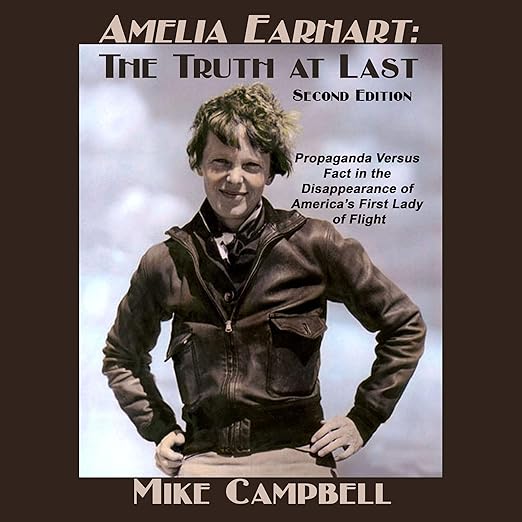
- Voice: Bill Hemberger holds a measured, confident register across nearly sixteen hours of cumulative testimony without letting the volume of evidence blur into monotony.
- Big ideas: Amelia Earhart disappearance, Saipan capture theory, government cover-up argument
- Atmosphere: Immersive and document-heavy, closer to a cold-case file than a breezy popular history
- Worth it?: A rewarding deep dive for Earhart mystery enthusiasts and Saipan-theory readers, not a neutral survey of competing explanations.
Saipan, not Howland Island and not Nikumaroro, is where this audiobook insists Amelia Earhart actually died, and Mike Campbell spends nearly sixteen hours building the case for it. Two additional sections, a fresh foreword, and newly incorporated research have been folded into this second edition, expanding on an argument Campbell first published in 2012: that Earhart and navigator Fred Noonan were captured by Japanese forces after their July 1937 world-flight attempt went wrong, held on Saipan, and that the official record since has amounted to decades of obscured or suppressed documentation. This is contested territory, Campbell's Saipan theory is one of several competing explanations for Earhart's disappearance, not the consensus view, and the book argues its position with the confidence of someone who considers the matter settled.
Hemberger Holds a Measured, Confident Register
Campbell structures his case around eyewitness testimony and documentation, citing files from Fred Goerner, the newsman and Earhart researcher whose own investigation dates back decades, along with accounts he attributes to three named U.S. flag officers. The book explicitly sets itself against two rival theories: that Earhart's plane crashed and sank near Howland Island, and that she and Noonan died as castaways on Nikumaroro, formerly Gardner Island. Whichever theory a listener arrives already believing, and the Earhart disappearance has attracted serious researchers toward all three explanations for decades, Campbell's argument here is presented with total conviction rather than as one hypothesis among several worth weighing. That certainty is either the book's core strength or its central limitation depending on how a listener wants their history served.
Bill Hemberger narrates without an existing reputation to weigh this specific performance against, so the fairest assessment is on how his delivery suits the material itself. A nearly sixteen-hour argumentative history built on cumulative documentation, eyewitness accounts, official records, cross-referenced testimony, needs a narrator who can sustain steady conviction without letting the sheer volume of evidence blur into monotony, and without overselling contested claims into certainty through vocal emphasis alone. Hemberger holds a measured, confident register throughout that matches the book's own tone: this is presented as a closed case, not an open question, and his narration doesn't hedge on that framing any more than Campbell's prose does.
An Exhaustively Researched Cold-Case File
For listeners already invested in the Earhart mystery, this second edition genuinely adds material rather than just repackaging the first. One reviewer, Jeremy, describes reading the 2012 first edition, coming away well-cited and thoroughly satisfied, then still purchasing this second edition specifically because, as he notes, updates incorporated newer research completed since. That's a meaningful signal: a reader already convinced by the original case chose to invest in the expanded version anyway, which suggests the additions carry real weight rather than functioning as a marketing-driven re-release.
Reviewer H. Hopkins calls the underlying mystery 'one of the most fascinating mysteries of modern times,' adding that 'its deep attraction for writers, film makers and investigators continues unabated.' That enduring fascination is really the book's engine: whether or not a listener accepts Campbell's specific Saipan conclusion, the sheer density of documentation and eyewitness material assembled here gives true-crime and unsolved-mystery listeners a lot to weigh, closer in spirit to an exhaustively researched cold-case file than a breezy popular history.
Named Flag Officers Instead of Vague Insiders
Campbell's use of named sources is also worth noting on its own terms. Citing three specific flag officers by rank rather than gesturing vaguely at unnamed military insiders, and leaning on Fred Goerner's own investigative files rather than secondhand summaries of them, gives the argument a texture closer to investigative journalism than internet-forum speculation, whatever a listener ultimately decides about the underlying conclusion. That sourcing choice is a meaningful craft distinction between this and less rigorous conspiracy-adjacent nonfiction, even for listeners who remain unconvinced by the Saipan theory itself.
That this research project has now reached a second, expanded edition years after its first release also says something on its own about the durability of interest in this specific angle on the Earhart story. Books built around a minority historical position rarely earn a substantially revised re-release; that this one did suggests a genuinely engaged, ongoing readership rather than a single wave of initial curiosity that faded.
Closer to a Legal Brief Than a Narrative
This book argues a specific, contested position as established fact, framing rival explanations, including the crash-and-sink theory near Howland Island and the Nikumaroro castaway theory, as deliberate misdirection rather than good-faith alternative research. Listeners should go in aware they're hearing one committed advocate's case, built on his own selection and interpretation of testimony and documents, not a neutral survey weighing all major theories evenhandedly. Reviewer S. Martin Shelton, who gave the book four stars rather than five, still calls Campbell's account 'compelling' while using more measured language than the book's own certainty, a useful signal that even a sympathetic reader found room to hold the argument at slight arm's length.
Running nearly sixteen hours total, this also demands real practical commitment on its own, apart from where a listener lands on the underlying content debate. It isn't built to sample in a single sitting, and listeners weighing whether to commit should know it rewards patience with cumulative detail more than it delivers a single tidy narrative arc, closer to working through a case file chapter by chapter than following a conventional true-crime story with a clean beginning, middle, and end.
The sheer number of names, ranks, dates, and document citations moving through the book adds a second practical listening consideration. Following Campbell's evidentiary chain closely enough to evaluate it fairly takes real attention, closer to following a legal brief than absorbing a narrative history, and listeners who want history to wash over them passively should recalibrate before committing to the whole thing.
A Significant Investment in One Contested View
Earhart mystery enthusiasts, especially readers already familiar with the Saipan theory or Campbell's first edition, are exactly who this is built for, and the added second-edition material genuinely rewards that specific audience. It also suits listeners who enjoy immersive, documentation-heavy cold-case journalism generally, regardless of whether they end up agreeing with Campbell's specific conclusion, since the sheer volume of assembled testimony has value as historical material on its own terms.
A balanced survey of all major Earhart disappearance theories, presented neutrally and side by side, is not what this book offers; Campbell writes as a committed advocate for one specific explanation, and the book treats competing theories as errors to correct rather than positions to weigh fairly. If a strictly mainstream, consensus-adjacent account matters more to you than an immersive deep dive into one researcher's specific case, this second edition's nearly sixteen-hour runtime is a significant investment in a single, contested point of view.
A Few Questions About Amelia Earhart: The Truth at Last - Second Edition
How long is the Amelia Earhart: The Truth at Last audiobook?
It runs 15 hours and 49 minutes, a substantial length reflecting the density of testimony and documentation Campbell assembles to support his argument.
Is this audiobook a good starting point for someone new to the Amelia Earhart disappearance, or is it aimed at readers who already know the case?
One reviewer specifically recommends it as the place to start for newcomers to the Earhart story, though its committed advocacy for one specific theory may land differently for a first-timer than for a reader already familiar with the competing theories.