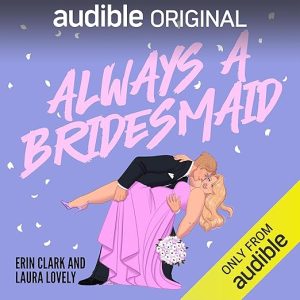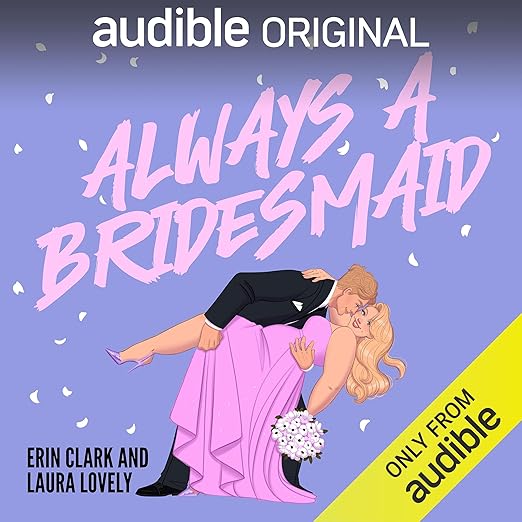
Randi Burnett wrangles missing grooms and drunk in-laws for a living, which is a fine premise for a romantic comedy audiobook and comfortably the best thing this one owns. She is a bridesmaid for hire, recently dumped, engaged to play maid of honor and pretend best friend to a bride she barely knows. The best man is a high school principal named Will Valentine who does not believe in marriage. The setup more or less writes itself. What surrounds it on this record raises more questions than the story does, beginning with how many people actually made the recording. Erin Clark has the byline here and the publisher line reads as an originals imprint, and both of those fields turn out to be part of the story rather than background to it.
First, the Big Picture
Only one written response describes the recording, and it repays close reading. A five-star from February 19, 2025 praises Andrew Eiden's and Krystal Hammond's dual narrations and says both performances enhanced the entertainment. The narrator field on this record names Andrew Eiden and nobody else. If Krystal Hammond read half of this romance, a buyer has no way of learning it from the page, and on a story the description builds around two leads, a second voice is not a detail you discover afterward. Confirm the cast before paying for it.
Two further things in that same response deserve attention. It calls this the reader's first encounter with these two authors' collaborative work, while the byline on the record names Erin Clark alone, so a co-writer may be missing from the credits as well. And it discloses, plainly and to its credit, that the audiobook was supplied free and the review volunteered without payment. That does not make the praise false. It does mean the most enthusiastic text on the page, and the only one describing any performance, arrived through a promotional channel.
Why Always a Bridesmaid Works as an Audiobook
Charm is what the book is selling, and a fair amount of it lands. A four-star from April 2025 calls the story short, sweet and entertaining, concedes that the characters carry annoying flaws, then argues those flaws make them feel more realistic. That reader also praises the representation and says it never felt forced. At seven hours and seven minutes this is the lightest kind of romantic comedy commitment, the sort you finish inside a weekend without owing it homework, and for a certain mood that is exactly the right size. The ice queen bride is the sharpest idea in the premise, a client who has hired a friendship rather than earned one, and the comedy works best whenever the book remembers she is standing there.
Andrew Eiden has the narrator credit, and the material presents a specific problem, because Randi is written at high volume. The copy calls her brilliant, beautiful, bubbly and vivacious, a woman who loves all things love, while two written responses find her exhausting rather than delightful and a third finds neither lead worth rooting for. A reader can lean into that energy or pull against it, and which choice was made will settle the book for you faster than the plot will.
A Few Reservations
Nobody in the column agrees about this book, which is unusual and genuinely informative. The five written responses grade it at two, three, four, five and two, and a 3.3 spread across ten votes is the arithmetic of a divided room rather than of a quiet failure. A three-star from May 2025 says the book has the potential to be good and then spends its remaining length explaining why the female lead is not: upset that a friend eloped, and mostly upset about how the eloping affected her.
Genre filing is the other oddity. This record sits under an LGBTQ+ category while the description sells a romance between Randi and Will and mentions no other pairing at any point. Two written responses discuss representation and flatly contradict one another, one insisting it never felt forced, the other, a February 2025 two-star, calling it thrown in rather than genuinely representing the experience. That is a one-to-one disagreement rather than a verdict, and the description offers a prospective buyer nothing to weigh it against. Anyone shopping by category deserves better than a shelf label that neither the copy nor the column can confirm, and this is the sort of gap a single line in the description would close.
Who Should Pick Up Always a Bridesmaid
Wedding-adjacent comfort romance is a real appetite and this feeds it cheaply. If you want cake tastings, dress fittings, a fake-friendship premise and a grumpy man reluctantly color coordinating, the machinery is all present and the runtime is merciful. An October 2025 two-star gave up at Chapter 11 and describes a book good enough to put you to sleep, which is a harsh way of saying what a kinder reader would call low stakes. Plenty of listeners are shopping for low stakes.
Give it a miss if you need a lead you can root for without qualification. The most persistent complaint across the column is that Randi's self-absorption is written as charm and does not read that way. Give it a miss too if you are buying specifically for the LGBTQ+ shelf, because the description does not support that expectation and the two people who raised the subject reached opposite conclusions about it. If the 3.3 makes you hesitate, the hesitation is well founded, since ten votes is a small enough pool that the two-star grades are visibly holding the number down rather than being averaged away.
Somewhere inside this is a better and sharper book. The professional-bridesmaid conceit is underused, the ice queen bride is a promising figure who mostly stays offstage, and Will Valentine is a decent joke the copy tells better than the plot does. What arrives instead is a pleasant, uneven comedy whose warmest review came with a free copy attached and whose second performer may not appear in the credits at all. Check the cast list first, then decide.
Questions Listeners Ask
What is the runtime on this audiobook, and where do listeners tend to stop?
Seven hours and seven minutes, which is short for the genre. Two of the written responses report abandoning it, one after roughly an hour and one at Chapter 11, both citing boredom rather than anything objectionable. If the first hour holds you, the remaining six are unlikely to change your mind in either direction.
Does the audiobook use two points of view?
The page never states it outright. The description gives Randi and Will separate sections of their own, and one written response refers to dual narrations by two performers, which points strongly toward alternating perspectives. Since only one narrator is credited in the field, treat the structure as likely rather than confirmed until you have heard the sample.