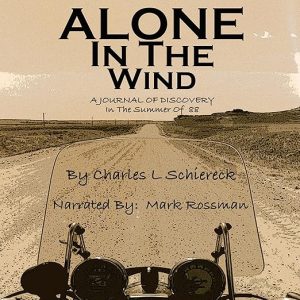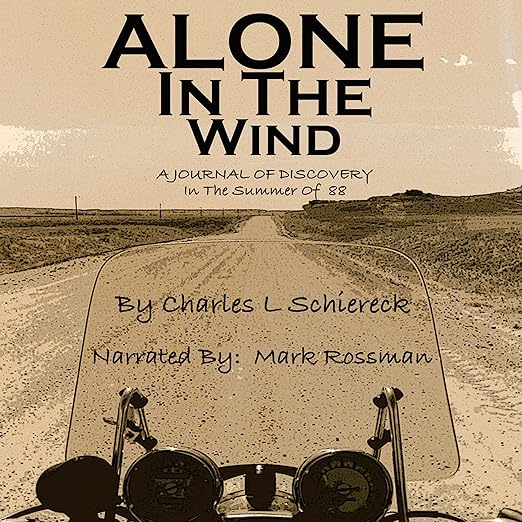
Charles Schiereck packed his motorcycle in the summer of 1988 and left the garage without a destination or a return date. The audiobook Alone in the Wind, narrated by Mark Rossman across 4 hours and 6 minutes, came from something Schiereck never planned: brief journal entries written for himself during 12,000 miles from sea to sea and back, later expanded into longer narrative form years after the trip concluded, and eventually published. That origin story is the audiobook's most important piece of context, because it explains the book's most distinctive quality: the prose has not been shaped by an awareness of audience. Schiereck was not performing his experience while he was living it, and the writing retains the honest, occasionally thin, always unguarded quality of private observation rather than crafted travel writing.
The summer of 1988 is a more interesting historical backdrop than Schiereck himself acknowledges. Yellowstone was burning in what would become the largest wildfire in the park's recorded history. Ronald Reagan was in his last year in office. The country was in the grip of the worst drought since the Dust Bowl of the 1930s. And Schiereck, by his own description, was oblivious to all of it, moving through a landscape shaped by forces he was not tracking, encountering an America that existed below and behind the news cycle. That obliviousness is not a limitation of the book; it is the condition of the road trip as a form, the specific freedom of moving through a country without the obligation to process it for anyone else's benefit.
What Charles L. Schiereck Delivers
The reception the book has earned reflects its unusual position in the road trip genre. One reviewer called it a historical gem and praised the charm and wit with which Schiereck tells his story, noting explicitly that it appeals to men and women, young and old, because the underlying subject is freedom and the desire to simply leave for a while rather than motorcycles specifically. Another described it as a great read for motorcycle enthusiasts as well as the general reader and traveler, which is the same observation from a slightly different angle. A third reviewer, who approached the book with the vocabulary of literary criticism, was less emphatic but still positive, finding it entertaining and worth the time investment. The pattern across these responses is consistent: the book works not because Schiereck is a literary writer but because he is a genuine one, which is a different thing.
The motorcycle is the vehicle rather than the subject. Schiereck owns the machine and relies on it for 12,000 miles, but the technical content is functional rather than enthusiast-level. He is not writing for bikers specifically; he is writing about what happens to a person when they remove the structures that normally organize their days and drive into open country without knowing which direction tomorrow will take them. That experience is universal in its appeal even when its specific vehicle is singular.
Rossman's narration is a good match for the material throughout the audiobook's 4-hour-6-minute runtime. He does not try to make Schiereck's prose more than it is, which is the correct instinct: the book's value is in its honesty and its period specificity rather than in its literary ambition, and a narrator who imposed emotional significance on passages Schiereck wrote plainly would misrepresent the experience rather than enhance it. The restraint in the delivery mirrors the restraint in the writing, and both reflect an account of a trip taken for private reasons and written up for private purposes before anyone suggested it might matter to a wider audience.
At just over 4 hours, the audiobook functions comfortably as a single listening session. That compactness suits the journey's shape: the account accumulates through small observations and encounters rather than through dramatic incident, and the short-format listening mirrors that accumulation without demanding that you manage a complex narrative across multiple days of returning to the text. The journey's arc, from departure without destination through 12,000 miles of American landscape to return, is satisfying at this length in a way it might not be if expanded.
Before You Commit to Alone in the Wind
The journal origins of the text are both its strength and its limitation, and listeners should know both sides of that equation before they begin. The prose can be episodic in ways that a memoir more deliberately shaped for publication from the start would not be, and some passages are thinner than others because Schiereck was recording a day when not much of note happened and he recorded the nothing faithfully rather than skipping it or inflating it. Listeners expecting the architectural coherence of a professional travel memoir, the kind where every encounter feels selected and weighted for narrative purpose, will occasionally find the pacing uneven.
The historical context of 1988 America is embedded in the account rather than foregrounded by the author, which means listeners who want to engage with the book as period document will need to supply some of that context themselves. Schiereck knew Yellowstone was burning but was not writing about it; he moved through drought-stricken landscapes but was not analyzing them. That first-person obliviousness, which is the truth of how road trips actually feel from inside them, is both authentic and, occasionally, an opportunity missed for the kind of historical texture that might have given the audiobook additional depth for listeners who come to it decades after the summer it documents.
Who Should Pick Up Alone in the Wind
This audiobook is well-suited to listeners who have felt the specific appeal of solitary travel, who have packed a vehicle and driven into uncertainty without quite knowing what they were looking for. Motorcycle enthusiasts will find the setting familiar, but the book explicitly exceeds that audience: the 12,000-mile arc through a particular American summer is what the audiobook is actually about, and the motorcycle is the mechanism rather than the meaning. At just over 4 hours, the time investment is modest relative to the warmth of the experience the book offers. Skip it if you want dramatic incident, sustained character development, or travel writing with the literary ambition of a Steinbeck or an Abbey. Alone in the Wind is quieter than all of those, and its pleasures are honest and commensurate with its modesty.
- Voice: Mark Rossman gives Schiereck's road memoir a steady, unadorned delivery that suits the book's origins in private journal entries, maintaining the voice of a solitary traveler without editorial amplification.
- Big ideas: Solitary travel as self-discovery, America in the specific summer of 1988, the motorcycle as vehicle for both freedom and vulnerability
- Atmosphere: Unhurried and observational, with the particular freedom of a trip undertaken without destination or deadline and written without an audience in mind
- Worth it?: A warm, unpretentious road memoir that works precisely because it was never intended for publication and retains the honesty of that private origin.