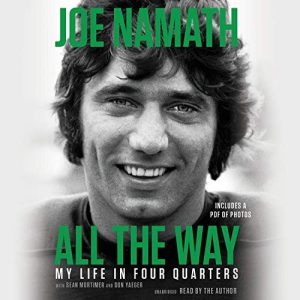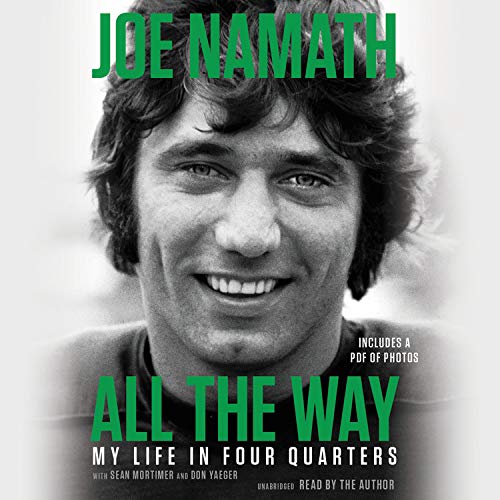
Three days before the 1969 title game, a quarterback with wrecked knees told the country his heavy-underdog team would beat the Colts, and then went out and did it. Hachette Audio built this seven-hour audiobook around the fiftieth anniversary of that promise, and the entry hands you an odd fact before a word of it plays: the byline belongs to Don Yaeger, while the reading credit belongs to Joe Namath, the man who made the guarantee in the first place. Two names, two jobs, one life, and no note anywhere on the page about how the pair divided the work.
Yaeger takes the story from Beaver Falls, Pennsylvania, where an arm good enough to catch Bear Bryant's attention at Alabama started everything, through four years at that program, to the $427,000 the Jets put on the table to pull football's Golden Boy into the upstart AFL. By 26 he had a Super Bowl title and, in the description's phrasing, a level of celebrity only a handful of athletes have ever reached. That is the first half of the arc, and it is the half most football listeners already know by heart. What comes after decides whether a memoir like this earns its length or merely fills it.
Nothing in the copy hedges about what the second half holds. Doctors treated the knees with painkillers strong enough to knock out a horse; Johnnie Walker went on top of the prescriptions; the nights began alongside Sinatra and Mantle and ended wherever they ended, usually with somebody famous. Injury took the career before it was ready to go, Hollywood and endorsements took the years after, a marriage to Deborah Mays came apart, and sobriety arrived in fits and starts long before it held. The vantage point is a man of 74, dry at last, looking back at all of it.
That vantage point decides how the whole thing lands. This is not a highlight reel with a rueful epilogue bolted on: the promise the publisher makes is that addiction, fatherhood and mortality get equal billing with the football, and that the charm everyone remembers gets examined rather than performed. Handing the reading to the person under examination is the strongest editorial decision on the entry, and also the one it explains least.
Highlights
Memoirs organized around one famous moment tend to run dry by the second act, because the moment has nowhere left to go. The guarantee works better than most such spines because the copy treats it as a starting line rather than a summit: a 25-year-old promising a result he had no standing to promise, watching it come true, and then spending the following fifty years being the man who said it out loud. Everything afterward gets measured against one sentence he could never take back.
What surrounds that moment is what reaches past the sports shelf. The publisher places him inside an era of raucous rebellion and shifting social norms, argues that his roughish charm came to stand for the commercialization of pro sports, and credits his progressive views on race with pushing integration on the gridiron. Those are large claims for a 300-word description to make, and whether the book cashes them is the genuinely interesting question here, considerably more so than any replay of the Colts game.
Audio adds something print cannot manage. The reading credit sits with the subject himself, so the boasting, the excuses and whatever the copy means by redemption all arrive in the first person from the person who lived through them, including the passages about the drinking and the pills. On a memoir this dependent on tone, where a shrug and an admission can be the same sentence, that is not a small structural advantage.
Before You Commit to All the Way
Zero written responses sit beneath the 4.7 average on this entry, which rests on 252 ratings and not one sentence of listener text. Nothing indicates whether those ratings came from the recording, the hardback or a disc edition, and nothing describes how a self-read memoir holds up across seven hours by a man who spent his career being interviewed rather than reading aloud. Buyers who want other people's reports before spending a credit will find this page bare.
Damage runs through the listing text as well. The famous Guarantee comes through wrapped in broken characters where the quotation marks should be, the same corruption hits Broadway Joe two lines later, and the sentence about faith arrives with a lowercase g. A print ISBN has been parked on the audio entry as well, and the record files a memoir under Sports and Outdoors with a single Football tag and no biography category at all. None of that touches the book, but it points to a page assembled by an importer rather than checked by an editor.
Be honest with yourself about the material, too. Addiction is not a chapter here, it functions as a through line: prescription painkillers, alcohol taken as a matching medication, and what the copy calls struggles with both sex and substance. Anyone hoping for the 1969 season broken down drive by drive should recalibrate as well, since the description spends far more of its energy on the man than on the games, and the games it does mention are the ones everybody has already seen on film.
Is This One for You?
Sports memoirs get chosen for two different reasons, and this one serves the fame reason rather than the box-score reason. It suits listeners with an appetite for mid-century New York at its loudest, for the machinery of endorsement and image that grew up around the first genuinely modern athlete-celebrity, and for accounts of heavy drinking told from the far side of sobriety by the person who did the drinking rather than by a biographer keeping a polite distance.
Pass if that register wears you out, or if you are early enough in your own recovery that a detailed account of self-medication would cost you more than it gives you. Pass, too, if you need corroboration before you commit: this page offers an average, a duration, a publisher and nothing else, which is a thin basis for a purchase when the whole appeal of the format rests on one voice.
The guarantee held up because the man who made it had to live inside it afterward, in public, for half a century. Giving him the microphone at 74 is the one decision on this entry that needs no review to evaluate.
At a Glance
- Read by: The subject reads his own memoir while the byline names his collaborator, a split the entry never explains.
- At its heart: Football fame, addiction and self-medication, fatherhood, the cost of celebrity
- Vibe: Brash on the surface, rueful underneath
- Short version: Worth it for the life rather than the football, provided you can buy from a page with no listener feedback on it.