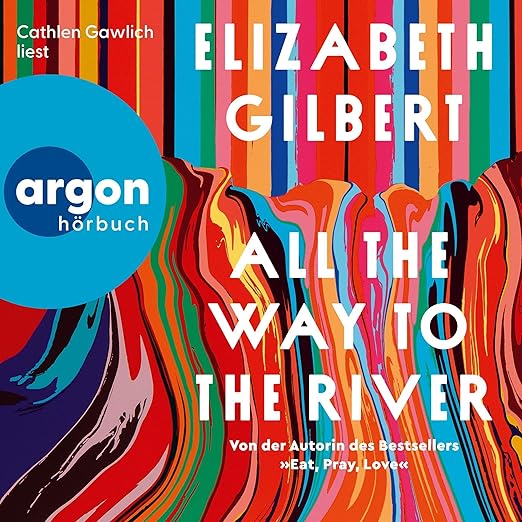
I need to note at the outset that the audiobook available through this listing is the German-language edition of Elizabeth Gilbert's All the Way to the River, published by Argon Verlag and narrated by Cathlen Gawlich. Gilbert's memoir about her relationship with Rayya Elias, the love affair, the addiction, the terminal diagnosis, the grief, was published in German in September 2025. English-language listeners looking for this title should confirm the edition before purchasing. What follows is an assessment of the audiobook as a production and of Gilbert's project as a piece of literary memoir, which is of interest regardless of language edition.
Gilbert is the author of Eat Pray Love, and that association has followed her work in ways that have sometimes obscured how serious and formally ambitious her better writing is. All the Way to the River is, by every account that has emerged from its reception, the most personal and least performed thing she has written. The book traces a relationship that began in 2000 when Gilbert met Rayya Elias, a filmmaker, musician, and stylist. Friendship deepened over years into something the book describes as Seelenverwandte, soulmates in the German edition, and eventually into a romantic partnership. Both women were recovering addicts, and the book does not romanticize that shared history. Then came Rayya's diagnosis with terminal brain and pancreatic cancer, and everything that follows.
Is All the Way to the River Worth Your Time?
Gilbert's relationship with Rayya Elias was public knowledge by the time Rayya's diagnosis was announced in 2016. Gilbert wrote about it on social media, and the story of how she left her marriage to be with Rayya in the last years of Rayya's life became, briefly, a kind of cultural touchstone, a story about love that surprised people who thought they knew what Gilbert's life looked like. All the Way to the River is the book that sits behind that story, the account of the full arc from the 2000 meeting through friendship, through the years both women were using, through recovery, and then through a romantic partnership neither of them had fully anticipated. It is a significant distance to travel in a single memoir, and the fact that Gilbert waited until she had the perspective to write it honestly rather than releasing something immediately after Rayya's 2018 death is visible in the book's structure.
German reviewers describe All the Way to the River as shocking and inspiring in the same breath, and one noted reading the whole book in a single sitting because the story was not at all what they had expected. That response, surprise at the actual substance of the narrative, is itself informative. Gilbert's reputation as a writer of spiritual self-help adjacent memoir creates expectations that this book does not fulfill. This is not a book about finding yourself in a foreign country. It is a book about loving someone who is dying, about what addiction does to the people who have it and the people who love them, and about the particular form of reckoning that proximity to death enforces.
One German reviewer described it as gnadenlos authentisch, mercilessly authentic, and noted that the book held up a mirror in ways that were uncomfortable and clarifying simultaneously. That is a specific kind of literary praise, the kind that distinguishes books that are merely well-written from books that do something to the reader. Gilbert's earlier work has been criticized, sometimes fairly, for a kind of spiritual niceness that buffers the hard material. By these accounts, she has removed that buffer here.
Before You Commit to All the Way to the River
The co-addiction dynamic between Gilbert and Rayya is one of the book's most difficult and most important subjects. Both women in recovery is a fact that the synopsis acknowledges and the memoir apparently treats with full seriousness, not as a redemption arc that is complete by the time the book begins, but as a living condition that shapes how each woman moves through the world and through the relationship. The German description, zwei Süchtige auf Kollisionskurs in Richtung Katastrophe, is stark: two addicts on a collision course toward catastrophe.
What literary memoir about addiction does well, when it does its job, is refuse the easy consolations: the clean recovery narrative, the singular moment of clarity, the redemptive ending that erases the damage. The reception of Gilbert's book suggests she has refused those consolations here. The cancer diagnosis is not the book's climax so much as its crucible, a condition under which everything that had been deferred or avoided in the relationship has to be faced. That is an enormous amount of material for a single memoir to carry, and the overwhelmingly positive response from German readers suggests it does.
Should You Listen to All the Way to the River?
Gawlich is an accomplished German audiobook narrator with a track record in literary fiction, and her work on this edition reflects that experience. The memoir's emotional register shifts between intimacy, grief, and something close to reportage, Gilbert is simultaneously inside the story and trying to make sense of it from outside, and Gawlich navigates those shifts with technical precision. The ten-hour-plus runtime is substantial for a memoir of this kind, and the narration does not flag. Her restraint in the most devastating sections is, paradoxically, what gives those sections their force.
The 4.0 rating from a small number of reviews reflects the book's early stage in its reception cycle rather than a lukewarm response, the German edition was released in September 2025, and the reviews that do exist are predominantly five stars, with one dissenting voice describing it as boring, which suggests a reader who came to it with incompatible expectations. Gilbert's most serious work will not appeal to every reader of Eat Pray Love, and that is probably as it should be.
Is this audiobook the German edition of All the Way to the River, or is an English version available here?
The audiobook listed is the German-language edition, narrated by Cathlen Gawlich and published by Argon Verlag. English-language listeners should search for the English edition separately. The review above addresses Gilbert's project as literary memoir, which is relevant regardless of language edition.
Is All the Way to the River available as a free audiobook through Audible?
Yes, this German-language edition is currently available as a free audiobook for Audible members. For German-speaking readers looking to experience one of Gilbert's most serious works, the free access is an excellent entry point.