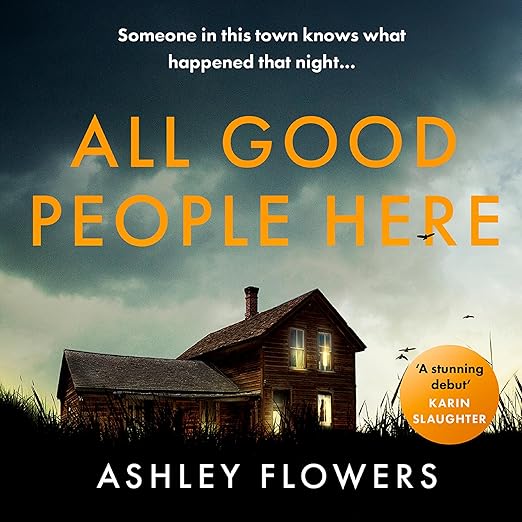
The small Indiana town at the center of All Good People Here keeps its worst knowledge buried in plain sight, and the audiobook version of Ashley Flowers's debut novel lets that atmosphere build with particular intensity. Karissa Vacker narrates the story of journalist Margot Davies, who returns to her hometown and stumbles into the cold-case murder of six-year-old January Jacobs, a child whose body was found in a ditch twenty-five years after her parents woke to find her bed empty and a threatening message spray-painted on their wall. The premise draws directly on Flowers's expertise as the host of the Crime Junkie podcast, and what makes this audiobook distinctive is how fluently that expertise translates from audio journalism into fiction.
Vacker's narration is a genuine asset. She locates Margot as a character whose professional obsessiveness and personal fragility coexist without either canceling the other out. Reviewer Surgery1st notes that Margot herself has baggage and a broken history that make you question whether her own opinion and ideas can be trusted, and this is the quality that gives the thriller its real tension. Vacker communicates Margot's unreliability not through obvious signaling but through the small variations in confidence and certainty that accumulate across the ten-plus hours of listening. It is a nuanced performance that takes the source material seriously.
What Ashley Flowers Delivers
Flowers brings to this debut the instincts developed across years of true crime research, and the novel reflects that background in specific ways. The cold-case architecture is not simply a thriller convention here; it functions as a genuine structural engine. January's murder is presented with the layered ambiguity that characterizes real unsolved cases, where the evidence is insufficient to definitively exclude multiple suspects and where the passage of time has both hardened certain memories and distorted others. Flowers has absorbed enough actual case pathology to know that real cold cases are not tidy, and she builds that messiness into her fiction without sacrificing narrative drive.
The complication she adds to the cold case involves a contemporary disappearance that Margot connects to January's murder, and this dual timeline structure keeps the tension from plateauing. As Margot digs deeper into the town's history, the investigation begins to threaten her directly, and the sense that something sinister is still operating in the community, still capable of violence, escalates the stakes beyond retrospective mystery. Reviewer MommaLayne describes it as a haunting debut that intertwines a chilling unsolved murder with a harrowing disappearance, and that intertwining is precisely what the novel does most effectively. The two threads cast light on each other in ways that make the pattern gradually, uncomfortably visible.
What Ashley Flowers Gets Right
The audiobook format is especially suited to a novel that emerges from a podcasting tradition. Flowers spent years developing stories that are fundamentally audio experiences, where pacing, tone, and the gradual revelation of information are managed through sound rather than text. Those instincts are embedded in the prose, which has a natural rhythm suited to being heard rather than read. Vacker honors that rhythm. The ten-hour-and-thirty-five-minute runtime gives the cold-case structure room to operate as it should: with accumulation rather than shock, building dread through what is not yet known rather than through what is revealed too quickly.
Karin Slaughter's blurb describes the book as a debut from a fresh new voice in the thriller space, and the freshness she is pointing to is real. It comes partly from Flowers's authentic relationship with true crime material and partly from her willingness to make Margot a genuinely complicated protagonist rather than a clear-eyed heroine. Margot's personal history, which becomes relevant as the investigation deepens, means that her pursuit of January's killer is not cleanly motivated by justice alone. That complication is what gives the novel its texture beyond genre mechanics.
Where Ashley Flowers Loses Some Ground
The novel's strongest quality is its atmosphere. Flowers builds a very specific sense of place, a community where everyone knows the official story and most people have a private reason not to disturb it. That quality of collective silence, and the social mechanisms that maintain it, is rendered with a precision that suggests Flowers has interviewed enough real-world subjects in small communities to know how secrets get kept. It is worth paying attention to the secondary characters, many of whom carry information they are not immediately forthcoming with, because the resolution depends on understanding the network of interests and evasions that has preserved the mystery for twenty-five years.
A note on expectations: All Good People Here is compared on its cover to I'll Be Gone in the Dark and Sharp Objects, which is fair in terms of tone and ambition but sets a high bar. It is a strong debut rather than an established classic, and a few reviewers have noted that certain plot elements resolve with more convenience than the preceding complexity fully earns. Those moments are minor relative to the overall construction of the novel, but listeners with high tolerance for ambiguity may notice them.
Who Should Pick Up All Good People Here
Crime Junkie listeners who have followed Flowers's podcasting work will find this audiobook a natural extension of her sensibility into fiction, and the listening format aligns with how many of them already engage with true crime storytelling. Beyond that audience, the novel works well for readers who enjoy cold-case fiction with psychological depth, unreliable narrators, and atmospheric small-town settings. Those who prefer more procedural thriller mechanics with a faster revelation pace may find the atmospheric accumulation somewhat slow. Flowers's debut rewards patient listening more than it rewards rushing toward the resolution.
At a Glance
- Voice: Karissa Vacker's performance grounds the cold-case tension effectively, keeping Margot's unreliable perspective from tipping into melodrama.
- Big ideas: small-town secrecy, media obsession with true crime, the unreliable narrator as investigator
- Atmosphere: Tense and claustrophobic, with a sense of dread that accumulates slowly and never fully lifts
- Worth it?: Ashley Flowers's debut thriller carries the atmospheric density of the best cold-case podcasting into novel form, with a protagonist whose compromised perspective sharpens rather than blunts the suspense.
Frequently Asked Questions
Do I need to be a Crime Junkie podcast listener to appreciate this audiobook?
No prior familiarity with the podcast is required. 'All Good People Here' is a standalone thriller that stands on its own merits as a novel. That said, listeners who enjoy Flowers's podcast work will recognize her characteristic approach to cold-case storytelling and find it translates effectively into fiction form.
Is the audiobook narration by Karissa Vacker well-matched to the story?
Yes. Vacker handles the first-person perspective of journalist Margot Davies with a register that captures both her professional drive and her personal unreliability as a narrator. Reviewers have described the pacing and character portrayal as well done. At ten hours and thirty-five minutes, her performance sustains consistent atmospheric tension across the full runtime.