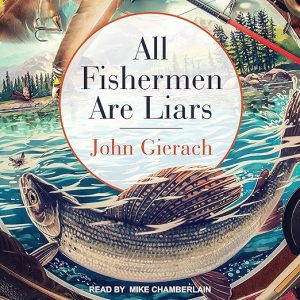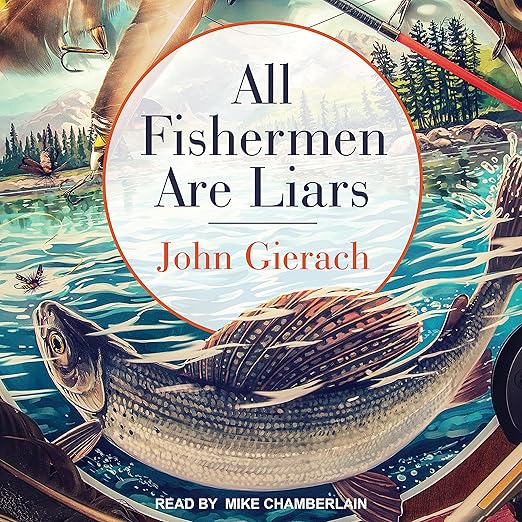
- Narrator: Mike Chamberlain reads Gierach's essays with the unhurried ease they demand, never pushing the contemplative passages past the pace the prose sets for itself.
- Subjects: Fly-fishing as philosophy, the companionship of place, the ethics of obsession
- Tone: Wry, meditative, and gently self-deprecating
- Bottom line: Gierach's familiar collection of essays delivers exactly what his audience returns for, and Chamberlain's narration is the right vehicle for prose that rewards listening over skimming.
John Gierach's All Fishermen Are Liars, narrated by Mike Chamberlain in this audiobook from the John Gierach's Fly-fishing Library, opens somewhere in North America on a stretch of water Gierach has decided is worth his time, which is the only qualification that has ever mattered to him. The Sacramento Bee's label of "the master of fly-fishing" understates what Gierach actually does: he is a literary essayist who has chosen fishing as his primary subject, and the fish themselves are often the least interesting part of the result. At six hours and fifty-seven minutes, this collection of linked essays moves through presidential pools, secluded mountain lakes, debates about the perfect steelhead fly, and the philosophy of showing up to water that may or may not yield anything worthwhile.
Chamberlain's narration is the right match for this material. Gierach's prose moves at the tempo of someone who has decided there is no reason to hurry, not because nothing is happening, but because the point of being out here is the being out here. Chamberlain doesn't manufacture urgency where none exists; he follows the pace the essays set and lets the wit land at its own speed.
Where This One Lands
The title essay positions Gierach's whole enterprise beautifully. Fishing stories are stories told after the fact, shaped by memory, selective emphasis, and the psychological need to justify the time spent. The "lie" in fishing isn't malicious, it's the natural distortion of any story that needs to be worth telling. Gierach includes himself in this critique without apology, which is one of the reasons his readers trust him. He is not selling the romance of fly-fishing; he is documenting what it actually costs and feels like and occasionally looks like from the outside, including the moment when someone is required to say, "You know, there are people who wouldn't think this is fun."
The essay "The Nuclear Option", about the quest for the perfect steelhead fly, shows Gierach at his best as a naturalist and craftsperson. The specificity of the fly-tying detail, the way the search for a perfect pattern becomes a meditation on perfectionism itself, and the dry acknowledgment that the fish may not care anyway: this is Gierach's characteristic territory, and he covers it here with the confidence of someone who has been writing about this subject for decades and knows exactly how far each idea can extend before it becomes repetitive.
The Best Parts of All Fishermen Are Liars
The audio format suits Gierach's essays well because they were designed to be heard as much as read. His sentences have a speaking rhythm, they pause where pauses belong, they build toward the quiet joke, they undercut themselves before the reader can do it first. Chamberlain captures that rhythm without overcooking it. One reviewer described reading a Gierach collection from "a comfortable arm chair on a winter night with an adult beverage in hand," and the audio experience approximates exactly that register: low-key companionship with a narrator who knows what he is talking about and doesn't feel the need to prove it.
The travel across North America gives the collection geographic variety that prevents the essays from feeling repetitive. Gierach moves between busy public streams and hidden mountain lakes, between fishing with congenial companions and fishing alone, between the meditative and the social dimensions of the sport. That range keeps the collection from collapsing into a single note, even as the underlying philosophy, fishing is always the answer, even when you don't know the question, remains consistent throughout. The essay about fishing the Presidential Pools, in which Gierach muses on the karmic implications of following the elder George Bush upstream, demonstrates this range particularly well: it is simultaneously about fishing, politics, place, and the mild absurdity of finding yourself anywhere at all.
What Gives Us Pause
One reviewer, a devoted fan, noted some overlap with Gierach's earlier collections, specific stories or situations that felt familiar from prior books. Gierach has been writing about fly-fishing for long enough that some thematic repetition is inevitable, and this collection may test the patience of readers who have followed his work closely for years. For those newer to his catalog, or for listeners who return to his books periodically rather than reading them in close sequence, the repetition is less detectable and less consequential.
The collection is not for readers looking for dramatic narrative arcs or resolution. Gierach's essays do not climax in the way that adventure writing does; they arrive at something more like recognition or acceptance. If you come expecting the satisfactions of a fish story in the traditional sense, the big catch, the near-miss, the lesson learned, you will find elements of those, but they are subordinate to the texture of the experience rather than the point of it.
Who Should Listen to All Fishermen Are Liars
This audiobook is for established Gierach readers who want his prose in a format that suits its contemplative pace, for fly-fishing enthusiasts who want literary company during the off-season, and for listeners who enjoy nature writing in the tradition of writers who make a specific outdoor pursuit into a vehicle for examining how humans relate to time and place. It is accessible to non-fishers with an appetite for essay writing, the fishing is specific enough to feel real but explained clearly enough to follow, though those with no patience for the sport as subject matter will not convert here. Chamberlain's narration makes this a particularly pleasant winter listen for anyone who has ever chosen to be somewhere cold and wet because it seemed worth it.
Common Questions
Do you need to be a fly-fishing enthusiast to enjoy this audiobook?
Not necessarily. Gierach writes about fishing as a lens for examining patience, place, and the psychology of obsession. Non-fishers with an interest in nature writing or personal essays often find his work accessible, though the specifics of fly-tying and river behavior are discussed in detail and won't resonate equally for everyone.
Is this audiobook part of a series, and does it need to be listened to in order?
All Fishermen Are Liars is part of the John Gierach's Fly-fishing Library, but these are collections of independent essays, not a serial narrative. Each volume stands alone, and there is no required reading order within the library.