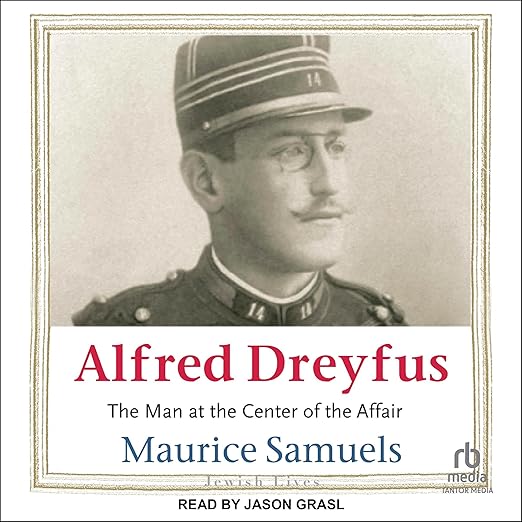
I spent a long Sunday with this audiobook, moving between the kitchen and the couch, pausing it to look things up, coming back to it in a way I rarely do with nonfiction. Maurice Samuels has written something unusual: a biography of a man who became a symbol so large that the actual man largely disappeared, and the project of restoration Samuels undertakes here is careful, specific, and finally moving in a way that surprised me.
The Dreyfus Affair is one of those historical events that most educated people know in outline without quite knowing it completely. Captain Alfred Dreyfus, a Jewish officer in the French army, was falsely accused of treason in 1894, convicted on fabricated evidence, publicly degraded, and shipped to Devil's Island off the coast of French Guiana, where he spent five years in brutal isolation before the truth began to emerge. The affair divided France, animated Emile Zola's J'Accuse, and is generally credited with accelerating the development of political Zionism through its effect on Theodor Herzl. Dreyfus himself is typically a supporting character in this story about the story that surrounded him.
The Review
Samuels's central argument is that Dreyfus has been misread, even by his supporters. The standard interpretation frames him as an assimilated Jew, someone who had absorbed French identity so completely that his Jewishness was incidental rather than constitutive. Samuels disputes this directly, arguing instead that Dreyfus embodied a new model of Jewish identity made possible specifically by the French Revolution, when France became the first European nation to grant Jews full legal equality. He was not trying to disappear into France. He was living out a vision of what French Jewish citizenship could actually mean, and the affair that destroyed his military career and his freedom was an assault on that vision.
This reframing gives the biography a coherence that goes beyond chronological account. Samuels draws on a newly available archive of more than three thousand documents and objects donated by the Dreyfus family, and that material gives him access to Dreyfus's inner life in ways that earlier biographers did not have. The portrait that emerges is of a reserved, principled, deeply stubborn man who genuinely believed in the institutions that had destroyed him and spent years insisting that those institutions would eventually correct themselves. Whether that belief was noble or naive is a question Samuels does not resolve, which is the right choice.
Why Alfred Dreyfus Works as an Audiobook
Jason Grasl's narration carries the scholarly weight of the material without becoming dry. This is a biography that requires the listener to track multiple political factions, legal proceedings, military hierarchies, and public figures across several decades, and Grasl keeps the architecture legible throughout. One reviewer described feeling as though they were experiencing the events in real time, which is a significant achievement for a historical biography covering events from the 1890s.
The resonance Samuels explicitly draws between the Affair and the current rise of global antisemitism is not heavy-handed, but it is present throughout, and it gives the five-hour listen a weight that purely historical accounts do not always carry. One reviewer noted that the story echoes still, and Samuels earns that observation through the accumulated detail of what Dreyfus actually endured and what it cost him.
The Caveats
At five hours and seven minutes, this is a relatively compressed biography of a subject that could sustain something much longer. Samuels is writing an introduction as much as a comprehensive study, and readers with deep existing knowledge of the Affair may find the coverage of some periods thinner than they would prefer. The legal and military proceedings of the trials are summarized rather than reconstructed in granular detail, and the political context of French Third Republic antisemitism is painted in broad strokes that specialists will find incomplete.
For listeners without background knowledge, however, this compression is a virtue. One reviewer explicitly described it as a well-written account for those who do not know much about the subject ahead of time, and the pacing that sacrifices depth for accessibility is the right choice for general audiences.
Who Should Pick Up Alfred Dreyfus
This audiobook is well-suited to listeners with a general interest in modern European history, Jewish history, or the history of antisemitism who want a focused, accessible account of a consequential story. It is equally appropriate for anyone who follows contemporary debates about Jewish identity, citizenship, and belonging, since the themes Samuels develops around Dreyfus's particular model of French Jewish identity have obvious contemporary relevance. Specialists in French history or the Affair specifically will find it a useful but not exhaustive addition to the literature. For general audiences, it is a precise and generous introduction to a man history has often treated as a footnote in his own story.
Good to Know
Do I need background knowledge of the Dreyfus Affair to follow this audiobook?
No. Samuels writes accessibly for general audiences, and multiple reviewers without prior knowledge describe it as an excellent entry point. He provides the historical context needed to understand Dreyfus's situation, the political landscape of late nineteenth-century France, and the significance of the Affair's resolution without assuming specialist knowledge.
How does Jason Grasl's narration handle the complex historical and political material?
Grasl maintains a measured, clear delivery that keeps the multiple factions, legal proceedings, and historical figures legible throughout. The narration is scholarly without being academic, and reviewers describe the experience as feeling immediate and real-time despite the historical distance of more than a century.