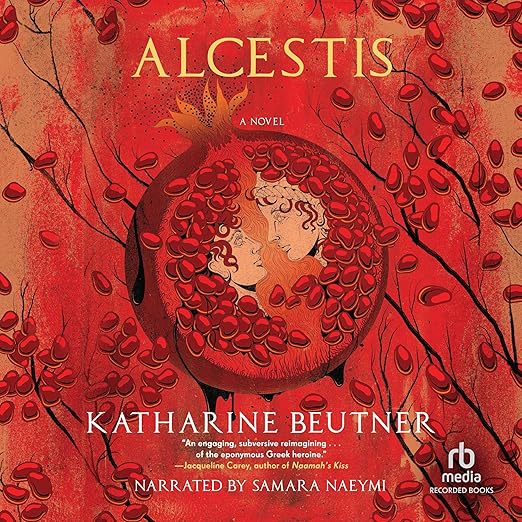
Greek mythology has always told stories about women without asking what those women wanted. Katharine Beutner's Alcestis, winner of the Edmund White Debut Fiction Award and a finalist for the Lambda Literary Association's Lesbian Debut Fiction Award, takes the most famous self-sacrificing wife in the classical canon and gives her the interior life the myth refused. This audiobook, narrated by Samara Naeymi, delivers a novel that is, in the Lambda Literary reviewer's words, 'resolutely queer: strange, beautiful, ambivalent, sexually fluid, full of human complexity and godly simplicity.'
The context matters for understanding what Beutner is doing. In the original myth, Alcestis dies in place of her husband Admetus, who has been promised that he can escape death if someone volunteers to die in his stead. The myth praises Alcestis for this sacrifice without pausing to examine it. Beutner's novel asks the questions the myth does not: who was Alcestis before the marriage, what did she love before Admetus, and what did she find in the three days she spent in the underworld before Heracles brought her back?
What We Made of It
Beutner's debut is described in the synopsis as 'lush' and 'emotionally devastating,' and both adjectives earn their place. The novel is not interested in rehabilitation of Alcestis through modern feminist framing; it is interested in what a woman's interiority actually looked like in a world where gods attended weddings and the underworld was a river away. The magical realism of ancient Greece is not fantasy here. It is the given reality within which desire, sacrifice, and power operate, and Beutner's prose inhabits that reality without condescension toward either the myth or its heroine.
One reviewer described the novel as exploring 'the confining life of Ancient Greek women,' and the confinement is rendered with precision. Alcestis grows from sheltered princess to the woman who makes the sacrifice, and Beutner tracks that journey without idealizing it. The Persephone sections, which some reviewers found surprising or unsettling, are the novel's most formally ambitious passages: a descent narrative that is also a love story, rendered in prose that refuses the comfort of easy symbolism.
The Lambda Literary reviewer noted that Beutner 'helps us re-see the familiar,' and the audiobook format accelerates that process in a specific way. The first-person voice of Alcestis, which might read on the page as studied restraint, takes on immediate emotional weight when delivered aloud. Naeymi brings the character's careful self-possession into the listening experience as something you can hear, not just infer.
The Best Parts of Alcestis
Samara Naeymi's narration carries the weight of a first-person voice that is simultaneously ancient and intimate. Alcestis speaks from inside a world the reader inhabits as stranger, and Naeymi maintains the distance and the closeness simultaneously. The underworld sequences are the audiobook's most technically demanding passages, requiring a vocal performance that can hold the dreamlike without losing its emotional anchor, and Naeymi manages this without recourse to affectation.
Listening to Alcestis move through her arranged marriage, her compressed existence as a royal daughter, and finally her extraordinary choice is different from reading it. Voice gives presence to interiority in ways that prose alone does not, and the audiobook format suits a novel whose central subject is a woman who has been defined by silence and whose reclamation of voice is the book's deepest subject.
At just over ten hours, the audiobook has the right weight for the emotional material. Beutner's prose is dense but not laborious, and Naeymi's pace allows the imagery to land without rushing toward the narrative conclusion. This is a novel that rewards listening across multiple sessions, where the accumulation of Alcestis's observations builds toward the underworld sequence with the inevitability of myth itself. The award recognition, from both the Edmund White Award and the Lambda Literary finalists list, signals that the literary community has recognized what the novel achieves: something rare in the mythology retelling genre, a book that takes the source seriously enough to be genuinely disturbing.
A Few Reservations
One reviewer found the relationship between Alcestis and Persephone unexpected and questioned whether it originated in mythological source material or Beutner's interpretation. The answer is that it is Beutner's invention, which is also the novel's most radical gesture. The Lambda Literary review praised precisely this: Beutner's refusal to write a 'celebratory gayed-up Greek myth' and her choice instead to make the queerness 'strange, beautiful, ambivalent.' Listeners who want their retellings to feel wholly celebratory may find the novel's emotional texture more complicated than they anticipated.
The novel's rating of 3.9 reflects a readership divided between those who found the prose beautiful and the approach revelatory and those who were unsettled by the Alcestis-Persephone relationship or who found the underworld sections difficult to follow. The novel does not resolve its central tensions in conventional ways. That irresolution is not a failure; it is the intention, and listeners who come expecting conventional narrative closure will be better served by adjusting that expectation before they begin.
The Right Listener for Alcestis
Readers who love LGBTQ literary fiction, feminist mythology retellings, and lyrical prose will find Alcestis one of the more ambitious debut novels in recent years. The Edmund White Award is a reliable indicator of quality: this is serious literary work operating within the queer fiction tradition, not genre retelling with a contemporary gloss.
Those who prefer their Greek mythology retellings plot-driven and tonally celebratory, in the mode of Madeline Miller's Circe, will find Beutner's approach more demanding and less resolved. This is a novel about interiority and limitation, not about triumphant self-discovery, and the audiobook delivers that distinction faithfully. The right listener will find it genuinely rare.
Good to Know
Is the Alcestis audiobook a LGBTQ+ retelling of Greek mythology, and how explicit is the content?
Yes. Beutner's novel is explicitly queer in its treatment of Alcestis's desire and her relationship with Persephone. The content is adult in its emotional and sexual dimensions but is not graphic; the writing is literary rather than explicit in a category-romance sense.
Is Alcestis the audiobook similar in style to Madeline Miller's Circe or Song of Achilles?
The Greek mythology connection is shared, but Beutner's approach is considerably more ambivalent and less triumphant than Miller's retellings. Alcestis is less interested in heroism than in confinement and desire, and its emotional register is more unsettling than cathartic. Fans of Miller will find this worth hearing, but the experience is distinct in tone and intention.