In Brief
- Narration: James A. Gillies delivers a measured, respectful performance suited to a firsthand combat memoir, he does not dramatize what is already dramatic enough on its own.
- Themes: Eastern Front survival, the experience of ordinary soldiers in extraordinary circumstances, the long aftermath of captivity
- Mood: Austere and unflinching, the memoir of a man who learned to observe carefully because observation was survival
- Verdict: One of the more honest and detailed infantry memoirs from the Eastern Front available in English, valuable for its specificity and for the private circumstances under which it was originally written.
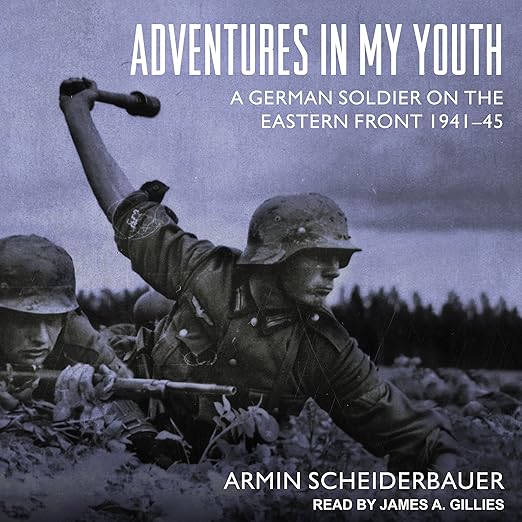
I listen to a fair amount of military memoir, and I have developed a reasonable sense of which accounts are shaped primarily by the need to make the author look admirable. Adventures in My Youth is not that kind of book. Armin Scheiderbauer originally wrote this memoir only for his daughter, it had never been published in any language before this edition. That private origin shows in the writing, and it is the book's greatest asset. He is not performing courage or patriotism. He is trying to explain what happened.
Scheiderbauer was an infantry officer with the German 252nd Infantry Division on the Eastern Front. He joined his unit in the winter of 1941-42, when he was seventeen or eighteen years old. By the time the war ended in 1945, he was twenty-one, had been wounded six times, and had survived some of the largest battles fought on European soil in the twentieth century. He was then captured by the Soviets and held as a prisoner of war until 1947. He emerged from that experience two years after the shooting stopped, one of the relatively few men to return from Soviet captivity at all.
A Closer Look at Adventures in My Youth
The private origin of this memoir changes how you read it. Scheiderbauer was not writing for an audience, he was writing for his daughter, to answer the question that children of survivors often ask: what was it actually like? That question, asked privately rather than for publication, tends to produce a different kind of answer. More specific, less concerned with how the teller will be judged, more willing to include the details that a public memoir might smooth over.
One reviewer who reads widely in first-person soldier accounts noted that personal memoirs frequently fall short of their promise but found in Scheiderbauer a story teller who has a gift for detailed memory and excellent prose. The reviewer continued: the reader not only learns about the fear, the blood and the gore that is war, but also about the life of a man in Hitler's army. That scope, from logistics and daily routine to the largest Soviet offensives of 1944 and January 1945, is part of what makes the account valuable as a historical document rather than simply a personal record.
What Makes Adventures in My Youth Worth Hearing
The period Scheiderbauer covers, 1941 through 1945, includes some of the most destructive combat of any war in recorded history. The Eastern Front killed an estimated thirty million people in total. The massive Soviet offensives of summer 1944, which Scheiderbauer participated in repelling, involved forces on a scale that Western accounts of the war rarely convey. His recollections of the battles in East Prussia in January 1945, some of the final large-scale fighting of the war in the east, are particularly valuable because there are relatively few German infantry accounts of that specific period that have reached English-language readers.
One reviewer called the book a remarkable remembrance and noted Scheiderbauer's arc: a young officer cadet in 1941, a captain leading what remained of a battalion by 1945. That progression from inexperienced recruit to battle-hardened commander, achieved across four years of almost continuous combat and six wound-hospitalizations, is the narrative structure the memoir follows without ever being schematic about it. The wounds function not as dramatic punctuation but as markers of time, each one a boundary between a phase of the war and the next.
Things to Know Before Starting Adventures in My Youth
James A. Gillies narrates with appropriate gravity. This is not a memoir that benefits from theatrical delivery, Scheiderbauer's prose is direct and observational, and Gillies matches that register without imposing emphasis where the author did not intend any. The eleven-hour-plus runtime is comfortable rather than exhausting; Scheiderbauer writes in passages that have the rhythm of someone who has spent a long time thinking about what he is trying to say before committing it to the page.
One reviewer offered a measured assessment: the book is thoughtful and mostly objective, with a few questionable assertions and no excess of complaint. That last observation, no whining, is offered as praise, and it is. Scheiderbauer lived through something most people cannot imagine and describes it without asking for sympathy. That restraint is, in its own way, the most eloquent choice the memoir makes.
Who Armin Scheiderbauer Is Writing For
The Eastern Front remains one of the most underrepresented theaters of WWII in English-language memoir. The accounts that have reached general audiences tend to be German commanders' postwar justifications or Soviet-perspective histories that understandably center different experiences. A mid-level infantry officer's account, honest, specific, written for a single reader rather than for posterity, fills a gap in the available literature. Scheiderbauer was not important enough to have his story shaped by politics or career interests. He was simply a young man who saw an enormous amount and recorded it as faithfully as memory allowed. That modesty is what makes this free audiobook essential reading for anyone seriously engaged with the history of the period. The Eastern Front remains one of the least-understood theaters of the war for general English-language audiences, and firsthand accounts at the infantry level, rather than the command level, are particularly scarce. This one fills that gap with unusual honesty and precision.
Frequently Asked Questions
Why was this memoir originally written only for the author's daughter and never published before?
Scheiderbauer wrote it as a private family document, an explanation of his wartime experience for his daughter's benefit rather than a public record. The decision to publish it was made by others; the private origin is part of why the account has a different quality than memoirs written with publication in mind.
Is this suitable for listeners who are primarily interested in the military history rather than the personal narrative?
Yes. The memoir provides operationally specific detail about the 252nd Infantry Division's experience across major Eastern Front engagements including the 1944 Soviet summer offensive and the January 1945 East Prussia fighting. Listeners with a history focus will find substantial material alongside the personal narrative.