The Short Version
- Performance: Roger Wayne delivers the wilderness narrative with controlled energy and a dry quality that suits Sean Bloomfield's understated recounting of genuine hardship. Never overwrought, but present enough to carry the physical intensity of the journey.
- What it covers: Wilderness endurance, coming-of-age adventure, the cost and reward of deliberate simplicity
- Feel: Tense and kinetic, with stretches of quiet contemplation between the danger
- Our call: Adventure North earns its reputation as a coming-of-age wilderness story precisely because Bloomfield does not inflate the experience. Roger Wayne's narration respects that restraint.
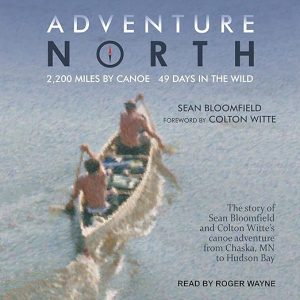
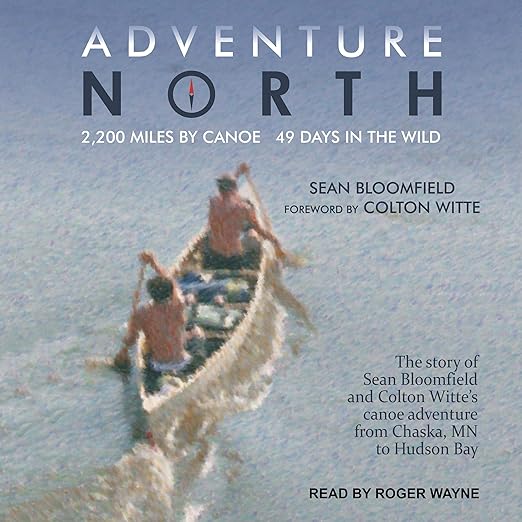
Sean Bloomfield and his best friend Colton Witte finished high school early, specifically so they could spend the spring and summer paddling 2,200 miles from Chaska, Minnesota, to York Factory on Hudson Bay. Adventure North is the audiobook account of that journey, narrated by Roger Wayne, and the premise alone contains enough latent tension to carry the first hour: two teenagers on the Minnesota River in late April, before the water has properly decided what it wants to do, heading toward man-sized waves on Lake Winnipeg and foaming Canadian rapids that neither of them had any rational business attempting. Reviewer Richard and Liz described the journey as an ordeal and meant it admiringly. The word captures something that adventure alone does not.
The book's great virtue is Bloomfield's refusal to sentimentalize the journey retroactively. The flooding Minnesota River section in the early chapters establishes the book's physical register immediately: this is wet, cold, exhausting, and the two teenagers are finding out in real time whether their planning was adequate. Wayne's narration suits this tone. He does not perform bravado on Bloomfield's behalf; he reads the account at the pace of the decisions being made, which creates a kind of documentary intimacy that straightforward adventure narration often misses.
Where This One Lands
The journey was inspired by the 1930 Sevareid and Port canoe expedition covering the same general route, a fact Bloomfield acknowledges early and which gives the book a layer of historical consciousness that distinguishes it from pure adventure memoir. He and Colton are retracing something, attempting to measure themselves against an earlier generation's endurance. That framing gives the Lake Winnipeg crossing and the northern rapids a dual weight: these are physical tests and also a form of conversation with the past.
The friendship between Bloomfield and Colton is the book's emotional core, and Bloomfield handles it with the same honesty he brings to the physical account. Reviewer doc noted that the triumphs and failures, fear and elation, are all present, and specifically that the friendship is tested by the duration and difficulty of the journey in ways that neither of them anticipated. Wayne navigates these interpersonal passages with the same even quality he brings to the rapid-running descriptions, which is exactly right. Bloomfield is not writing melodrama, and the narration should not supply it artificially. The result is a friendship account that feels real rather than constructed for effect.
Why Adventure North Works as an Audiobook
At 7 hours and 30 minutes, this is a well-proportioned audio experience for an endurance journey story: long enough to develop the geography and the relationships, short enough that the momentum never stalls. Wayne's pacing is particularly good in the Lake Winnipeg section, where the waves are large enough to be genuinely life-threatening and Bloomfield's account becomes tighter and more stripped-down. The contrast between the looser, more exploratory tone of the prairie sections and the compressed intensity of the northern water is handled well in audio, where pace and register can carry meaning that white space on a page would otherwise signal.
The audiobook also works for listeners who have never canoed. Bloomfield writes about the physical mechanics of paddling, portaging, and camp-making with enough specificity that you understand what is hard about the journey, but without the kind of technical gear-listing that alienates non-outdoors readers. Reviewer Shaun described it as having the excitement, comedy, and despair you would expect, and that quality translates cleanly to the audio experience. This is adventure writing that prioritizes the human account over the equipment inventory.
What Gives Us Pause
The Lake Winnipeg crossing is the book's central physical crisis and worth paying close attention to. Bloomfield describes the waves as man-sized, and his account of navigating open water that was genuinely beyond the canoe's design tolerance is the most technically specific and emotionally concentrated section of the book. Wayne slows the narration slightly in these passages, creating the right effect. You are not racing through the danger but sitting inside it.
The final section, approaching Hudson Bay, shifts register significantly. The physical danger diminishes, and the account becomes more reflective. Bloomfield is processing what the journey has cost and what it has given him, and the writing moves from kinetic to contemplative in a way that Wayne handles by settling into a quieter delivery. It is the kind of ending that a different narrator might have over-emphasized, turning it into a lesson. Wayne lets it arrive at its own pace, which is the right choice for a book that has earned its conclusions through the preceding 200 miles of paddling. The quietness of the final chapters is not anticlimax; it is the authentic shape of what a journey like this actually leaves behind.
Who Should Listen to Adventure North
This works for listeners who enjoy wilderness memoir in the vein of Jon Krakauer's shorter accounts: narrative-driven, physically specific, and anchored in a clear human relationship. Younger listeners, particularly high schoolers considering their own gap-year or outdoor challenges, will find the protagonist's age and the pre-planning sections unusually relevant. Those who want deep natural history or ecological analysis will find Bloomfield's focus more personal than scientific, though the geography of the Minnesota-to-Hudson Bay corridor is sketched with enough detail to satisfy general curiosity. Anyone looking for manufactured drama or a redemption arc should know that Adventure North is quieter and more honest than those structures allow, and considerably better for it. The journey changed both participants in ways the book describes without sentimentality, and that honesty is what earns the final pages their weight.
Before You Listen
Does the Adventure North audiobook require any background knowledge of the Sevareid and Port 1930 expedition it references?
No. Bloomfield provides enough context about the earlier expedition to frame the journey's inspiration without requiring any prior knowledge. The reference enriches the account without being essential to following it.
Is this audiobook suitable for younger listeners, given that the protagonists are teenagers?
Yes. The book was written for a broad audience and the language is accessible for high school-age listeners and older. The physical dangers described are real but not gratuitously violent. It is specifically well-suited for teens who are interested in outdoor challenges or wilderness travel.
How does Roger Wayne's narration handle the quieter, more reflective passages compared to the intense rapid-running scenes in the audiobook?
Wayne's delivery adjusts noticeably between the two registers. The kinetic sections are read with slightly tighter pacing and more controlled tension; the reflective passages settle into a calmer delivery that mirrors Bloomfield's own shift from action to contemplation. The transitions feel natural rather than performed.