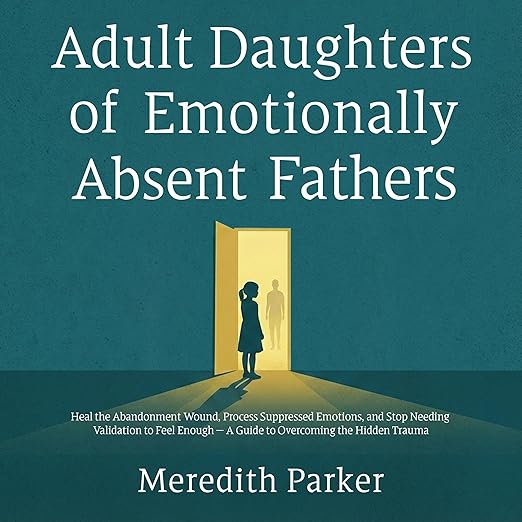
- Narration: Samantha Novak reads with a steady, non-intrusive warmth that respects the material's emotional weight without pushing the listener toward any particular emotional response.
- Themes: Father-daughter attachment wounds, relationship pattern repetition, identity reconstruction after emotional neglect
- Mood: Quietly intense and purposefully uncomfortable, with a forward-looking rather than blame-centered framework
- Verdict: One of the more carefully constructed audiobooks in the father wound niche, notable for its refusal to offer false resolution and its genuinely useful practical framework for change.
I do not usually review audiobooks in the self-help psychology category without some personal distance from the subject, but Adult Daughters of Emotionally Absent Fathers is a title I kept encountering in conversations among listeners who typically prefer literary fiction and memoir. That crossover readership told me something about the book's register that made me want to listen myself. I got through about half of it on a Tuesday evening and found myself pausing several times, not because the content was overwhelming, but because it kept naming dynamics I recognized from watching people close to me navigate relationships that seem to follow patterns they can see but cannot interrupt.
Meredith Parker is not a household name in the psychology writing space, but this audiobook demonstrates the kind of careful thinking that earns genuine standing in a crowded genre. The central argument is not novel: emotionally absent fathers leave daughters with specific relationship patterns that tend to repeat until actively interrupted. What is notable here is the precision with which Parker maps those patterns. The five types of emotionally absent fathers she identifies give real texture to a taxonomy that most books treat much more vaguely. This is not the undifferentiated unavailable dad. It is the one who was physically present and emotionally weaponized silence, versus the one whose unavailability was delivered through constant critique that the daughter eventually internalized as her own voice, versus the one whose emotional distance left a specific kind of hunger that gets mistaken for attraction when encountered in adult relationships.
Naming the Fawn Response and the Absorbed Voice
Multiple reviewers use some variation of the phrase naming things I had never had words for before, and that repetition is meaningful. Parker gives specific language to dynamics that tend to be described vaguely in everyday conversation and even in most therapy contexts. The fawn response. The pattern of choosing emotionally unavailable partners because unavailability registers as familiar rather than alarming. The inner voice that is literally the absent father's tone absorbed so completely it no longer sounds like something external. These are not obscure clinical concepts, but Parker makes them accessible and specific in ways that do not feel like a glossary being read at you. She makes them feel like recognition.
One reviewer wrote that this is not a book you breeze through, and that it requires pauses because it touches nerves you did not know were exposed. Another described the experience as not being soothed too quickly or rushed toward neat conclusions, and appreciating that restraint as what made it possible to keep listening even when she wanted to stop. Those two observations together capture the book's therapeutic logic precisely. Parker is not offering a recovery arc that resolves within the audiobook's runtime. She is offering a map of territory you have been living in without knowing its full shape, plus tools for beginning to navigate it differently.
Grieving a Father Who Is Still Alive
The synopsis makes a pointed critique of both generic therapy advice and standard self-help approaches, and that critique is not merely marketing. Parker actually delivers something different. The focus on father-daughter dynamics specifically, rather than treating parental emotional unavailability as gender-neutral and interchangeable, allows her to be precise in ways that broader attachment-focused books cannot manage. She is not claiming all parent-child attachment wounds are equivalent. She is arguing that the father-daughter wound has specific features, specific expressions in adult relationships, and specific mechanisms of perpetuation that require frameworks built for that particular dynamic.
The section on processing grief for a father who is still alive is one of the more emotionally sophisticated portions of the audiobook and one I found genuinely original in its framing. Parker distinguishes carefully between grieving a deceased parent and grieving a living one who was never emotionally present, and the distinction matters enormously because the conventional frameworks for grief do not map onto the second situation at all. You cannot have closure with someone who is still alive and still, in most cases, still not capable of giving you what you needed. The book does not pretend otherwise or offer false comfort about the possibility of eventual reciprocity.
Samantha Novak's Calm Clarity Over Twelve Hours
The narration choice is significant in a book like this. Material about emotional wounds and father-daughter dynamics could easily be over-performed in ways that feel manipulative or that tell the listener how to feel at each turn. Novak avoids this entirely. Her delivery is calm and clear, with a steadiness that suits the book's orientation: this is not an audiobook about crying. It is an audiobook about understanding. The difference in register between a narrator who invites devastation and one who invites clarity is enormous, and Novak lands consistently on the latter side across the nearly twelve-hour runtime.
At close to twelve hours, this is one of the longer audiobooks in the personal development space, and the length is justified by the breadth and depth of Parker's framework. The runtime would feel excessive if the content were primarily inspirational, but because it is primarily analytical and practical, the extended duration allows each concept to be properly developed and illustrated before the next arrives. Listeners who have worked with therapists will find the framework either complementary or alternative to what they have encountered in clinical settings, depending on their experience and their therapist's approach.
Women Ready to Move Beyond Blame-Centered Catharsis
This audiobook is clearly built for adult women who grew up with emotionally absent fathers and are actively working through the consequences in their relationships and sense of self. Listeners who are not ready to engage with this territory will find it uncomfortable without the context that makes the discomfort productive rather than simply difficult. Partners or family members of women who fit the target audience may find it genuinely illuminating as an explanatory framework, though that is not its primary mode of operation. People looking for blame-centered catharsis will find Parker too oriented toward personal agency and change to provide it. People looking for false resolution will find her honest enough to be genuinely demanding. Both of those are exactly the right reasons to recommend it to someone who is ready for it.