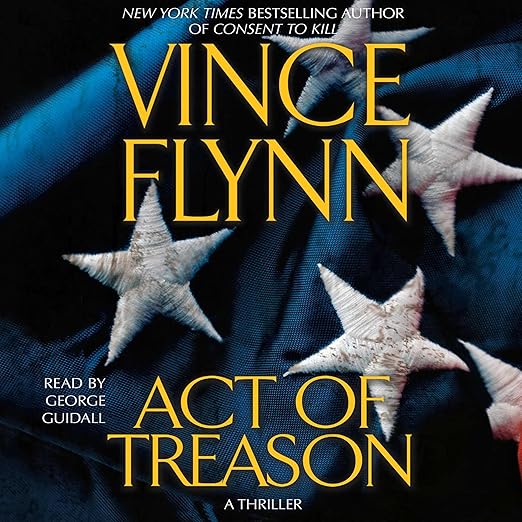
I came to Act of Treason during a stretch of late evenings when I needed something that would hold my attention without demanding I bring my full analytical self to it. I had been reading literary fiction for weeks, dense, demanding, rewarding, exhausting, and what I wanted was competent genre storytelling that trusted its own momentum. Vince Flynn is exactly that. I finished this one in four sittings, which for eleven hours of audio is about as close to compulsive as I get with a political thriller.
This is the ninth novel in the Mitch Rapp series, and Flynn writes it with the confidence of a writer who knows his audience is already sold on the premise. A car bomb detonates inside a presidential motorcade. The candidate's wife is killed. The attack propels Josh Alexander to victory on a wave of national sympathy. Then the intelligence community starts getting nervous: the people behind the bomb have not been caught, and the trail leads somewhere deeply inconvenient.
The novel's most interesting structural choice is its willingness to expose its villain relatively early. This is not a whodunit, Flynn seems far more interested in the how and the at-what-cost than in a revelation-as-payoff model. The tension lives in watching Mitch Rapp operate against a ticking clock, with the institutional friction of CIA bureaucracy on one side and a professional kill network on the other. George Guidall narrates with the kind of calm authority that serves this material perfectly: he does not perform excitement, he simply lets the prose carry it, which turns out to be the right instinct entirely.
The Best Parts of Act of Treason
CIA director Irene Kennedy and Special Agent Skip McMahon function as Rapp's institutional handlers, and Flynn uses them well, they represent the limits of what official channels can accomplish, which is exactly why Rapp exists. One reviewer compared the experience of discovering this series to finding a substitute for Lee Child's Jack Reacher, and the analogy holds: Rapp is operating in a register of political specificity that Reacher does not, but the appeal is similar, a capable protagonist in a world where the institutions have failed and the individual has to step in. Flynn makes the CIA's internal politics feel plausible without turning them into a bureaucratic slog, which is harder than it sounds.
Before You Commit to Act of Treason
The Oval Office revelation at the novel's center will divide listeners cleanly. Some will find it a genuinely audacious move, the idea that the conspiracy reaches that high is not something Flynn handles with narrative cowardice. Others felt it stretched the premise past plausibility. My honest read: Flynn earns the reach. He has spent eight novels establishing that in his fictional Washington, the calculus of power is ruthless and the institutions are brittle. The payoff feels like a logical extension of that worldview, not a cheap escalation. If you find political cynicism plausible in 2026, Flynn's Washington will not feel like a fantasy.
Should You Listen to Act of Treason?
If you have read and enjoyed earlier entries in the Mitch Rapp series, this one delivers exactly what you want and George Guidall remains the right narrator for it. If you are a fan of post-Cold War political thrillers in the Clancy tradition, procedurally grounded, ideologically blunt, satisfying in their resolutions, this is a reliable entry point into the series even without prior knowledge. Skip it if you need your protagonists morally complex or your conspiracies to stay within the bounds of strict credibility. Flynn is not writing ambiguity. He is writing certainty, efficiently and with skill.
A note on series order: Act of Treason is the ninth novel in the Mitch Rapp sequence as originally published, though Flynn and his estate have since released prequel novels that fill in the earlier years of Rapp's career. New listeners often wonder whether to start at the series beginning or at this entry point. The honest answer is that either works, but starting with Transfer of Power or American Assassin will give you the character's formative years before the events here, which makes the weight Rapp carries in Act of Treason feel more earned.