In Brief
- Narrator: Michael G. delivers a composed, respectful reading that suits the scholarly register of Malik Badri's translation - unhurried and clear, treating the medieval Arabic source material with appropriate gravity without becoming stiff.
- Subjects: medieval Islamic psychology, soul-body integration, cognitive behavioral parallels
- Tone: Contemplative and historically significant, quietly astonishing
- Bottom line: A short but genuinely important audiobook that reveals a tenth-century Islamic scholar diagnosing anxiety, depression, and OCD centuries before Western clinical psychology named them.
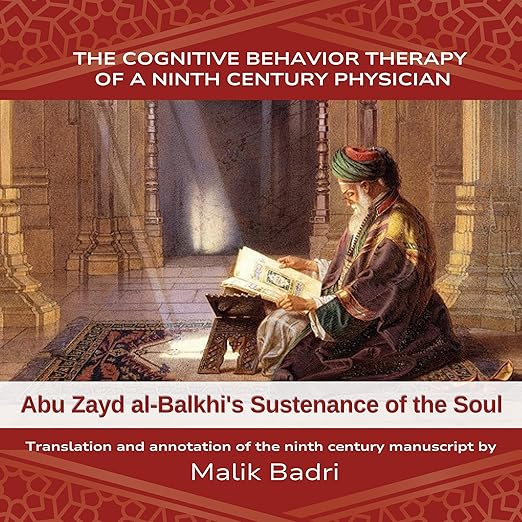
Abu Zayd Al-Balkhi completed his psychological treatise in tenth-century Baghdad, and the audiobook of Malik Badri's English translation of that work - running two hours and forty-one minutes and narrated by Michael G. - confronts listeners with a specific kind of intellectual vertigo. Al-Balkhi was diagnosing symptoms of depression, fear, anxiety, phobic disorders, and obsessive-compulsive behavior and proposing treatment strategies that align remarkably closely with modern cognitive behavioral therapy, roughly a thousand years before CBT was formalized. Abu Zayd Al-Balkhi's Sustenance of the Soul is not a curiosity or an artifact of historical interest only; it is a working psychological framework that happens to be ancient, and Badri's careful translation makes that legible to contemporary readers without smoothing away the distinctiveness of Al-Balkhi's Islamic worldview. The translation is the product of decades of bilingual scholarship from a clinical psychologist who trained in both the Arabic tradition and Western psychiatric practice.
The book's central argument is structural rather than merely historical. Al-Balkhi understood the human being as a composite of body and soul, and he approached psychological disturbance as something that could affect either component or both simultaneously. His taxonomy of emotional conditions - what he calls states of stress, depression, fear, anxiety, and obsessive preoccupation - maps with striking precision onto modern diagnostic categories, and his recommended interventions include both cognitive reframing techniques and spiritual practices involving prayer and the worship of God. Badri, described by one reviewer as "an Egyptian psychiatric professional," is positioned uniquely to make this translation: he trained in contemporary clinical psychology and spent his career examining the relationship between Islamic tradition and modern mental health practice. That dual expertise shows in the translation's ability to render Al-Balkhi's clinical observations in language that psychiatric professionals can engage with directly rather than as metaphor. One reviewer who studies psychology described the book as revealing "an innate relationship between the soul and body that is not acknowledged in conventional medicine" - a fair characterization, and one that points to the book's genuine contribution to current conversations about integrative mental health care. Another reviewer noted learning "a lot about psychology and how the mind works" despite no prior background in the field, which speaks to the accessibility Badri achieves without sacrificing depth. The book is also notable for what it says about the history of scientific knowledge: Al-Balkhi was not a precursor awkwardly anticipating something that would come later. He was working within a fully developed intellectual tradition that independently arrived at conclusions Western medicine would not systematize for another millennium.
What Malik Badri Gets Right
Michael G.'s narration is steady and unadorned, which is the appropriate choice for a scholarly translation. He does not dramatize the text or impose emotional coloring on Al-Balkhi's clinical observations, and that restraint is correct. The material is persuasive on its own terms and does not need performative enhancement. At two hours and forty-one minutes, the audiobook is short enough to be absorbed in a single session, and the density of the content makes that concentrated encounter more effective than breaking it into fragments. The listening format has a specific advantage here: hearing Al-Balkhi's prescriptions for managing intrusive thoughts or recovering emotional equilibrium read aloud gives them an immediate, almost instructional quality that the printed page renders slightly more passive. Several of the cognitive strategies Al-Balkhi recommends - redirecting attention, challenging distorted thinking, integrating spiritual grounding - sound, when spoken, remarkably close to the language a contemporary therapist might use in a session. That correspondence is striking in real time. The production is clean and competent, with no distracting elements. The focus is entirely on the text, and for a work of this historical weight, that simplicity is exactly right.
Where Malik Badri Loses Some Ground
The most intellectually arresting sections are those where Al-Balkhi draws the sharpest parallel between what he observes clinically and what he recommends spiritually. He does not treat these as competing frameworks; for him, the worship of God is not a supplement to psychological treatment but an integral component of it, addressing dimensions of suffering that purely behavioral or cognitive interventions cannot reach. Contemporary secular listeners may resist that integration, but the book is more interesting if they resist it analytically rather than dismissively - Al-Balkhi's argument for the soul's role in emotional health is not vague but specific, and Badri renders it in terms precise enough to engage with seriously. Listen also for the treatment of the relationship between body and soul in his diagnosis of what we now call somatic symptoms - physical manifestations of psychological distress. Al-Balkhi's account of how emotional states produce physical symptoms and vice versa is sophisticated enough to anticipate the psychosomatic medicine of the twentieth century by a millennium. One reviewer called this "pioneering psychiatric work from centuries ago," and that description is not hyperbole. It is the literal situation of a text that describes cognitive behavioral therapy seven centuries before Aaron Beck formalized the method.
Who Should Pick Up Abu Zayd Al-Balkhi’s Sustenance of the Soul
Listeners interested in the history of psychology, Islamic intellectual tradition, or the philosophical relationship between spiritual and clinical mental health care will find this audiobook unusually rewarding. Mental health professionals curious about pre-modern frameworks for understanding psychological disturbance will encounter a text that is practically coherent, not merely historically interesting. Muslims seeking an integration of faith and psychological understanding that predates Western clinical psychology - and that treats that integration as intellectually rigorous rather than apologetically hedged - will find Al-Balkhi's framework compelling. Listeners who need an introduction to Islamic history or medieval philosophy before engaging with primary sources may want additional context, but the translation is accessible enough that prior specialized knowledge is not required. At under three hours, the time commitment is minimal relative to the intellectual return, and the short runtime makes re-listening practical for those who want to work through specific sections more carefully.
Is this audiobook a translation of an ancient text, and is it accessible to modern listeners?
Yes. Malik Badri, a clinical psychologist, translated Al-Balkhi's tenth-century Arabic treatise into contemporary English. Multiple reviewers with no prior background in Islamic history describe the translation as clear and easy to follow. Badri's psychiatric expertise ensures the clinical concepts are rendered in language that connects to modern mental health frameworks.
Does this audiobook require familiarity with Islam to be meaningful?
No, though familiarity enriches the experience. Al-Balkhi integrates the worship of God as a component of psychological treatment, which is distinctive to his Islamic framework. Secular listeners can engage analytically with that integration without sharing the belief system. The clinical observations stand independently of their spiritual context.
Is Abu Zayd Al-Balkhi's Sustenance of the Soul a long audiobook?
At 2 hours and 41 minutes, it is short enough for a single listening session. Given the density of the material, a concentrated single session is more effective than fragmented listening, and the short runtime makes re-listening practical for deeper engagement.