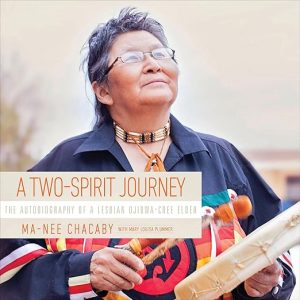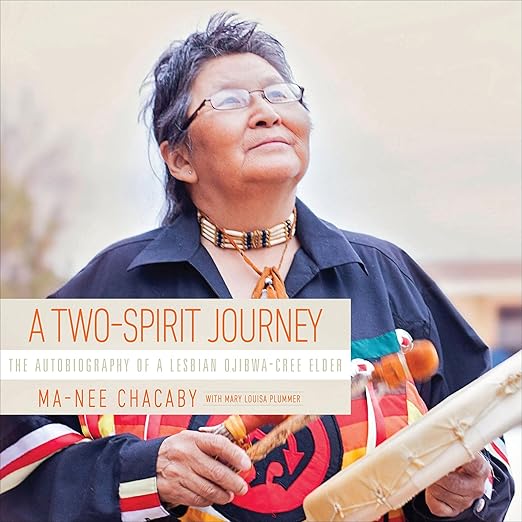
- Read by: Marsha Knight is credited with a first-person life story whose worst passages are recounted rather than staged, which is a casting question before it is a range question.
- At its heart: Surviving colonial policy, sobriety and counseling work, Two-Spirit and lesbian identity, fostering.
- Vibe: Unhurried, plainspoken, cumulative.
- Short version: Twelve hours that earn their length, on a listing whose scholarly series badge arrives without a number.
Ma-Nee Chacaby led the first pride parade held in Thunder Bay, in 2013, and that afternoon sits near the end of an audiobook that runs almost twelve hours. Everything before it explains why it took that long to get there. Chacaby's earliest memories are of a remote Ojibwa community riven by poverty and alcoholism; she learned Cree spiritual and cultural practice from a grandmother and bush survival from an Ojibwa stepfather; she was abused by several adults as a child and was drinking herself by her teens.
Chacaby's Life Refuses One Crisis, One Recovery
Chacaby's life refuses to organize itself into one crisis and one recovery. At twenty she left an abusive marriage and moved to Thunder Bay with her children; the abuse followed her there and racism compounded it. She got sober. She trained and worked as an alcoholism counselor, raised her own children and fostered many more, learned to live with losing her sight, and came out as a lesbian. Set down as a list it reads as improbable. Given twelve hours it stops reading that way.
Series fields on this page tell half a story. The record files the book under Critical Studies in Native History and then leaves the number blank, so anyone who recognizes that list has no way to learn where this volume sits inside it or what sits beside it. University of Manitoba Press published the recording in July 2021. The scholarly framing is genuine, and the page hands you the badge without the catalog it belongs to, which for a memoir positioned as a contribution to a field is the difference between a book and an entry.
Nearly twelve hours is long for one life, and the length is doing work. A shorter version would have to choose between the childhood and the activism, between the drinking and the sobriety, between Chacaby the survivor and Chacaby the elder who ended up at the front of a parade. This runtime declines to choose. What it asks for is patience, and what it returns is the one thing a summary of the same events cannot supply, which is duration.
Trapping, Counseling, and Fostering, Named Precisely
Specificity separates this from the genre it will be shelved beside. The skills carry names: trapping, hunting and bush survival, taught by an Ojibwa stepfather, alongside spiritual and cultural practice taught by a Cree grandmother. The counseling work is a job with hours rather than a metaphor for healing. The visual impairment is a condition to be lived with rather than a symbol of anything. Detail at that level is what stops a life story from hardening into an argument.
Sobriety arrives in the middle, and what happens next is unusual. Many recovery accounts stop at that point and invite you to imagine the rest. Chacaby became a counselor for people with the same problem, so the second half of this memoir is largely about work: other people's relapses, other people's children, a professional life conducted inside the thing she survived. Writing in December 2016, one of the pool's five-star readers puts the weight exactly there, on decades of leadership across First Nations, Two Spirit and LGBT communities by somebody still doing it as an elder.
Fostering runs quietly beneath all of it and rarely gets its due. Raising her own children while taking in many others occupies a single clause in the description and a decade or more of an actual life, and it belongs to the same pattern as the counseling: a person who kept absorbing other people's emergencies. The 2013 parade reads as a culmination only once you have heard the decades that built the standing to lead one.
Content Warnings First, Then Twelve Hard Hours
Content warnings belong on this one, and the pool supplies them unprompted. Writing in July 2023 at four stars, one reader lists what the book holds before saying anything else: child abuse, child death, sexual abuse, domestic violence, substance abuse, post-traumatic stress, racism, sexism and homophobia. That same response calls the book a hard read while saying it began as a listen, which is a useful pairing. None of this material gets easier for being spoken aloud, and parts of it get harder.
Four of the five written accounts describe reading rather than listening, using that verb outright, and the fifth uses no verb of consumption at all. So the 4.5 across 114 ratings belongs substantially to a printed edition, and anyone weighing this recording against other audio is comparing a page against a file. University of Manitoba Press has had that print edition in circulation far longer than this version has existed, worth weighing before you take the number as a verdict on the listening.
Twelve hours of accumulating harm is a real demand, and the book does not stage relief at intervals the way a novel would. Anyone who needs a narrative to lift on schedule will find the structure unaccommodating, because the structure is a chronology and chronologies do not pace themselves for a listener. That is a description of the material rather than a complaint about it, but knowing it in advance changes how you plan. Two weeks of short sessions beats pushing through in three.
Testimony First, Scholarly Analysis Belongs to the Series
Readers of Indigenous life writing get a primary document here rather than a secondary one, with nobody standing between the account and the emphasis it chooses. Listeners working in addiction services, child welfare or community health get something more particular: a first-person record of being on both sides of that system, decades apart. Writing in November 2021 at four stars, another describes the effect as a look into a life at once like and unlike one's own, and that is close to right.
Social workers and counselors are not the only professional audience. Anyone teaching or studying the health and economic legacies of colonial policy has a case study running the full length of a life rather than a chapter of one. And listeners who came specifically for the Two-Spirit material should know that it is threaded through everything instead of confined to a coming-out sequence: the title describes a whole life, not an episode inside one.
Approach with care if anything on that content list applies to you, because none of it is handled at a distance. Anyone wanting scholarly analysis of colonial policy should go to the series this book sits in rather than to the book, which is testimony and never pretends otherwise. And anyone hoping for an uplifting arc should know the uplift is real but arrives late and costs eleven hours to reach. Chacaby earned the telling, and the length is the price of hearing it whole.
Is nearly twelve hours of audiobook too much for a single memoir?
It depends what you want from it. The runtime holds a childhood, an escape at twenty, a recovery, a counseling career, the fostering of many children, sight loss and a coming out, and none of those stretches feels like filler. What the format will not do is compress. Plan on two weeks of sessions rather than one long weekend.
Does the audiobook appear to be abridged?
Nothing on the record says so, and the runtime argues against it. Almost twelve hours is generous for a single-volume memoir, and the description accounts for childhood, marriage, migration, recovery, a counseling career, fostering, sight loss and a coming out. A length like that leaves room for all of it rather than a selection.