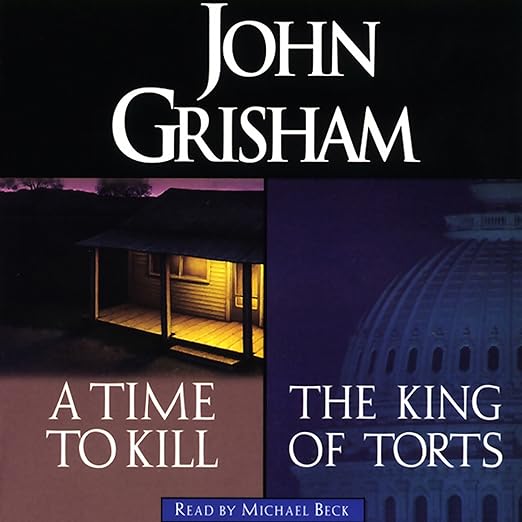
I came to this two-for-one audiobook the way many people come to John Grisham: already a convert. I had read A Time to Kill years before, in the analog sense, and had always meant to revisit it. The pairing with The King of Torts turned what might have been a straightforward relisten into an interesting study in contrasts, two novels by the same author, set in adjacent corners of the American legal system, with almost nothing else in common except craft and pace.
The combination package runs nearly 29 hours, which is a significant time investment. But each novel earns its length independently, and together they demonstrate something about the range Grisham operates in. A Time to Kill, which was actually his first novel, is the more morally serious work. The King of Torts, published much later, is more comfortable operating in a register of dark comedy about professional corruption. Knowing that both were written by the same person who was nominated for no prizes and simply sold by the millions says something interesting about the relationship between literary ambition and readerly loyalty.
How A Time to Kill / The King of Torts Holds Up
The premise of A Time to Kill is as stark as legal fiction gets. A ten-year-old Black girl is brutally assaulted by two young white men in Clanton, Mississippi. Her father takes justice into his own hands. Defense attorney Jack Brigance must now defend a man who may be morally right and legally indefensible, in a town where the trial is conducted against a backdrop of burning crosses and sniper fire. The novel does not simplify this. It is aware of how race and justice interact in the American South, and it insists on taking that interaction seriously. The decade-spanning popularity of this book, it was Grisham's first novel and remains one of his most beloved, comes precisely from this moral weight. It is not a comfortable book, and it is not supposed to be.
The King of Torts is a different animal. Clay Carter begins in the public defender's office, stumbles onto a pharmaceutical conspiracy that dwarfs anything in his previous experience, and is suddenly propelled into the world of mass tort litigation and the obscene wealth it generates. What Grisham is satirizing here is the transformation of legal work into a wealth-maximization exercise, and the story of how Clay Carter's values erode in the face of private jets and fee agreements that would make a partner at a white-shoe firm blink. It is entertaining in a way that depends on watching someone make decisions you can see will eventually destroy them.
Michael Beck is a narrator built for long-form legal fiction. He reads with the kind of steady, authoritative delivery that suits Grisham's prose style, clear, efficient, not literary in the self-conscious sense, structured around momentum rather than sentence-level beauty. Over nearly 29 hours, consistency matters more than brilliance, and Beck delivers that consistency. He doesn't attempt accents or elaborate character differentiation, which is probably the right call for Grisham's large, plot-driven casts. You always know where you are and who is speaking, which is the baseline requirement for audio legal fiction.
The pairing creates an interesting listening rhythm. Coming off the gravity of A Time to Kill and into the moral cynicism of The King of Torts is a tonal shift that takes a chapter or two to adjust to. But once you settle into the second novel's register, the contrast enriches both books. Grisham writing about racial justice and Grisham writing about professional corruption turn out to be two sides of the same fascination with how American institutions actually function versus how they present themselves.
Weak Spots in A Time to Kill / The King of Torts
New Grisham readers may wonder which book to engage with more seriously. The answer, without much contest, is A Time to Kill. It is the more fully realized work, with a moral center that its plot actually serves rather than decorates. The King of Torts is a great airport novel in the original sense, it moves brilliantly and the premise is smart, but it doesn't carry the emotional weight of the first novel. Listeners who pick up this package expecting both novels to hit with equal force may find the transition to the second book slightly anticlimactic. That's a packaging issue as much as a quality one.
The 2006 release date means the production quality is good but not modern. The audio is clean and perfectly functional; it simply doesn't have the immersive production values some recent audiobook releases favor. For a two-novel package of this length, that's not a meaningful drawback.
Should You Listen to A Time to Kill / The King of Torts?
Anyone who has been meaning to get to Grisham's back catalog and wants two substantial works in one package will find this a good value proposition. The combination is particularly well-suited to listeners who want to understand why Grisham became Grisham, A Time to Kill explains it immediately and forcefully. Existing fans of legal thrillers who haven't visited these particular titles should prioritize A Time to Kill above almost everything else in the genre. The King of Torts is for Grisham completists and listeners who enjoy watching characters make spectacular, well-foreshadowed mistakes. Together, they're nearly 29 hours of uninterrupted professional storytelling from someone who has been doing this longer and better than almost anyone.